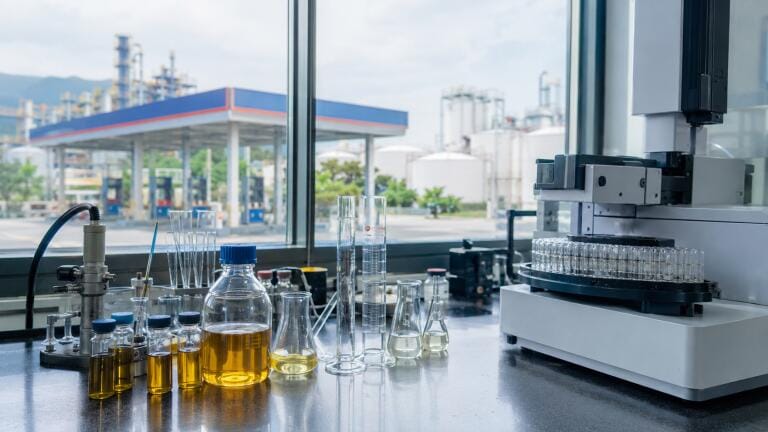
Fuel analysis
Vietnam began nationwide implementation of E10 gasoline on 1 June 2026, marking a major change in the country’s fuel supply.
E10 contains between 8.0 and 10.0 per cent ethanol by volume under Vietnam’s amended QCVN 01:2022/BKHCN technical regulation.
The amended regulation took effect on 30 April 2026.
The change is not simply a blending decision. It creates an ongoing requirement to demonstrate that fuel reaching the market meets the specified composition and quality requirements.
That puts analytical testing capacity firmly inside the implementation process.
Vietnam’s Ministry of Industry and Trade reported in June that the government had introduced pilot policies supporting the E10 rollout.
Resolution 29/2026/NQ-CP allows fuel businesses involved in blending to contract designated testing organisations to test fuel quality against the relevant national technical regulation. The measure is in force from 16 June 2026 to 15 June 2028.
That is significant for laboratories because it creates a defined role for external testing capacity during the transition.
Rather than requiring every blending facility to establish all testing capability on site, the framework permits designated organisations to provide testing services.
For laboratories, the opportunity is therefore linked to capacity, accreditation, method competence and the ability to deliver results within the operational timescales of fuel distribution.
The amended regulation specifies E10 as gasoline containing between 8.0 and 10.0 per cent ethanol by volume.
The required test method for ethanol content is TCVN 7332, which is based on ASTM D4815. The same regulation also sets an oxygen-content limit of 4.0 per cent by mass, with that particular requirement taking effect from 1 January 2027.
This provides a useful example of how fuel-policy changes translate into laboratory work.
A blending mandate creates a specification. The specification creates a measurement requirement. The measurement requirement then creates a need for suitable analytical methods, reference materials, competent personnel and quality systems.
Ethanol changes the behaviour of a gasoline blend compared with conventional hydrocarbon-only fuel.
For laboratories and fuel operators, this means quality control cannot be reduced to measuring ethanol concentration alone.
Sampling and storage conditions matter because the sample reaching the laboratory needs to remain representative of the fuel being assessed.
The exact analytical requirements will depend on the applicable specification and test programme.
Laboratories should therefore distinguish between mandatory parameters under QCVN 01:2022/BKHCN and additional tests used for operational quality control.
That distinction is important when designing a testing service.
Vietnam’s experience also provides a useful case study for other Asian markets considering higher ethanol blends.
The analytical issue is not whether E10 can be produced. It is whether fuel can be blended, transported, stored and distributed while maintaining compliance with the required specification.
That requires testing at appropriate points in the supply chain.
It also requires laboratories to manage increased sample throughput without weakening QA/QC.
For testing providers, this may favour flexible capacity and access to established fuel-analysis methods rather than highly specialised one-off testing.
Vietnam’s E10 policy illustrates a wider point about fuel transitions.
Regulatory changes are often discussed in terms of infrastructure, vehicles and fuel supply. Yet every change in fuel composition eventually reaches the laboratory.
Someone has to demonstrate that the fuel contains the required components and meets the applicable specification.
In Vietnam, that task is now supported by a framework that allows designated testing organisations to provide quality-testing services to blending businesses.
The next stage will be operational: maintaining consistent sampling and testing as E10 becomes part of routine fuel distribution.
For fuel laboratories across south-east Asia, that makes Vietnam a useful example of what happens when a blending policy moves from a target on paper to a specification that has to be measured in thousands of real samples.
PIN 27.4 Aug/Sept 2026





 Product directory