Fuel analysis
As global pressure for improved fuel efficiency continues, lubricant formulators have been shifting toward lower-viscosity engine oils. These modifications amplify concerns that hydrodynamic protection will be reduced causing friction increase. This trend, driven by both regulatory mandates and OEM engineering strategies, has elevated the importance of High-Temperature, High-Shear (HTHS) viscometry as a core measurement of lubricant performance. With the industry’s transition into ever-lower viscosity grades, precise shear-rate viscometry at 100°C and below is becoming essential alongside traditional HTHS evaluation at 150°C.
Engine durability and lubricant viscosity are tightly interconnected. The viscosity of a lubricant governs its ability to form and maintain the protective oil film required for hydrodynamic lubrication. In this regime, the oil’s resistance to flowing out of the high-pressure zone between moving surfaces prevents direct metal-to-metal contact. A fluid with sufficiently high viscosity and with greater internal molecular friction, will resist permanent viscosity loss and keep critical engine components separated. However, this same internal friction also represents energy loss, thus increasing the need for improved additives. Higher-viscosity oils improve wear protection but do so at the expense of fuel efficiency.
Consequently, the industry’s challenge is dual: lowering viscosity where possible to reduce frictional drag while ensuring the lubricant retains enough viscosity under high shear to protect heavily loaded engine components. With newer engines running cooler and using low-viscosity oils such as SAE 0W-16, 0W-12, and even 0W-8, the demand for highly accurate shear viscometry at 150°C, 100°C, and even 80°C continues to grow.
Worldwide, fuel economy regulations are reshaping engine development. OEMs are designing smaller, more efficient engines with tighter tolerances and higher power densities, all of which impose new lubrication challenges. Lower viscosity oils support fuel efficiency targets, but they must be engineered with precise viscometric properties to avoid compromising engine durability.
This evolution in lubricant formulation requires instrumentation capable of evaluating viscosity under extreme mechanical stress and across a wider temperature range. As a result, HTHS viscometers remain central to defining how engine oils behave under the most demanding conditions they will experience in service.
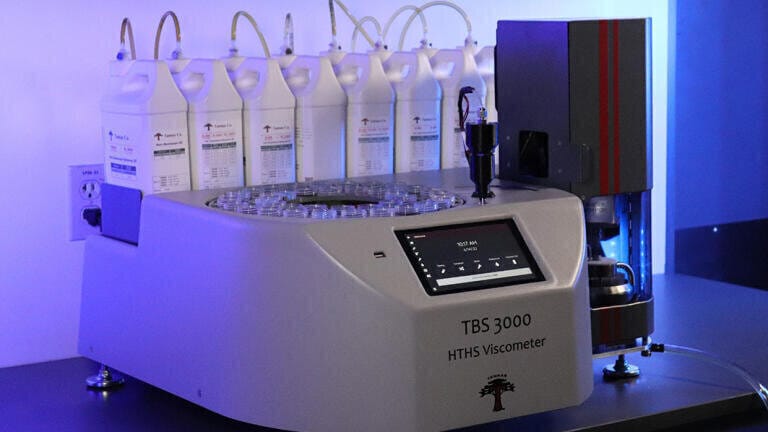
Among available instruments, the TBS Viscometer from Tannas continues to stand as the referee HTHS device for both fresh and used oils. Its global reputation rests on its ability to produce consistent, repeatable, and physics-based viscosity measurements. Unlike instruments that infer viscosity indirectly, the TBS is an absolute viscometer, directly measuring shear stress and shear rate without reliance on empirical calibration curves.
Using a Newtonian reference fluid, the TBS determines shear rate through reciprocal torque and precision rotor height measurements. This enables accurate characterization of non-Newtonian oils commonly used in modern engine lubrication, where polymeric viscosity modifiers produce shear-thinning behaviour.
A unique strength of the TBS system is its use of non-Newtonian reference oils—whose known behaviour at various shear rates allows the instrument to automatically or manually verify rotor positioning during operation. This ensures stable operation and eliminates drift, even when testing oils with complex rheology.
Historically, HTHS testing was anchored at 150°C, following ASTM D4683, to simulate high-temperature lubrication environments such as engine bearings. However, as OEMs develop engines that operate at lower temperatures, and as lower viscosity grades proliferate, industry demand has expanded to include testing at 100°C (ASTM D6616) and even 80°C.
The TBS Viscometer enables accurate shear-rate control and viscosity determination across this temperature range, with no observable loss in measurement precision. This ability is particularly valuable for evaluating polymeric viscosity modifiers whose temperature-dependent behaviour is critical to fuel-efficient oil formulations.
Extensive studies using the absolute viscometer have characterised the viscosity–temperature relationships of low-viscosity oils at 150°C, 100°C, and 80°C, providing insight into how viscous friction affects overall power loss. Lowering viscosity can reduce parasitic energy loss, provided the oil maintains adequate protection under high shear conditions.
One of the advantages of using an absolute viscometer like the TBS is the ability to interpolate high-shear viscosities at temperatures beyond the tested points. By accurately measuring viscosity at high shear across several key temperatures, formulators can model performance under real-world engine operating conditions.
This becomes increasingly vital as next-generation engines operate under broader thermal environments, and as specifications evolve to include lower-viscosity oils with stricter durability expectations.
As efficiency, durability, and sustainability pressures reshape the lubricant landscape, the need for accurate high-shear viscometry across multiple temperatures is more critical than ever. The transition to lower-viscosity oils has expanded the boundaries of traditional HTHS testing, driving demand for instruments capable of providing dependable, physics-based measurements from 80°C to 150°C.
The TBS Viscometer, with its absolute measurement principles and proven stability, remains a cornerstone technology for lubricant developers, additive suppliers, and OEMs. Its ability to characterise modern oils with precision makes it indispensable in the industry’s ongoing pursuit of cleaner, more efficient, and more durable engine performance.
PIN 27.4 Aug/Sept 2026





 Product directory