Measurement and testing
The approach holds promise for ageing brownfield plant but data quality, legacy system integration and cybersecurity remain open questions.
For decades refineries have managed rotating and stationary equipment through two basic strategies.
Run equipment until it fails, or service it on a fixed schedule regardless of its actual condition.
Neither approach is efficient. A third option is maturing: predictive maintenance, in which sensor data and machine learning (ML) models flag early signs of degradation before a failure occurs.
The idea itself is not new. Vibration monitoring and thermography have supported condition-based maintenance for decades.
What has changed is the scale and cost of sensing, and the sophistication of the analysis applied to the resulting data.
Cheaper wireless sensors, cloud computing and ML models now let operators monitor thousands of assets continuously, rather than relying on periodic manual rounds.
For process engineers and reliability teams, that shift changes how maintenance decisions get made.
Predictive maintenance in refineries and petrochemical plants draws on several sensor types.
Vibration sensors on pumps, compressors and turbines.
Temperature and pressure transmitters on process lines.
Ultrasonic thickness gauges and corrosion probes on pipework prone to erosion or corrosion.
Process analysers monitoring composition, moisture and contaminant levels in feed and product streams.
Each produces a continuous stream of time-series data. Supervised models, trained on historical failure records, look for patterns that precede known failure modes.
Unsupervised anomaly detection is often used where labelled failure data is scarce.
It flags deviations from a normal operating signature without needing a prior example of the specific fault.
More advanced deployments add remaining-useful-life estimation, giving planners a probable window for intervention rather than a single trigger point.
McKinsey & Company, the consultancy, notes that mature programmes apply layered analytics to categorise issues, rather than simple threshold alarms.
The underlying principle is pattern recognition.
A bearing beginning to fail typically produces a vibration signature distinct from normal operation, well before it fails outright.
Train a model on enough historical examples of that signature, and it can, in principle, recognise a similar pattern developing on a different but comparable asset.
This depends on two things: sufficient historical failure data to train on, and sensor data of sufficient quality to make the signature detectable amid background noise.
Both are harder to guarantee in practice than monitoring vendors sometimes suggest.
Much of the current interest in predictive maintenance concerns retrofitting, not new-build instrumentation.
Most refineries were not designed with today’s sensing and analytics in mind.
Replacing existing instrumentation on operating plant is costly and disruptive.
Retrofit sensor kits aim to work around that constraint.
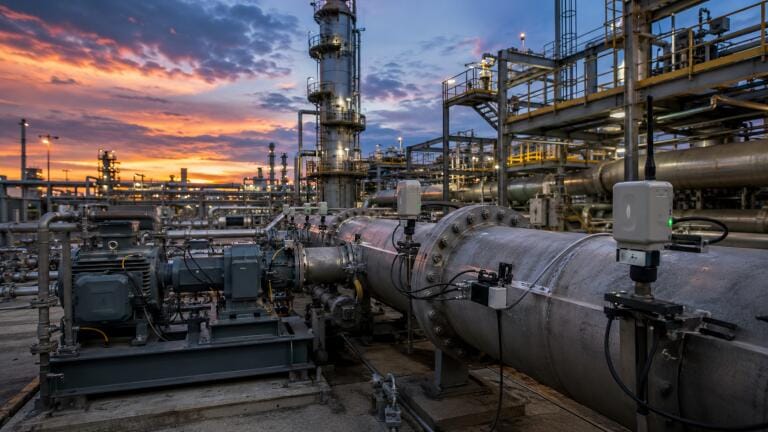
Wireless vibration, temperature and corrosion sensors, often battery powered with claimed lifespans of around ten years, can be clamped onto existing rotating or stationary equipment.
This works without modifying the plant’s distributed control system (DCS) or supervisory control and data acquisition (SCADA) architecture.
Data is transmitted over a wireless network to a centralised analytics platform, kept separate from the safety-critical control system.
This approach is not confined to smaller specialist software vendors.
Established instrumentation manufacturers, including Emerson and Yokogawa, market wireless vibration monitoring kits designed for retrofit onto legacy rotating equipment, according to their own product literature.
Emerson reports that one unnamed United States (US) refinery has used wireless monitoring to reduce loss-of-primary-containment events across more than 450 critical centrifugal pumps, according to its own case material.
Independent, third-party verification of predictive maintenance performance in refining specifically is thin.
Analyst evidence exists mainly at the level of the broader digital maintenance category, and it is more measured than most vendor marketing.
McKinsey has documented one detailed case: an offshore oil and gas operator that introduced a mature predictive maintenance system across nine platforms in Africa and Latin America.
Using 30 years of operating data, the company built and refined more than 500 advanced-analytics models over two years, with a team of ten to 15 data scientists.
The result was a 20% average reduction in downtime.
Production gains were equivalent to more than 500,000 barrels of oil annually, across a fleet McKinsey describes as already in the top quartile for the sector.
McKinsey also cautions that the initial precision of such models is typically too low for frontline acceptance.
Less data-intensive anomaly detection, often the realistic first step for brownfield assets with limited history, delivers only around 10% or less of the benefit of a fully-scaled programme.
Wood Mackenzie, the energy research and consultancy firm, has separately estimated that digitalisation, including predictive analytics and maintenance, could deliver up to US$150bn a year in operating cost savings across the energy and natural resources sectors.
Claudio Descalzi, chief executive of ENI, has said predictive analysis systems based on big data would let the company optimise maintenance, logistics and well operating costs.
This was part of a target 7% reduction in production costs, according to comments reported by Wood Mackenzie.
Vendors of retrofit monitoring kits publish more specific figures. iFactory, a vendor of retrofit sensor kits, reports 87 to 92% accuracy predicting failures 15 to 45 days out.
It also reports a 58% reduction in unplanned downtime and a 40% reduction in unnecessary preventive maintenance, according to its own case-study material.
A separate vendor case study, cited in an unrelated feature on Industry 4.0 in refining, claimed 90% prediction accuracy, a 65% reduction in unplanned downtime and a 40% reduction in maintenance costs for an unnamed production-pump application.
Neither set of figures has been independently verified. Both should be read as vendor-reported rather than confirmed outcomes.
Three practical limitations recur in independent commentary on predictive maintenance, and matter directly to process analyser and instrumentation specialists.
The first is data quality. A vibration sensor mounted on a pump also picks up the driving motor, nearby structural vibration and passing forklift traffic.
Without careful signal processing and operational context, models generate false positives that erode confidence, or miss genuine degradation masked by non-standard operating conditions.
Process analysers face an equivalent problem. Fouling, sample-conditioning drift and calibration lag can all corrupt the composition data a model relies on, without producing an obvious fault signal of their own.
The second is integration with legacy systems. Brownfield refineries are typically the product of decades of incremental modification, with instrumentation from multiple original manufacturers and, in places, incomplete documentation.
Retrofit sensor kits are designed to sit alongside rather than inside the DCS or SCADA architecture, which avoids a costly control-system upgrade.
But it also means predictive-maintenance data initially sits apart from the process historian, complicating the work needed to make models reliable.
The third is cybersecurity. Wireless retrofit devices add network endpoints to plant that was, in many cases, never designed with connected sensing in mind.
Industrial cybersecurity standards such as ISA/IEC 62443 exist precisely to manage this risk, covering the security lifecycle of industrial automation and control systems, including sensor-level and supply-chain considerations.
Any retrofit deployment needs a clear architecture separating monitoring networks from safety-instrumented and control systems, and a plan for patching and decommissioning devices.
A poorly secured wireless sensor network is, in principle, a route into the wider plant network.
For reliability engineers, the realistic starting point is asset-by-asset validation rather than a blanket rollout. McKinsey’s experience suggests predictive maintenance pays off where downtime is expensive, some failure history exists, and near-real-time data streaming is achievable.
That describes most large refineries and petrochemical plants, but not every piece of balance-of-plant equipment.
For process analyser and instrumentation suppliers, the trend reinforces two points. Sample preparation and data quality are becoming a competitive differentiator, since a monitoring platform is only as good as the signal feeding it.
Retrofit-friendly, vendor-agnostic sensing that avoids DCS or SCADA modification is also becoming a genuine purchasing criterion for brownfield sites, not just a marketing angle.
The direction of travel is clear enough. What remains unproven, outside a small number of documented cases, is how much of the benefit claimed by monitoring vendors survives contact with an actual 30-year-old brownfield unit, its own legacy wiring and its own data quality problems.
PIN 27.4 Aug/Sept 2026


 Product directory


.jpg)
.jpg)
















.jpg)