Safety
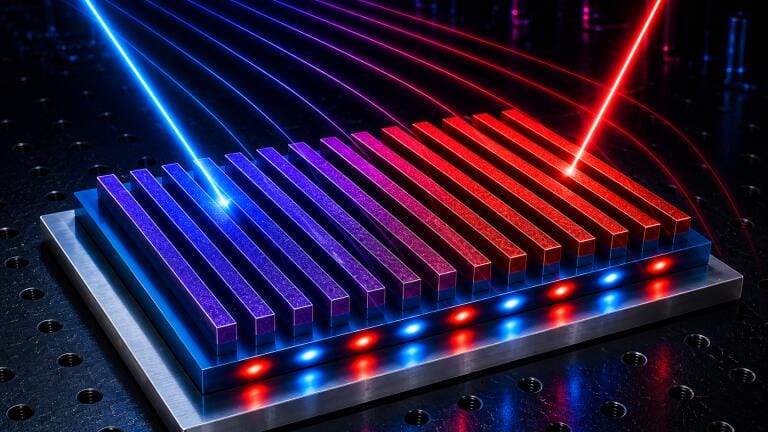
Researchers have developed a device that can steer heat radiation and retain its programmed state after power is removed.
The work, led by Professor Koichi Okamoto and Dr. Shunsuke Murai from Osaka Metropolitan University’s Graduate School of Engineering, explores a way to separate how a structure absorbs and emits thermal radiation.
For the petrochemical and process monitoring sectors, the research is not a direct flare monitoring technology.
Its relevance is more upstream. It points to future infrared sensor components, thermal control systems and photonic devices that could eventually be used in analysers, gas detection systems, thermal imaging equipment or high-temperature industrial monitoring environments.
In most materials, heat absorption and heat emission are linked.
A surface that absorbs heat well at a certain wavelength and direction will usually emit heat in the same way. This relationship, known as reciprocity, places limits on how independently engineers can control thermal radiation.
The research team set out to create a device that behaves differently for incoming and outgoing radiation.
To do this, the researchers used magneto-optical materials. These materials interact with light in ways that can be altered using a magnetic field.
The team combined a magneto-optical material with GST, a phase-change material. This allowed the device to control the direction of heat radiation and switch that effect on and off.
The device can also remember its state after power is removed.
That memory function is important because it suggests thermal behaviour could be programmed in a way that is closer to data storage in electronic or photonic devices.
Dr. Murai said: “We made heat radiation behave in a ‘smarter’ way. Achieving these capabilities in a working model could enable a new generation of efficient infrared emitters, thermal-energy devices, sensors and photonic memory technologies.”
Infrared sensing is already important in process industries.
It is used across areas such as gas detection, thermal imaging, combustion observation, non-contact temperature measurement and some forms of online analysis.
In refinery and petrochemical environments, sensors and analysers may also need to operate near hot equipment, variable ambient conditions and complex process streams.
Any improvement in how devices manage, direct or stabilise thermal radiation could therefore be relevant to future analyser design.
The Osaka Metropolitan University work does not provide a ready-made process analyser. It does not address flare combustion efficiency, net heating value, methane slip or regulatory emissions monitoring.
However, it may be relevant to the underlying components used in future infrared emitters, detectors and photonic sensing systems.
For process engineers and instrument specialists, the practical interest is in whether this type of material control could eventually improve sensor selectivity, device stability, power consumption or thermal management.
The team reported that the device showed different responses depending on the direction of light, even when light arrived almost straight on.
This matters because previous devices required light to arrive at very large angles. At those angles, absorption and radiation efficiencies can fall compared with normal incidence.
A device that can work closer to normal incidence may be easier to integrate into compact sensing systems.
That could be useful for future infrared instrumentation, where optical layout, alignment and package size all affect practical deployment.
The researchers also reported improved control of the switching effect compared with previous devices.
In earlier systems, switching behaviour could be variable and memory could be lost when power was removed. The new device is designed to retain its state, allowing the thermal response to be reconfigured and stored.
Professor Okamoto said: “Our ultimate goal is to develop compact devices that can actively control heat radiation, much like electronic circuits control the flow of electricity. Such devices could be used in smarter infrared sensors, more efficient energy systems, and new types of photonic memory that store information using light and heat instead of electrical charges.”
For PIN readers, the phrase “smarter infrared sensors” is the most relevant part of the announcement.
Refineries, petrochemical plants and fuel analysis laboratories already depend on stable measurement technologies. These include spectroscopy, thermal sensing, gas detection and online analysis.
A material platform that allows heat radiation to be directed, switched and retained could eventually contribute to smaller or more energy-efficient devices.
That may be particularly useful where instruments must operate continuously or where thermal drift affects measurement reliability.
The research should be treated as an early-stage device concept.
Before it could be relevant to industrial deployment, further work would be needed on durability, repeatability, operating temperature range, integration with detector systems and performance in real process environments.
It would also need to be assessed against the practical demands of refinery and petrochemical sites, including safety, calibration, maintenance and long-term reliability.
The current significance is therefore not that programmable heat control is ready for flare monitoring or process analyser retrofits.
It is that materials and photonic device research is moving toward more active control of thermal radiation. That could shape future infrared sensing, thermal management and compact process monitoring instrumentation.
PIN 27.4 Aug/Sept 2026



 Product directory
























.jpg)
