Gas detector
For environmental and process monitoring professionals, the significance is not simply that more oil and gas companies are reporting methane emissions.
It is that the standard of reporting is being pushed towards measurement-based inventories, site-level checks, reconciliation and independent verification.
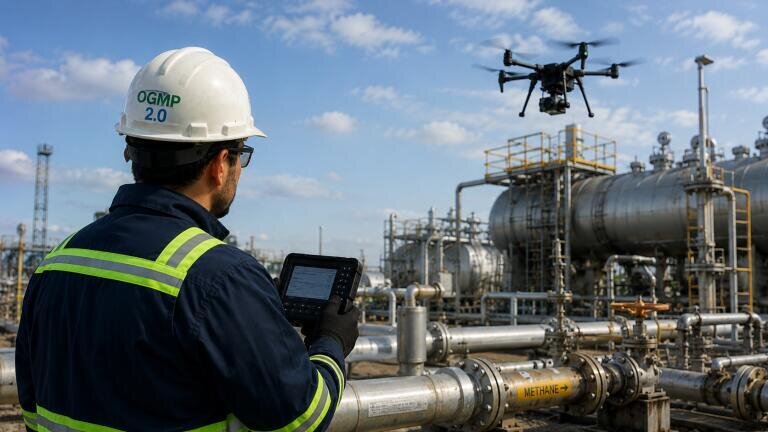
OGMP 2.0, led by UNEP’s International Methane Emissions Observatory, is now one of the central frameworks shaping how oil and gas methane emissions are measured and reported.
Its 2026 Level 5 assessment says the partnership has expanded to nearly 160 companies, covering around 45% of global oil and gas production. UNEP describes it as the only comprehensive, measurement-based international reporting framework for the sector.
The direction of travel is clear. OGMP is not designed to leave companies at desktop emissions factors or broad estimates.
Its higher reporting levels require companies to develop detailed source-level inventories and then test those inventories against site-level measurement.
Level 5 reporting is the key milestone, because it requires reconciliation between bottom-up source estimates and top-down measurement, creating a more robust estimate of annual methane emissions from an asset.
Recent OGMP guidance for transmission systems states that Level 5 should represent the best estimate of annual emissions from an asset, including all methane sources.
That matters for the monitoring sector because methane reporting is becoming less about corporate sustainability language and more about evidence chains.
Companies need leak detection and repair programmes, measurement campaigns, source attribution, uncertainty management, emissions quantification, data reconciliation and audit-ready reporting systems.
This creates demand not only for methane sensors, mobile surveys, optical gas imaging, aerial monitoring and satellite data, but also for the software, QA/QC procedures and third-party expertise needed to turn measurements into defensible reports.
The latest OGMP updates show how quickly this framework is being refined.
The OGMP resources page lists new material in 2026, including transmission systems guidance in April, a Level 5 assessment in March, and further guidance on non-operated joint ventures, venture engagement and distribution grids in January and February.
That suggests OGMP is now moving into the detailed implementation phase, where sector-specific asset types and awkward reporting cases are being clarified.
Transmission systems are a good example of why this matters. Pipelines, pressure-reduction stations, compressor stations and other above-ground assets do not all present the same measurement problem.
Some emissions are intermittent, some are difficult to capture with site-level technologies, and some sources are hard to reconcile neatly with standard survey methods.
OGMP’s transmission systems guidance recognises these practical constraints while still keeping the framework focused on measurement-based inventories, source-level data and reconciliation.
The EU Methane Regulation, which entered into force in August 2024, explicitly builds on OGMP 2.0 and aims to shift methane reporting from estimates towards direct measurement checked by independent verifiers.
The European Commission says its Methane Transparency Database is scheduled to launch in September 2026. From 1 January 2027, EU importers must demonstrate that imported oil, gas or coal was produced under equivalent MRV requirements or, for oil and gas, at OGMP 2.0 Level 5 plus verification.
Methane intensity reporting follows in August 2028, with methane intensity limits applying from August 2030.
This gives OGMP a wider commercial significance. A framework that began as a voluntary reporting initiative is now being tied to buyer expectations, import rules and international energy trade. Producers that can demonstrate credible Level 5 reporting may be better placed to sell into regulated markets.
Those that cannot may face tougher questions from importers, financiers, customers and regulators.
There is still uncertainty. Oil and gas industry groups have urged the EU to pause or revise parts of its methane law, warning that 2027 requirements could affect fuel imports. Reuters has reported that Brussels has offered some flexibility on compliance options but has not withdrawn the policy.
For monitoring professionals, the practical conclusion is that methane measurement is becoming a compliance-grade discipline.
It will not be enough for operators to say that leaks are being managed or that emissions have been estimated using standard factors. Increasingly, they will need to show how emissions were detected, how often assets were surveyed, which technologies were used, how detection limits were handled, how uncertain data was reconciled, and how final figures were verified.
The next updates to watch are therefore not just new OGMP documents, but the interaction between OGMP guidance, EU methane import rules and the launch of methane transparency systems.
The most important window is 2026–2027, when the EU database is expected to go live and importers begin facing stricter MRV requirements. For suppliers of methane detection, emissions monitoring, LDAR, environmental data management and verification services, this is likely to be a major growth area.
OGMP is becoming a practical test of whether the oil and gas sector can move from estimated methane emissions to measured methane accountability. For the monitoring industry, that shift is where the opportunity lies.
PIN 27.4 Aug/Sept 2026



 Product directory























.jpg)
