Synthetic fuels
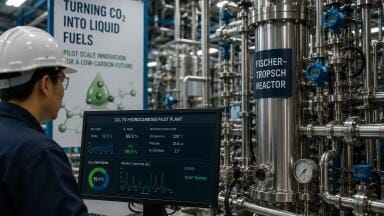
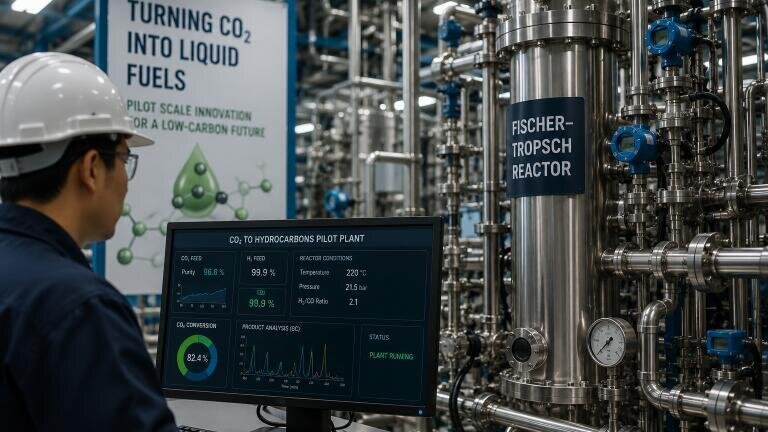
The process draws on Fischer–Tropsch synthesis, a catalytic chemistry that has been understood since the 1920s but is now being adapted to run on CO₂ and green hydrogen rather than coal-derived syngas.
It is a meaningful milestone. But for process engineers and instrumentation specialists, the more interesting question is not whether the conversion is possible, but whether it can be monitored reliably enough to run commercially.
The answer, right now, is: with difficulty. And that difficulty is increasingly where the industrial frontier lies.
CO₂-to-hydrocarbons plants face an instrumentation challenge that is qualitatively different from conventional refining. The feedstock – captured CO₂ – is not a consistent, specification-grade commodity.
It arrives with impurities: nitrogen oxides, sulphur compounds, water vapour, residual hydrocarbons, and ammonia, the exact mix depending on whether the source is a cement kiln, a power station, or a direct air capture unit.
Each of these impurities interacts differently with Fischer–Tropsch catalysts, and many will degrade catalyst performance or skew product selectivity if not detected and managed in real time.
Fourier transform infrared (FTIR) spectroscopy is emerging as the instrument of choice for online gas quality monitoring in these settings.
It provides continuous, non-intrusive, quantitative analysis of the process stream – capable of simultaneously measuring CO₂ purity alongside concentrations of NOx, SOx, moisture, CO, and volatile organics.
A new framework for CO₂ impurity monitoring in CCUS infrastructure, published in 2026 in the International Journal of Greenhouse Gas Control, formalises many of the measurement requirements that pilot facilities have been working out pragmatically.
Downstream of the reactor, the monitoring challenge shifts. Fischer–Tropsch product streams are complex mixtures, and determining real-time product distribution — the ratio of methane, C2–C4 fractions, naphtha, and heavier waxes – requires gas chromatography or online mass spectrometry integrated directly into the process control loop.
This is standard practice in conventional refining; it is not yet standard practice at most CO₂ utilisation pilot plants, where the instrumentation spend has often been minimised to keep demonstration costs down.
The scale of investment now entering the sector makes this a pressing practical issue rather than an academic one.
According to the International Energy Agency’s State of Energy Innovation 2026 report, global investment in CO₂ utilisation technologies reached $4.8 billion in 2025 – a 62 per cent increase on the previous year.
Carbon capture, utilisation and storage took a prominent role at the IEA Energy Innovation Forum this spring, with project showcases from Canada, Norway, and the Netherlands all highlighting commercial-scale deployment timelines in the 2027–2030 window.
The IEA’s broader finding is that CCUS is moving from pilot to first-of-kind commercial, and that the critical bottleneck is the operational reliability of integrated plants.
Dimensional Energy, for instance, is already running an integrated Fischer–Tropsch demonstration at a cement point-source CO₂ site in Richmond, British Columbia – the first such facility in the world to combine on-site capture, conditioning and conversion.
The instrumentation lesson from Richmond, which involved partners Amrize and Svante, is that the hand-off between the capture stage and the conversion reactor is the most analytically demanding point in the process: CO₂ composition and flow must be measured accurately enough to maintain steady catalyst conditions, or conversion efficiency degrades rapidly.
Increasingly, CO₂ conversion facilities are being instrumented not just for process control but for continuous mass balance verification – a requirement driven partly by carbon credit accounting.
If a tonne of CO₂ is claimed to have been converted into a stored or utilised product, that claim needs analytical backing.
The Industrial Internet of Things (IIoT) is providing the data infrastructure: networked sensor arrays, real-time visualisation dashboards and edge computing units capable of running anomaly detection against process baselines.
Machine learning models – trained on the kind of multi-variable reactor data that catalyst performance generates – are beginning to be applied for early warning of catalyst deactivation, potentially allowing proactive maintenance rather than reactive shutdowns.
The trajectory is clear. CO₂ conversion facilities are, at their core, chemical plants – and they will need to be instrumented, monitored, and controlled to the standards that chemical plants demand.
The gap between what current pilot facilities carry and what full commercial operation will require is significant, and closing it is as much a market opportunity for the analytical instrumentation sector as it is a technical challenge for plant operators.
PIN 27.4 Aug/Sept 2026


 Product directory


.jpg)