Synthetic fuels
Yet that does not mean synthetic fuels have suddenly become cheap.
Higher oil prices improve the strategic case for e-fuels, e-methanol and green ammonia, but most projects still depend on policy support, long-term offtake and very cheap renewable power to make sense.
Brent and WTI both surged sharply in early March as conflict risk around the Strait of Hormuz escalated. Daily data show Brent rising from $71.32 a barrel on 27 February to $95.74 on 6 March, while WTI rose from $66.96 to $90.77 over the same period.
Reuters also reported intraday spikes that briefly pushed Brent close to $120 a barrel. The International Energy Agency described the market move as a major supply shock, with crude prices rising roughly $20 a barrel after hostilities began on 28 February.
That matters because synthetic fuels tend to look most attractive when oil markets remind the world how fragile they are. If governments and industrial buyers believe a fuel can be made from domestic renewable electricity, captured carbon and water rather than from imported crude routed through contested chokepoints, its value goes beyond the headline price per tonne.
But the key question for a process industry audience is whether this latest oil rally changes the commercial outlook in a serious way.
For now, the answer is only partly.
Synthetic fuels gain from oil shocks in three ways. First, higher crude narrows the price gap between fossil fuels and synthetic alternatives. Second, volatility strengthens the appeal of supply diversification. Third, policymakers become more willing to support technologies that reduce exposure to politically unstable hydrocarbon markets.
That last point may be the most important. The real commercial story for synthetic fuels is not that they suddenly beat fossil fuels on spot price, but that they become easier to justify in regulatory and strategic terms. A high and volatile oil market makes mandates, subsidies and contracts-for-difference look less like distortions and more like insurance.
This is already visible in recent industry commentary. Reuters reported in January 2026 that major commodity traders still see clean fuels as reliant on subsidies and mandates rather than free-market competitiveness. In other words, even before the March oil spike, the market view was that synthetic fuels would scale through policy-built demand, not commodity parity.
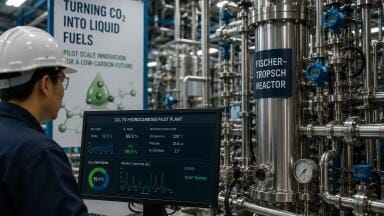
Synthetic fuels remain expensive because they are, in effect, electricity turned into molecules. Renewable power is used to split water into hydrogen, then additional process steps combine that hydrogen with nitrogen or carbon dioxide to produce ammonia, methanol or synthetic hydrocarbons. Every step consumes energy, adds capital cost and reduces overall efficiency.
That conversion penalty is central. The ICCT notes that roughly half the electricity input can be lost in the conversion of electricity into e-fuels. This means project economics depend heavily on renewable electricity prices, plant utilisation rates and electrolyser costs. If power is expensive or intermittent, synthetic fuel costs rise quickly.
Carbon-based fuels add another layer of difficulty because they also need a qualifying CO2 source. For e-methanol, e-kerosene and e-diesel, the cost, purity and accounting treatment of carbon feedstock all matter.
Direct air capture remains costly, with the IEA putting current DAC costs in the range of roughly $500 to $1,900 per tonne of CO2. Point-source capture can be cheaper but raises long-term questions about availability and eligibility as industrial emissions decline and regulations tighten around what counts as low-carbon input carbon.
That is why oil price rises help but do not transform the market overnight. Even with Brent near $100 a barrel, most synthetic fuel pathways still remain well above fossil equivalents unless they benefit from strong policy support or exceptionally favourable production conditions.
The outlook is not uniform across all synthetic fuels.
E-methanol looks like one of the clearest early commercial pathways. It is already gaining traction in shipping and chemicals, and Reuters reported in 2025 that the world’s first commercial-scale e-methanol plant had opened in Denmark. The wider renewable methanol project pipeline is large on paper, with the Methanol Institute tracking more than 250 announced renewable methanol projects by late 2025.
The cost challenge remains substantial, but e-methanol benefits from relatively strong market pull in maritime transport. Shipping is more open to fuel switching than aviation, and vessel orders and bunkering plans are beginning to create real demand signals.
Green ammonia is also gaining momentum, especially in shipping, power and industrial decarbonisation. Its advantage is that it avoids the need for carbon feedstock. Its disadvantage is that it still rests on the economics of green hydrogen upstream, plus synthesis, storage, transport and safety handling requirements.
Japan has become one of the clearest examples of how this market may grow. Rather than waiting for ammonia to become cost-competitive on its own, the Japanese model explicitly supports the price gap between low-carbon ammonia and conventional alternatives. JOGMEC-backed mechanisms and subsidy awards to import projects show that governments are willing to pay for strategic market creation.
Synthetic aviation fuels may be the most strategically important category, but they are also among the hardest to scale. Aviation has fewer realistic decarbonisation options than road transport, so synthetic kerosene has a long-term role. But the economics are difficult and the integrated supply chain is harder to finance than the chemistry alone might suggest.
A European study cited in the underlying research estimates average PtL-SAF costs of about €1.2 per litre in 2030 under its assumptions, with lower costs only emerging later. Other assessments for renewable e-diesel or related carbon-based e-fuels delivered to Europe indicate substantially higher near-term costs, showing how sensitive results are to location, power price, financing, carbon source and logistics.
The strongest near-term prospects are in sectors where direct electrification is difficult and policy is already creating demand.
Aviation is a prime example. The EU’s ReFuelEU Aviation regime is already setting a rising SAF obligation and includes a synthetic fuel sub-mandate from 2030. Maritime transport is also becoming more favourable through FuelEU Maritime, which progressively tightens lifecycle greenhouse-gas intensity requirements for shipping fuels.
These policies matter more than the oil spike itself. The real growth model for synthetic fuels is not “oil got expensive, so e-fuels win”. It is “regulation guarantees a market, and high oil prices make that transition easier to defend politically and commercially”.
The United States is taking a different route, relying more on incentives than mandates. Treasury and IRS rules around hydrogen and clean fuel credits, together with state programmes such as California’s LCFS, create revenue support for qualifying pathways.
China, by contrast, has moved more slowly on demand creation for synthetic aviation fuels. Reuters reported in 2025 that some planned green jet fuel projects were delayed by the absence of a clear nationwide SAF mandate. That highlights a wider point: project pipelines alone are not enough. Investors need credible long-term market pull.
For readers in process monitoring, quality assurance and industrial analysis, the significance of synthetic fuels is not just that new plants may get built. It is that these fuels are measurement-heavy products from the outset.
A synthetic fuels project needs far more than a reactor and an offtake agreement. It needs verified renewable electricity input, reliable electrolyser performance, gas purity control, hydrogen flow measurement, carbon or nitrogen feedstock assurance, emissions accounting and lifecycle compliance. In many cases, the measurement and verification system is part of the commercial product.
This is especially true for carbon-based e-fuels. The source and status of CO2 are not minor details; they affect certification, compliance value and buyer confidence. A tonne of methanol made with the wrong carbon source or under the wrong power-matching conditions may be chemically identical to a compliant tonne, but commercially much less valuable.
The same is true on the energy side. If a project cannot demonstrate credible renewable sourcing and matching, the climate case weakens quickly. The ICCT has warned that because conversion losses are large, fossil electricity leakage can materially worsen lifecycle emissions. That puts a premium on traceability, process analytics, carbon accounting and digital assurance systems.
For equipment suppliers and monitoring specialists, that could become one of the most durable commercial opportunities in the sector. Even if synthetic fuels remain subsidy-dependent for years, they will still require high-integrity measurement to qualify for those subsidies and to satisfy customers.
PIN 27.5 Oct/Nov 26


 Product directory



.jpg)



















.jpg)