Hydrogen fuel
Far less attention is paid to a quieter but increasingly critical variable: mechanical force.
As electrolyser systems scale up and operate more dynamically, force sensing is emerging as a key technology for maintaining efficiency, reliability and uptime.
At the centre of this issue is the electrolyser stack itself. Most industrial alkaline and PEM electrolysers are built as compressed stacks of cells, clamped together using tie rods or frame bolts.
These rods apply a precisely specified preload force that keeps electrodes, membranes, seals and bipolar plates in uniform contact. The mechanical integrity of the stack is therefore not incidental—it is fundamental to electrochemical performance.
In an electrolyser stack, clamping force directly affects electrical contact resistance, gas tightness and cross-over prevention, membrane flatness and durability as well as long-term structural stability.
If the applied force drops too low, internal leakage and efficiency losses increase. If it rises too high, membranes and plates can deform or creep, accelerating degradation. The acceptable operating window is narrow, and it must be maintained over years of operation.
Traditionally, this has been handled using torque-based tightening during assembly or scheduled maintenance.
However, torque is only an indirect proxy for force. Once the electrolyser is in operation, actual clamping force changes continuously due to thermal cycling, pressure variation, material relaxation and long-term creep in seals and frames. Hydrogen systems that load-follow intermittent renewables experience these stresses more frequently and more aggressively.
This is where force sensing becomes important.
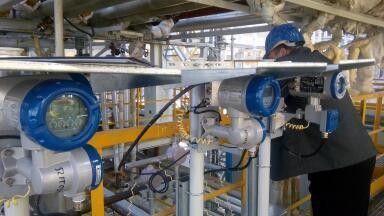
Force sensing systems measure true mechanical load, typically using strain-gauge-based load cells integrated into structural components. In electrolyser applications, sensors are commonly installed as load washers beneath tie-rod nuts or integrated into compression points within the stack frame.
As force changes, microscopic deformation in the sensor element alters the resistance of embedded strain gauges. This change is converted into a precise electrical signal that represents actual bolt tension or compressive load. Unlike torque measurements, force sensing provides a direct, continuous measurement of what is happening mechanically inside the system.
Modern systems transmit this data in real time to local control systems or plant monitoring platforms, allowing force to be treated as a live condition parameter alongside temperature, pressure, voltage, and flow.
One of the most immediate benefits of force sensing is its impact on maintenance strategy. Without direct force data, operators often rely on conservative shutdown schedules to re-torque stacks or inspect mechanical assemblies. These interventions are costly, time-consuming, and frequently unnecessary.
Real-time force monitoring enables a shift to condition-based maintenance. If tie-rod tension remains within specification, the system continues operating. If force begins to drift, maintenance can be planned before efficiency losses or damage occur. This avoids both unplanned failures and unnecessary preventive shutdowns.
For large hydrogen plants, even small reductions in downtime translate directly into improved economics, particularly as electrolyser utilisation rates increase.
Mechanical degradation in an electrolyser often reveals itself indirectly. Operators may see rising cell voltages, increased heat generation, or gas purity alarms.
By the time these indicators appear, the underlying mechanical issue may already be causing accelerated wear.
Force sensing acts upstream of these symptoms. A gradual loss of preload can be detected early, long before electrochemical performance metrics are affected.
This allows operators to intervene while the system is still operating safely and efficiently, rather than responding to alarms after damage has begun.
As green hydrogen production shifts toward grid-responsive and renewable-driven operation, electrolysers are being cycled more frequently. Load following increases mechanical stress, making static assumptions about bolt tension increasingly unreliable.
Force sensing provides the confidence needed to operate closer to design limits. By continuously verifying that mechanical preload remains within safe bounds, operators can run systems more flexibly without compromising stack life.
This becomes especially important as hydrogen production moves from pilot installations to large-scale, continuously operated infrastructure.
From a monitoring perspective, force sensing fills a gap between traditional mechanical inspection and electrochemical diagnostics. It turns a hidden variable - like mechanical preload - into a measurable, trendable parameter.
For instrumentation professionals, this represents a familiar pattern. Just as vibration monitoring transformed rotating equipment maintenance, force sensing is beginning to do the same for compressed electrochemical systems. It enables predictive maintenance, improves asset integrity and supports safer, more efficient operation.
As green hydrogen scales up, force sensing is likely to move from a specialist add-on to a standard part of electrolyser condition monitoring. In an industry where uptime, efficiency and lifetime determine viability, knowing exactly how hard your system is being held together is no longer optional.
PIN 27.4 Aug/Sept 2026


 Product directory


















.jpg)