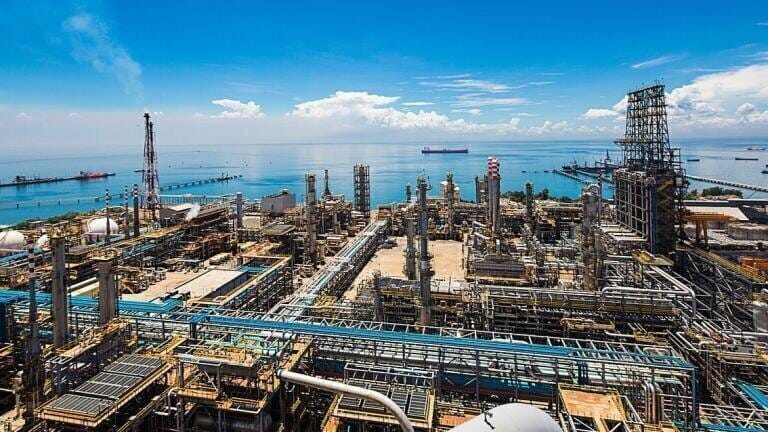
Flow meter
In the past, refineries and petrochemical plants had to choose between highly accurate in-line meters that required intrusive installation or less precise systems that could be deployed without cutting into process lines.
Recent advances in ultrasonic technology have changed that balance.
Clamp-on ultrasonic flow meters now deliver a blend of accuracy, safety and flexibility that makes them one of the fastest-growing measurement technologies in the process industries.
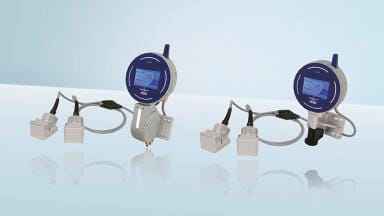
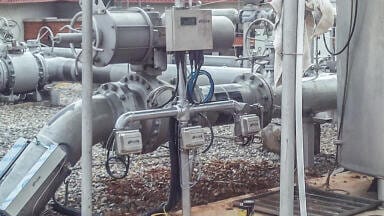
At its simplest, clamp-on ultrasonic flow monitoring uses a pair of externally mounted transducers to measure how long it takes sound waves to travel through the pipe wall and the moving fluid.
By comparing the difference in transit time between signals sent upstream and downstream, the meter calculates flow velocity and converts it to a volumetric rate.
Because the transducers are fixed to the outside of the pipe, the process fluid never comes into contact with the sensor.
No cutting or welding is required.
The result is a genuinely non-intrusive technology that can be installed in minutes, without interrupting operations, depressurising lines or applying for hot-work permits.
This makes clamp-on systems particularly attractive for a brownfield refinery or a chemical plant where lines are difficult to access or cannot be taken out of service.
Utilities such as cooling water, condensate and steam return systems are common early adopters, but the technology is now spreading to product and feedstock lines, where it can verify or back up existing in-line meters.
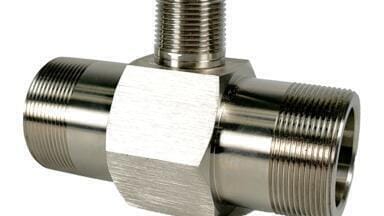
Traditional flow technologies, like Coriolis, turbine, differential pressure and positive displacement, each have performance strengths but share the same operational drawbacks: they disrupt flow and often require invasive maintenance.
Installation can involve line shutdowns, cutting into high-pressure or hazardous systems.
Clamp-on ultrasonics remove those risks.
For operators, the difference is not marginal but structural: measurement points can now be added or relocated without production downtime.
For instrumentation teams, the absence of wetted parts eliminates wear and contamination concerns.
For safety managers, there is no need to break containment, reducing exposure risk and eliminating the cost of hot-work authorisation.
Early clamp-on meters were valued for convenience but not precision.
They struggled with non-uniform velocity profiles and variable pipe wall thicknesses.
In recent years, those technical weaknesses have been steadily resolved.
Multi-path designs, which use two or more acoustic paths to sample the velocity profile across the pipe, now deliver repeatability and linearity close to in-line instruments.
Advanced digital signal processors compensate for scale build-up and acoustic noise.
Some manufacturers claim liquid-phase accuracy of ±0.5 %, which is competitive with traditional in-line technologies for many applications.
New high-temperature couplants and wave-guide mounts extend operating limits to over 400 °C, allowing deployment on hot hydrocarbon or steam lines.
Automatic configuration software can determine pipe thickness, alignment and acoustic path length within minutes, reducing installation skill requirements.
Clamp-on technology has also benefited from the digitalisation wave transforming process instrumentation.
Modern units provide continuous self-diagnostics on signal strength and transducer fouling.
Embedded software can verify meter performance without removing sensors, producing traceable electronic reports for audit purposes.
Connectivity options now include HART, Modbus, EtherNet/IP and increasingly wireless modules.
Combined with edge or cloud data collection, clamp-on meters can feed predictive maintenance systems that trend flow variability or detect leaks before they cause downtime.
For facilities pursuing digital, advanced control projects, clamp-on instruments offer an efficient way to expand measurement coverage without physically modifying process equipment.
Their non-intrusive nature allows real-time data to be layered onto virtual plant models safely and cheaply.
Several converging pressures are accelerating adoption in oil and petrochemical plants.
Continuous operation is now the norm, with very limited windows for maintenance or inspection.
Any instrumentation change that avoids shutdown is financially attractive.
Safety regulations also favour non-intrusive metering, particularly in hazardous areas where breaking containment introduces risk and requires extensive permitting.
In parallel, sustainability and energy-efficiency programmes demand accurate monitoring of utilities, feedstocks and waste streams for carbon accounting and leak detection.
Clamp-on ultrasonics address all three drivers simultaneously: uptime, safety and sustainability.
They provide a low-risk method for expanding monitoring coverage without process disruption.
The technology is not universal.
Ultrasonics depend on a clear acoustic path, so fluids with heavy aeration, entrained solids or multiple phases remain challenging.
Signal strength declines if the pipe wall is heavily scaled or lined with thick insulation. Extreme temperature swings can affect couplant stability.
For high-accuracy custody transfer or fiscal metering, Coriolis or positive-displacement meters still dominate.
Nevertheless, clamp-on systems increasingly serve as verification meters in those applications, offering redundancy and performance assurance.
Market analysts forecast sustained double-digit growth in ultrasonic flow measurement through the end of the decade, with clamp-on systems representing the fastest-expanding segment.
The main drivers are brownfield retrofits, energy-efficiency programmes and the wider digital transformation of process plants.
Manufacturers are converging toward integrated platforms that combine ultrasonic sensing with temperature and diagnostics data in a single transmitter.
Hybrid ultrasonic–wireless models are emerging for temporary or mobile monitoring, enabling safe installation in remote or hazardous zones.
The growing popularity of clamp-on ultrasonics reflects a broader shift in process instrumentation philosophy.
Measurement is moving away from static, hard-wired devices toward smart, non-invasive systems that align with predictive maintenance and digital twin strategies.
In this context, clamp-on ultrasonics are not just a convenient alternative; they are a structural enabler of modern operational models.
They support continuous optimisation by providing data without interrupting production, they reduce maintenance exposure, and they align with regulatory demands for safety and environmental transparency.
As process industries adapt to the twin pressures of efficiency and decarbonisation, technologies that extend measurement capability without physical modification will define the next generation of instrumentation.
Clamp-on ultrasonic flow monitoring stands at the centre of that transformation.
PIN 27.4 Aug/Sept 2026


 Product directory


.jpg)










.jpg)