Flow level pressure
As instruments evolve, could pressure transients become the next frontier in process safety and efficiency?
Pressure is one of the most measured variables in petrochemicals.
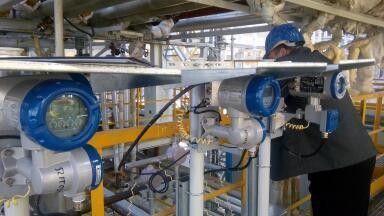
Every tank, every pipeline and every vessel is fitted with transmitters feeding data to control systems.
These readings reassure operators that systems are within design limits. But what happens in the gaps between measurements?
The reality is that most standard pressure sensors sample too slowly to catch rapid fluctuations.
A water hammer lasting just milliseconds, a flashing event in a pump or a sudden depressurisation can escape detection.
Yet these transients can fatigue metals, damage seals and trigger failures long after the event has passed. For decades, such phenomena were understood by engineers but effectively invisible to plant instrumentation.
The industry could once afford to treat pressure transients as theoretical risks.
But tighter safety standards, more complex process conditions and the integration of low-carbon fuels are making them harder to ignore.
Hydrogen embrittlement, for example, is exacerbated by pressure shocks.
Supercritical CO₂ systems are especially sensitive to flashing events. And as plants chase ever-greater efficiency, operating margins shrink, leaving less room for hidden stresses.
Regulators and insurers are beginning to notice. Some safety case reviews now ask for evidence of transient analysis, not just steady-state monitoring.
In effect, what was once a background engineering concern is moving into the compliance spotlight.
Recent advances are making it possible to capture transients in real time.
High-speed piezoelectric pressure transducers can sample thousands of times per second, recording the shape of a surge rather than missing it between readings.
Portable high-frequency loggers are being used to audit critical systems during commissioning and start-up.
In some plants, acoustic sensors are being coupled with pressure instruments to build a fuller picture of dynamic stress.
Digital twins amplify this progress. By comparing real-time data to simulated expectations, they allow operators to identify when a system has experienced abnormal stress, even if the event itself was fleeting.
Instead of waiting for cracks to appear, plants can take preventative action based on data-driven foresight.
The shift from steady-state to transient monitoring changes the very role of pressure instrumentation.
Instead of acting as passive guardians of safe limits, instruments become forensic tools and early warning systems.
A transient captured on a logger today can prevent a ruptured gasket tomorrow.
Over time, these records build a history of system stresses that can guide maintenance schedules and asset replacement with far greater precision.
For plant managers, this offers a new lever for reliability.
For compliance officers, it provides hard evidence that systems are monitored continuously and proactively, not just at the average level.
And for technicians, it represents a step change in skillsets, as interpreting transient data requires a different lens than steady-state process control.
Despite the benefits, adoption is far from universal. High-speed transducers are more expensive and require careful placement to deliver meaningful insights.
Plants may be reluctant to retrofit sensors across large networks of pipes and vessels.
There is also the challenge of data management: capturing pressure data at kilohertz rates generates enormous volumes of information, much of which requires sophisticated analysis to interpret.
Perhaps most importantly, there is a cultural barrier.
Engineers and operators are accustomed to thinking in terms of averages and ranges.
Convincing them that millisecond spikes matter as much as long-term stability requires a shift in mindset as much as in hardware.
Pressure has always been a comfortingly steady figure in process monitoring. But as new fluids, tighter regulations and more ambitious efficiency targets converge, the hidden world of transients is moving to centre stage.
High-speed instruments, acoustic hybrids and digital twins are revealing stresses that were once invisible, giving operators the chance to prevent failures before they cascade.
For the petrochemical sector, this is more than an upgrade in instrumentation. It is a redefinition of what it means to monitor pressure.
The future of process safety may depend not on how well plants manage average pressure, but on how well they capture the fleeting extremes. In those milliseconds, the difference between resilience and failure is being written.
PIN 27.5 Oct/Nov 26


 Product directory


.jpg)