Gas detector
Leak detection and repair has always been central to petrochemical safety and environmental performance - but it is slowly changing.
What was once dominated by periodic campaigns and manual inspections is increasingly evolving into a semi-continuous sensing layer that treats leaks as dynamic, trackable phenomena rather than static compliance findings.
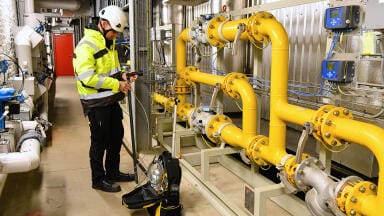
Traditional LDAR programmes were shaped by regulatory schedules and practical constraints. Inspections were conducted at defined intervals, often using handheld detectors or optical gas imaging cameras, and results were recorded as snapshots in time.
While effective at identifying major issues, this approach struggled with intermittency. Small leaks could persist undetected between surveys, while others might appear and disappear without ever being captured.
Several forces are now pushing LDAR monitoring toward continuity. Environmental expectations have intensified, particularly around methane and volatile organic compounds.
Optical gas imaging remains a cornerstone, but its role is shifting. Instead of being reserved for scheduled walk-downs, OGI is being integrated into routine inspection workflows, often supported by fixed gas sensors or mobile platforms.
The emergence of autonomous and remotely supervised inspection systems has been particularly influential. Regulatory acceptance of certain autonomous OGI deployments has signalled that what matters is not the physical presence of an inspector, but the quality, repeatability, and traceability of the monitoring evidence.
For monitoring professionals, this changes the nature of LDAR data. Images and detections are no longer isolated artefacts; they are part of a growing time-series record linked to specific assets, operating conditions, and maintenance actions.
This enables trend analysis, root-cause investigation, and performance benchmarking in ways that were previously impractical. A valve that repeatedly exhibits minor leakage under certain load conditions, for example, can be identified and addressed systematically rather than repeatedly rediscovered.
However, continuity brings new challenges. As detection sensitivity improves, so does the volume of data and the potential for false positives.
Effective LDAR monitoring now depends as much on alarm philosophy and workflow integration as on sensor capability. Monitoring systems must distinguish between leaks that require immediate action, those that can be scheduled for repair, and benign phenomena that should be logged but not escalated.
There are also organisational implications. LDAR monitoring increasingly sits at the intersection of operations, maintenance, environmental compliance, and digital teams.
Clear ownership of data and decisions becomes essential. Without this, even the most advanced monitoring systems risk becoming sources of frustration rather than insight.
Ultimately, the move toward continuous LDAR monitoring reflects a broader trend in petrochemicals: the recognition that safety and environmental performance are best managed through persistent visibility rather than periodic intervention.
PIN 27.4 Aug/Sept 2026


 Product directory


















.jpg)