Sustainable aviation fuel (SAF)
Europe’s jet fuel alarm should not be read simply as an airline panic story. The more revealing angle for a process and analytical audience is that a geopolitical shock has suddenly exposed how dependent aviation still is on a tightly balanced fuel system, and how quickly that becomes a problem of product qualification, blending, traceability and stock visibility.
On 16 April, IEA executive director Fatih Birol said Europe had “maybe 6 weeks or so” of jet fuel left if disruption linked to the Iran war and the Strait of Hormuz continued. Yet two days earlier, the European Commission had said there was no shortage in the EU “at present”, even while warning that supply problems could emerge soon.
That gap matters: it suggests Europe is moving from price shock towards an operational control problem, not simply running out everywhere at once.
For the market as a whole, the vulnerability is clear. Reuters reports that roughly 75% of Europe’s jet fuel imports come from the Middle East, more than for any other transport fuel, while stocks are unevenly distributed across the region.
Spain is a net exporter, Britain imports more than 60% of demand, many airports do not hold especially large stocks, and the EU’s 90-day emergency oil-stock rules do not include a specific obligation to hold jet fuel.
The Commission is now drafting measures to map refining capacity and ensure existing refinery capacity is fully utilised and maintained, while airlines have asked Brussels to improve monitoring of jet fuel supplies and consider joint kerosene purchasing. That alone tells you what kind of story this has become: one about system visibility, refinery flexibility and allocation under stress.
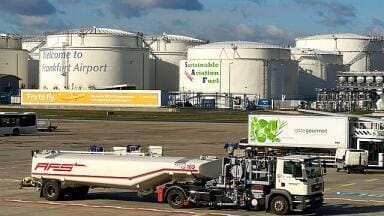
This is where SAF becomes more than a side issue. In the short term, a conventional jet fuel squeeze could make SAF deployment harder. SAF remains significantly more expensive than fossil jet fuel, with Reuters reporting it still costs roughly two to five times as much, and even major airlines have recently been scaling back some of their language around SAF and net-zero commitments because production growth is proving slower than hoped. In a market where airlines are worrying first about physical access to on-spec kerosene, there is an obvious risk that decarbonisation gets pushed down the priority list in day-to-day operations.
But there is another side to it. Europe is not at the pilot-project stage any more. Under ReFuelEU Aviation, reporting obligations for aviation fuel suppliers and aircraft operators have applied from 1 January 2025, and the regulation requires aviation fuel suppliers to ensure that aviation fuel made available at Union airports contains minimum shares of SAF. Reuters also reported on 30 March that early indications suggest European airlines likely met, and may even have exceeded, the EU’s 2% SAF target for 2025, with the next major step being a 6% target by 2030. So this crisis lands at a moment when SAF is already becoming an operational part of the fuel system rather than just a future ambition.
That is why the most interesting question is not whether SAF can solve this shortage. It cannot. The real question is whether a supply crisis changes how SAF is distributed, blended and claimed across Europe. The Commission’s own guidance says that from 1 January 2025 to 31 December 2034, supplier compliance with minimum SAF shares is verified on a weighted average across all Union airports where that supplier operates. That means a supplier does not necessarily have to deliver exactly the same SAF share at every airport in every reporting period. It is reasonable to infer, therefore, that in a disrupted market suppliers may concentrate scarce SAF volumes where logistics, storage, blending or commercial conditions make that easiest, while still remaining compliant overall. In other words, a fuel shock could accelerate optimisation of SAF deployment, not just its delay.
For instrumentation users, that turns this into a fuel quality and assurance story very quickly. ReFuelEU’s reporting obligations do not apply only to green fuels. The Commission states that the Article 10(d) reporting requirement covers all aviation fuels supplied to Union airports, including conventional fuels, and specifically mentions aromatics, naphthalenes and sulphur. It also says suppliers do not need to re-test those properties at airports if they can rely on relevant fuel quality certificates such as certificates of quality or analysis.
That matters because a stressed fuel market will place more weight on the integrity of upstream testing, certification and traceability. If product is moving through substitute routes, different blending points and more contested logistics chains, the value of trustworthy certificates, batch traceability and high-confidence release testing rises sharply.
The existing aviation fuel standards already point in that direction. JIG describes its standards as covering the aviation fuel supply chain “from refinery to wing-tip”, and EI/JIG 1530 explicitly covers manufacture, batching, testing, release, storage, handling and transport to airports. That is a reminder that fuel quality is not just a laboratory matter at the end of the chain. In a disrupted market, quality assurance becomes inseparable from continuity of supply. The question is no longer just whether Europe can source more molecules. It is whether those molecules can be converted, certified, blended, stored and delivered as compliant aviation fuel fast enough, with the documentation and traceability needed to keep both regulators and aircraft operators satisfied.
That is why this story should interest readers well beyond airline finance. A prolonged jet fuel squeeze would put new emphasis on refinery yield optimisation, terminal and hydrant inventory management, batch certification workflows, digital chain-of-custody systems, and the analytical infrastructure behind conventional jet fuel and SAF alike. Europe’s aviation fuel crisis is therefore not only exposing dependence on the Strait of Hormuz. It is also exposing how much the success of SAF depends on something less glamorous but more fundamental: a fuel quality and data system robust enough to handle scarcity without losing control of compliance, safety or product integrity.
PIN 27.4 Aug/Sept 2026



 Product directory


















.jpg)