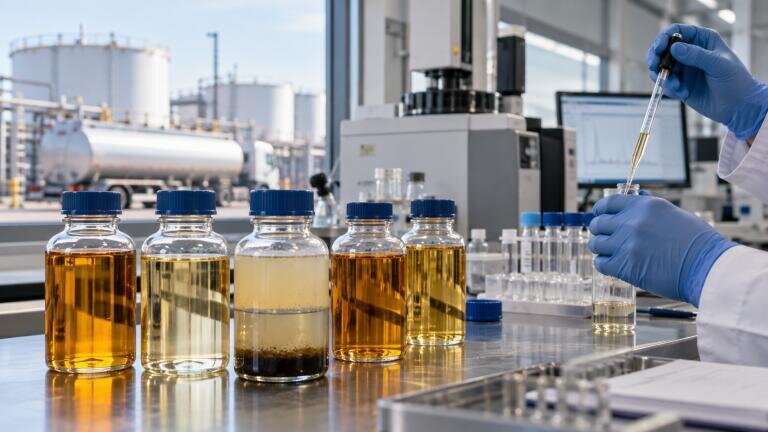
Fuel analysis
Competing explanations for months of damaged engines point to the same weakness: imported fuel was not being tested where it mattered.
Bolivia imports much of the petrol and diesel it uses. Its fuel quality testing regime was put under strain in the first months of 2026, when motorists began reporting stalling engines and damaged fuel systems.
By spring, the government was describing a national crisis, dubbed ‘gasolina basura’ – rubbish petrol.
The official figures are large. The government has said that more than 10,000 vehicles were damaged and that direct losses reached around US$150m.
By mid-May, state energy company Yacimientos Petrolíferos Fiscales Bolivianos (YPFB) had reportedly paid compensation to more than 19,500 vehicle owners.
On Tuesday, 31 March 2026, the interior minister, Marco Antonio Oviedo, described the problem as sabotage.
According to the government, around 150 million litres of petrol and diesel had been tampered with between October 2025 and March 2026.
Fuel was allegedly siphoned from tankers in northern Chile and replaced with water and used oil.
Bolivia and Chile agreed a joint response the same day. Bolivia also suspended fuel supply contracts with Vitol and Trafigura pending investigation.
No finding of wrongdoing against either company has been reported. Chilean prosecutors in Arica have since said they found no evidence of a transnational adulteration network.
YPFB offered a different account on Monday, 11 May 2026, identifying four factors.
Quality was checked at the pump but not on imported base gasoline travelling around 1,800km. Storage tanks had been run low between 2023 and 2025, allowing oxidation. Rapid refilling from December 2025 disturbed tank sediment.
Most significantly for laboratories, YPFB said diolefins in imported gasoline had formed gums. Bolivian specifications included no control on oxidation stability.
The YPFB account maps onto standard petroleum test methods. Oxidation stability of gasoline is measured by induction period under ASTM D525 or EN ISO 7536.
EN 228, the European petrol specification, requires an induction period of at least 360 minutes – the figure YPFB now cites.
Existent gum, the residue left when fuel evaporates, is measured under ASTM D381 or EN ISO 6246. EN 228 sets a maximum of 5mg/100ml. YPFB has tightened its contract limit from 5mg/100ml to 3mg/100ml.
Manganese, used in some octane-enhancing additives, was also tightened, from 18mg/l to 10mg/l. That remains five times the EN 228 limit of 2mg/l.
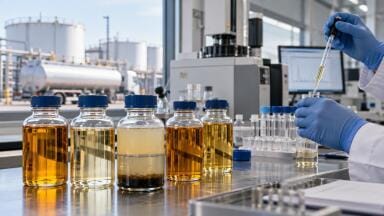
If the sabotage account is correct, different checks apply. Free water and particulates in diesel can be screened visually under ASTM D4176, a method suitable for field use.
Dissolved water is quantified by coulometric Karl Fischer titration under ASTM D6304, and total contamination in diesel by EN 12662. EN 590 limits water to 200mg/kg and total contamination to 24mg/kg.
Either way, the conclusion is similar. The fuel was not being tested adequately at the point of import, and the specification did not cover the failure mode.
Supreme Decree 5619, issued on Thursday, 14 May 2026, introduced a new quality regime for petrol, diesel, jet fuel and kerosene. Fuel cannot be sold without a laboratory analysis certificate.
The decree adds an oxidation stability requirement for imported gasoline, tighter gum and manganese limits, and minimum octane numbers of 85 for regular and 91 for premium.
Enforcement depends on testing capacity. A report by the National Hydrocarbons Agency (ANH), published in August, examined its three mobile laboratories.
The La Paz and Santa Cruz units were operating at 61 per cent and 55 per cent of capacity.
The Cochabamba unit had been out of service since 2024. All three lacked reagents and were more than ten years old.
The same report reviewed 121 imported fuel batches. Of these, 94 carried certificates from Intertek, four from Camin Cargo and six from a certifier without a contract. Sixteen had no quality certificate at all.
The political fallout continues. A former hydrocarbons minister, Mauricio Medinaceli, was detained in July on charges including breach of duties.
In early September, the government placed YPFB under a 180-day intervention, citing smuggling, diversion and logistics failures.
Contamination incidents have not stopped. On Sunday, 13 September 2026, a tanker from Chile carrying 36,000 litres of diesel was stopped in Cochabamba, short in volume and suspected of containing water.
For fuel testing professionals, Bolivia is an example of a familiar risk. Where a country depends on imports carried long distances by road, quality has to be verified at each custody transfer.
That verification has to be made against a specification that anticipates how the fuel can fail. The laboratory capacity to do so has to exist before the problem appears.
PIN 27.4 Aug/Sept 2026



 Product directory