Analytical instrumentation
Viscosity, density and freezing behaviour are critical quality-control parameters for aviation turbine fuels that directly influence pumpability, spray formation, and safe engine operation under low-temperature conditions.
According to ASTM D1655 [1] , ASTM D7566 [2], and Def Stan 91-091 [3], jet fuels must comply with viscosity specifications at -20 °C and -40 °C for fuels containing synthesised hydrocarbons.
In addition, freezing point and density at 15 °C are mandatory certification parameters.
Operationally, parameters such as kinematic and dynamic viscosity borderline temperature (kVBT and dVBT) and viscosity at 3 °C above freezing point are increasingly relevant for assessing fuel behaviour close to its operational limits.
Traditionally, these parameters have been determined using separate instruments, including ASTM D445 [4] or D7042 [5] for viscosity, ASTM D4052 [6] for density and ASTM D2386 [7] for freezing point.
While each method fulfills its individual purpose, the increasing complexity of aviation fuels, particularly sustainable aviation fuels (SAF), has highlighted the need for approaches capable of providing a comprehensive characterisation of cold-flow and pumpability behaviour.
The recent introduction of ASTM D8630 [8], a new automated freeze point method, reflects the industry’s transition toward instrument-based, objective cold-flow analysis in which all relevant jet fuel parameters can be determined within a single analytical workflow.
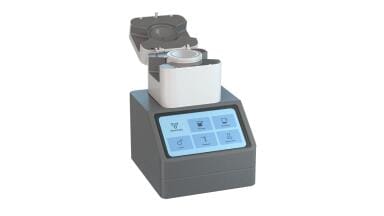
This article describes the determination of seven critical jet fuel properties using Anton Paar’s SVM 3001 Cold Properties, a multi-parameter viscometer based on ASTM D7042.
Figure 1: SVM 3001 Cold Properties, a multiparameter instrument for jet fuel analysis. The configuration shown features manual sample introduction.
ASTM D7042 determines dynamic viscosity and density simultaneously, allowing automatic calculation of kinematic viscosity.
For jet fuels at -20 °C, ASTM interlaboratory studies demonstrate performance equivalent to, or better than, ASTM D445.
The values shown in Table 1 are calculated from the precision equations given in ASTM D7042-25 and ASTM D445-24, assuming a representative jet fuel with a viscosity of 7.98 mm²/s.
Table 1: Precision comparison at -20 °C and 7.98 mm2/s
In addition, statistical evaluation by ASTM has identified only a minor systematic bias between the two methods.
At a viscosity of 7.98 mm²/s, this bias amounts to approximately 0.17 %, which is more than six times smaller than the repeatability of either method.
Consequently, in practical terms, both methods lead to the same specification decision for jet fuel viscosity.
Application data [9] for a range of different Jet Fuel A-1 samples confirm the agreement:
Table 2: Jet fuel viscosity at -20 °C
The observed deviations are well within reproducibility limits.
Because ASTM D7042 measures dynamic viscosity (η) and density (ρ) directly, kinematic viscosity (ν) is calculated as:
ν=η
ρ
The advantage of this approach lies in the elimination of gravitational dependencies inherent to capillary methods, which enables a single measuring cell to cover viscosities from 0.2 mm²/s to 30,000 mm²/s without capillary exchange.
Beyond single-point measurements, ASTM D4054 defines the evaluation of jet fuels by measuring viscosity and density over a temperature range.
This includes viscosity at -40 °C (or freezing point +5 °C), -20 °C and higher temperatures, as well as density at multiple temperatures.
The Temperature Table Scan (TTS) measurement mode of SVM 3001 Cold Properties, facilitated by its thermoelectric temperature control, permits the acquisition of full viscosity/density–temperature profiles from a single filling. Representative results for a jet fuel standard (N2B) are shown below.
Table 3: Viscosity and density vs. temperature (N2B Standard) using repeated test points per temperature [11]
Figure 2: N2B viscosity and density over temperature.
These data illustrate the strong temperature dependence of viscosity and highlight the importance of continuous profiling rather than isolated measurements when evaluating new aviation turbine fuels and fuel additives.
Freezing point defines the lowest permissible operational temperature of jet fuel, making it a critical safety parameter.
While ASTM D2386 has historically served as the reference method, it relies on visual detection of crystal disappearance and is inherently operator dependent.
ASTM D8630, with which SVM 3001 Cold Properties is fully compliant, introduces an automated procedure based on instrument-controlled detection of the phase transition.
This procedure replaces subjective visual endpoint determination with a standardised and reproducible measurement approach, improving both repeatability and operator independence.
The performance of the automated method has been validated in a worldwide interlaboratory study (ILS) using SVM 3001 Cold Properties.
The study demonstrated excellent precision, with a repeatability of r = 0.4 % and a reproducibility of R = 1.1 % (at -47 °C) and showed no statistically significant bias compared to the manual ASTM D2386 method.
These results confirm that the automated method provides equivalent measurement trueness while improving reproducibility and consistency across laboratories.
Application data obtained using automated freezing point determination are shown below:
Table 4: Freezing Point Results
(ASTM D2386-19 repeatability: 1.5 °C, reproducibility: 2.5 °C)
The repeatability achieved with automated measurement lies well within the repeatability and reproducibility limits of ASTM D2386, while the absence of bias ensures equivalence of results between both methods.
The introduction of ASTM D8630 therefore represents a significant step toward standardized and automated freeze point determination, enabling objective and reproducible cold-flow analysis as part of integrated multiparameter testing workflows.
The viscosity borderline temperature corresponds to the temperature at which fuel reaches a defined viscosity limit (typically 12 mm²/s).
This parameter is critical for pumpability and sprayability. In the following, two different jet fuel samples and one certified reference material were characterised.
In all cases, kVBT (kinematic viscosity borderline temperature) showed excellent repeatability (< 0.2 °C).
Table 5: Viscosity borderline temperature
The temperature scan measurement mode allows for direct determination of the viscosity borderline temperature without interpolation.
With SVM 3001 Cold Properties, the viscosity limit can also be freely adjusted to values other than 12 mm²/s.
Further, depending on user preference and to furnish results independent of fuel density, a dynamic viscosity borderline limit may be defined, instead of a kinematic viscosity, affording a dynamic viscosity borderline temperature (dVBT). Such flexibility proves especially beneficial in the development of novel fuels which might show broader density variation than conventional fuels.
The viscosity at 3 °C above the freezing point is used operationally as a safety margin. In SVM, this figure is commonly referred to as SFP (“standard measurement above freeze point”).
The same materials as in the previous section were measured:
Table 6: SFP Values
Since SVM 3001 Cold Properties allows for both freeze point determination and viscosity measurement within a single unit, the SFP can be determined directly after the freeze point within a single automated workflow and from the same filling.
To summarise, SVM 3001 Cold Properties – with its full compliance to ASTM D7042, ASTM D4052 and ASTM D8630 – allows the determination of seven critical jet fuel parameters within a single workflow:
1. Kinematic viscosity at -20 °C
2. Kinematic viscosity at -40 °C
3. Density at 15 °C
4. Freezing point
5. Kinematic viscosity borderline temperature (kVBT)
6. Dynamic viscosity borderline temperature (dVBT)
7. Viscosity at 3 °C above freezing point (SFP)
All of these parameters can be obtained from a single sample filling. During one measurement, up to 15 parameters can be determined and displayed simultaneously.
In addition, further quantities can be calculated and reported based on the measured values by defining user-specific functions within the instrument.
This offers full flexibility, especially in an R&D context.
Figure 3: SVM 3001 Cold Properties with Xsample 340, a setup enabling fully automated jet fuel analysis.
The introduction of ASTM D8630 complements established methods such as ASTM D7042 and ASTM D4052 within SVM 3001 Cold Properties and renders the instrument a true multi-parameter tool for jet fuel certification and development.
Application data demonstrate that viscosity measurement according to ASTM D7042 provides precision equivalent to or better than ASTM D445, while automated freezing point determination according to ASTM D8630 achieves repeatability well within ASTM D2386 precision limits.
In combination with temperature-dependent analysis according to ASTM D4054, a comprehensive characterisation of jet fuel behaviour becomes possible.
Integrated systems such as SVM 3001 Cold Properties enable determination of seven critical jet fuel parameters within a single analytical workflow, providing a technically consistent and efficient solution for modern aviation fuel laboratories.
[1] ASTM D1655-25a, “Standard Specification for Aviation Turbine Fuels,” Annual Book of ASTM Standards, ASTM International, West Conshohocken, PA.
[2] ASTM D7566-25a, “Standard Specification for Aviation Turbine Fuel Containing Synthesized Hydrocarbons,” Annual Book of ASTM Standards, ASTM International, West Conshohocken, PA.
[3] DEF STAN 91-091, Revision I14, March 7, 2022 – Turbine Fuel, Kerosene Type, Jet A-1; NATO Code: F-35; Joint Service Designa-tion: AVTUR.
[4] ASTM D445-24, “Standard Test Method for Kinematic Viscosity of Transparent and Opaque Liquids (and Calculation of Dynamic Viscosity),” Annual Book of ASTM Standards, ASTM International, West Conshohocken, PA.
[5] ASTM D7042-25, “Standard Test Method for Dynamic Viscosity and Density of Liquids by Stabinger Viscometer (and the Calculation of Kinematic Viscosity),” Annual Book of ASTM Standards, ASTM International, West Conshohocken, PA.
[6] ASTM D4052-22, “Standard Test Method for Density, Relative Density, and API Gravity of Liquids by Digital Density Meter,” Annual Book of ASTM Standards, ASTM International, West Conshohocken, PA.
[7] ASTM D2386-25a, “Standard Test Method for Freezing Point of Aviation Fuels,” Annual Book of ASTM Standards, ASTM Internation-al, West Conshohocken, PA.
[8] ASTM D8630-26, “Standard Test Method for Freezing Point of Aviation Fuels (Micro CFP Method),” Annual Book of ASTM Stand-ards, ASTM International, West Conshohocken, PA.
[9] Application Report: Aviation | Jet Fuel Viscosity - SVM 3001 Application Report. https://www.anton-paar.com/corp-en/services-support/document-finder/application-reports/aviation-jet-fuel-viscosity-svm-3001-application-report/ (accessed: 2026-04-17)
[10] ASTM D4054-25a, “Standard Practice for Evaluation of New Aviation Turbine Fuels and Fuel Additives,” Annual Book of ASTM Standards, ASTM International, West Conshohocken, PA.
[11] Application Report: Aviation | ASTM D4054 / SVM 3001 - Scanning Jet Fuel and Viscosity Borderline Temperature. https://www.anton-paar.com/corp-en/services-support/document-finder/application-reports/aviation-jet-fuel-viscosity-svm-3001-application-report/ (accessed: 2026-04-17)
[12] Application Report: Aviation | Cold Flow Properties of Jet Fuel (Freezing Point). https://www.anton-paar.com/corp-en/services-support/document-finder/application-reports/aviation-jet-fuel-viscosity-svm-3001-application-report/ (accessed: 2026-04-17)
PIN 27.4 Aug/Sept 2026


 Product directory




























.jpg)