Sulphur analysis
Trace sulphur analysis is important across natural gas, fuels, refining and petrochemical applications, where sulphur compounds at very low concentrations can affect catalysts, damage equipment and interfere with product quality. Accurate calibration is therefore critical when applying analytical methods designed to identify and quantify individual sulphur species.
Several ASTM methods address the measurement and calibration of trace sulphur compounds. ASTM D5504 covers the determination of sulphur compounds in natural gas and gaseous fuels using gas chromatography with sulphur chemiluminescence detection (SCD), while ASTM D3609 provides practices for calibration using permeation tubes. Other GC-based approaches for trace sulphur analysis include sulphur-selective detection (SSD) and pulsed flame photometric detection (PFPD).
Calibration becomes particularly challenging at sub-ppmv and ppbv concentrations because reactive sulphur compounds can adsorb onto storage vessels, tubing and other internal surfaces. Dynamically generated gas standards are an alternative to storing reactive components in cylinders. Permeation devices provide a continuously generated gas source at a known emission rate under controlled temperature conditions. Multiple permeation devices can create multicomponent sulphur mixtures.
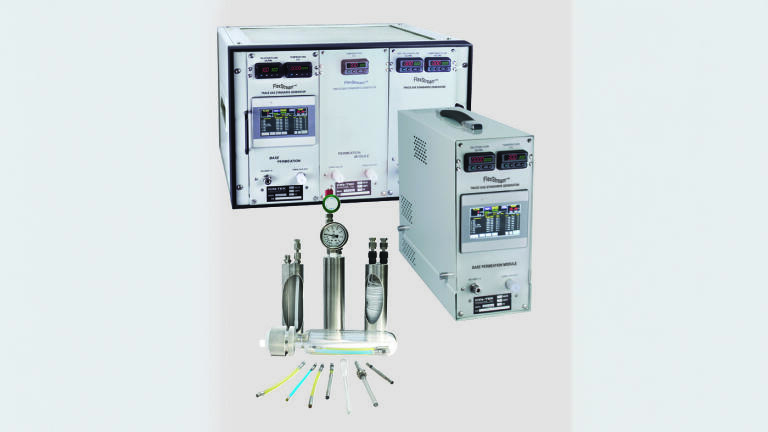
KIN-TEK Analytical’s Trace Source™ Permeation Tubes used with the automated FlexStream™ Permeation System generates calibration gas standards used for calibrating different detectors referenced in ASTM methods. Precise temperature and flow control from the Base Module creates a primary standard of multiple concentrations, while the Secondary Dilution Module expands capability to create ppbv and lower concentrations. Heated, Sulfinert®-coated output tubing further minimises losses of reactive sulphur compounds delivered to the analyser. By combining controlled permeation, accurate dilution and treated sample delivery pathways, dynamically generated standards provide laboratories with a NIST-traceable and flexible approach to calibration for ASTM methods.
Editorial adapted from KIN-TEK Analytical application note ‘Trace sulfur calibration for various chromatography methods using an automated permeation system’.
Danet M. Vrazel
PIN 27.4 Aug/Sept 2026



 Product directory















.jpg)




.jpg)