Safety
What has changed over the past decade is the role temperature transmitters play within wider safety and asset-integrity strategies.
Smart temperature transmitters are increasingly specified not simply as measurement devices but as diagnostic and safety-relevant nodes within the plant architecture.
In refineries and petrochemical plants, temperature is a proxy variable for multiple risk factors: reaction runaway, fouling, catalyst deactivation exchanger blockage and loss of containment.
Traditional analogue transmitters provided a single value to the control system, leaving operators to infer equipment condition indirectly.
Smart temperature transmitters add a second layer of information by continuously monitoring sensor health and internal electronics.
For process and safety teams, this matters because many temperature failures historically present as plausible readings. A drifting RTD or degraded thermocouple can remain within limits while masking abnormal process behaviour.
Embedded diagnostics - such as sensor drift detection and open-circuit prediction - are now being used to reduce this hidden failure risk, particularly in safety-critical loops.
There is growing alignment between smart temperature transmitters and functional safety frameworks.
While transmitters themselves are rarely the final safety barrier, they form part of Safety Instrumented Functions (SIFs) protecting furnaces and distillation systems.
Newer smart transmitters are increasingly designed with SIL-capable architectures and documented diagnostic coverage.
For safety professionals, this supports more realistic proof-test intervals and clearer failure classification.
Instead of treating the temperature loop as a black box, asset teams can distinguish sensor degradation from transmitter electronics issues, reducing unnecessary shutdowns while maintaining compliance with safety cases.
The petrochemical sector remains dominated by hazardous and hard-to-access environments, like high-temperature zones, elevated pipe racks, furnaces and confined process units.
Smart temperature transmitters are being adopted partly because they reduce the need for physical access.
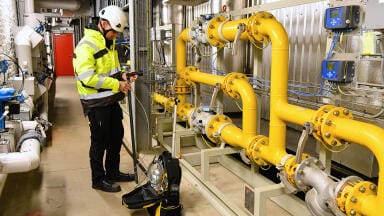
Remote validation and diagnostics via digital protocols allow technicians to assess loop health without opening enclosures or issuing work permits.
This trend has accelerated as sites rationalise maintenance staffing and seek to reduce exposure hours in classified areas.
For ageing plants, retrofit head-mounted smart transmitters have become a practical way to improve diagnostic coverage without replacing installed sensors or re-engineering cabling.
Temperature data is increasingly fed into predictive maintenance workflows alongside vibration, pressure and flow.
Smart transmitters support this shift by providing metadata - on sensor age, drift indicators, noise levels, etc. - that can be correlated with fouling or corrosion.
In fired heaters and polymerisation units, this supports earlier detection of abnormal thermal behaviour before it escalates into a safety or quality event.
For process engineers, the value is not higher temperature accuracy per se but higher confidence in the measurement chain over long operating periods.
Most petrochemical plants are brownfield sites with mixed generations of instrumentation. Smart temperature transmitters have seen higher uptake than some other smart field devices because they are backward compatible.
They can operate in conventional 4–20 mA loops while exposing digital diagnostics to control, safety or asset management systems.
This makes them a low-risk entry point into broader digitalisation programmes, particularly where full Ethernet-APL or fieldbus upgrades are not yet viable.
As a result, temperature loops are often among the first to be ‘smart-enabled’ in incremental modernisation projects.
For process engineers, smart temperature transmitters change how temperature data should be interpreted: not as a single number, but as a measurement with an explicit confidence level.
For safety engineers, they offer improved visibility of failure modes that historically sat outside routine alarm and trip logic.
The overall trend is clear. Smart temperature transmitters are being used more frequently in the petrochemical sector because they address operational risk and safety assurance simultaneously.
As plants face tighter margins and higher expectations around safety performance, non-diagnostic temperature measurement is increasingly treated as a legacy choice rather than a neutral one.
PIN 27.4 Aug/Sept 2026

 Product directory
















.jpg)