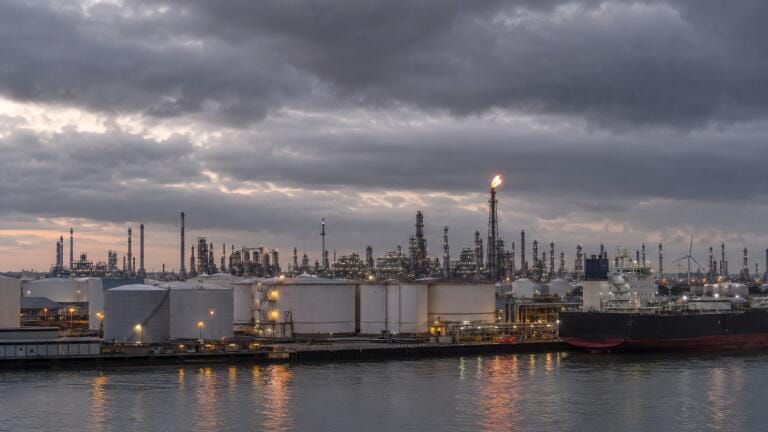
Safety
A fatal explosion during maintenance work at a fuel terminal, and a power outage that forced an unrelated refinery into shutdown and significant flaring.
Both incidents remain under investigation, and neither has a confirmed cause at the time of writing.
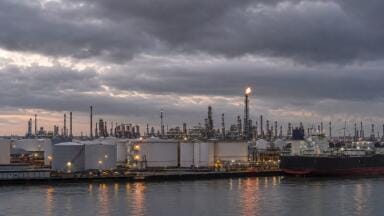
At approximately 11:30 local time, an explosion occurred at a Gunvor Energy fuel storage and terminal facility on Moezelweg in the Europoort area of the port.
According to reporting by NL Times and other outlets, the explosion happened during maintenance work being carried out by a contracted crew, reportedly involving pipeline disconnection work, though the precise technical cause has not been confirmed.
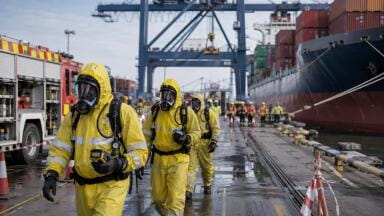
One fatality has been confirmed, with several other injuries reported.
The exact number and severity of injuries were not fully established in initial reporting. Dutch police and labour inspectors are investigating.
Separately, and around two hours earlier the same day, a damaged transformer in the regional electricity grid caused a power outage affecting the Botlek industrial area, roughly 10 to 15 kilometres from the Gunvor site, according to reporting by ICIS.
The outage triggered an emergency shutdown at an ExxonMobil refinery, which resulted in significant flaring, and also caused a complete power loss at Viterra’s Botlek biodiesel refinery.
It affected at least eight other companies in the surrounding Welplaatweg area. Grid operator Stedin was reported to be investigating the transformer failure; power was reported restored to the region by 14:27 local time.
The Port of Rotterdam Authority confirmed that the two incidents were unrelated.
Two independent failures at the same hub on the same day is, on its own, a reminder of how concentrated risk becomes at a site handling the volume and variety of process activity that Rotterdam does.
What the day’s events put back on the agenda for operators and regulators at major refining and petrochemical hubs is the adequacy of two separate categories of safeguard: process-safety monitoring during contracted maintenance work, and electrical grid resilience for sites where a single transformer failure can cascade into multi-site shutdowns and flaring events.
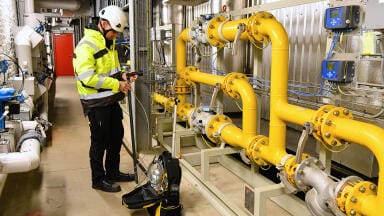
On the maintenance-safety side, incidents during pipeline or tank disconnection work typically prompt scrutiny of isolation procedures, permit-to-work systems, and the process monitoring and gas detection coverage in place during non-routine maintenance activity.
Continuous or portable gas detection and clear line-of-sight process data are standard risk controls in this context, though it is not yet known whether any monitoring gap contributed to the Gunvor incident.
On the power-resilience side, the fact that one transformer failure knocked out or forced the shutdown of multiple, ostensibly independent facilities across an industrial area raises questions about backup power provisioning.
It also raises the question of how far supposedly separate operators actually share common points of electrical failure – questions regulators and site operators are likely to revisit once Stedin’s investigation into the transformer failure concludes.
Neither incident has yet produced a public technical report, and both companies involved – Gunvor and ExxonMobil – have made only limited initial public statements.
ExxonMobil said the power-related shutdown “posed no danger to the surrounding area” and confirmed no injuries from that incident.
Until Dutch investigators and Stedin publish findings, the two incidents are best treated as separate case studies rather than evidence of a single systemic failure.
What they share is not a common cause but a common setting: a high-density industrial hub where a maintenance error at one site and a grid fault ten kilometres away can each, independently, produce a serious incident within hours of each other.
PIN 27.4 Aug/Sept 2026


 Product directory





















.jpg)