Fuel analysis
What the investigation has found so far shows how hard a jet fuel leak in buried hydrant piping can be to pin down.
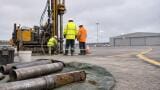
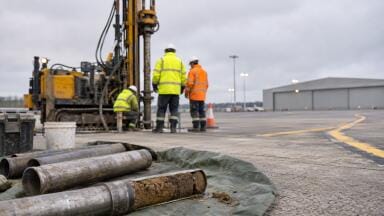
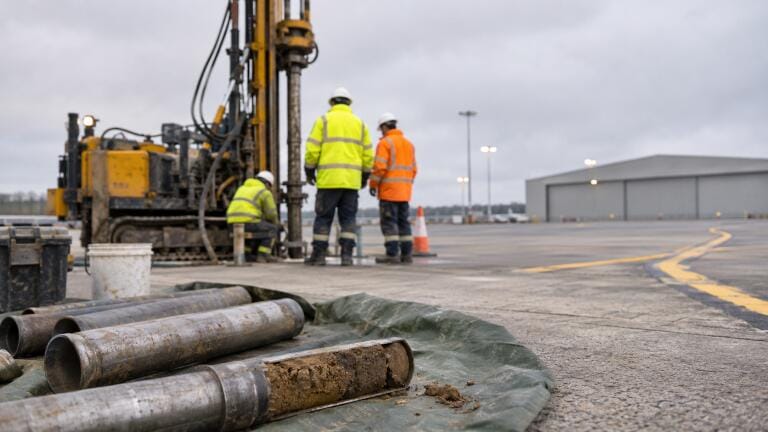
A soil boring drilled through a taxiway at Joint Base Andrews (JBA) on 13 November 2026 found liquid-phase hydrocarbon (LPH) 3.32 ft (around 1 m) thick in a temporary piezometer.
The finding is recorded in a Report of Observations filed by the Maryland Department of the Environment (MDE) and signed on 17 November.
The base’s fuel hydrant system has been under investigation since fuel odours and a sheen were found on Piscataway Creek on 23 March 2026.
The MDE report records that the borings were drilled to 15–20 ft below ground surface.
In the most heavily affected boring, impacts ran from 3 ft to 15 ft.
The peak photoionisation detector (PID) reading was 908, at around 8–9 ft, with LPH in the rod and core between 10 ft and 15 ft.
The piezometer installed there reached LPH at 5.13 ft and water at 8.45 ft.
A second boring at the edge of the taxiway also showed LPH between 10 ft and 15 ft.
A third showed petroleum impacts but no LPH, so no piezometer was installed. A fourth showed no PID response.
Soil samples are being analysed for volatile organic compounds (VOCs), including fuel oxygenates and naphthalene, by EPA Method 8260.
They are also being analysed for diesel- and gasoline-range total petroleum hydrocarbons (TPH-DRO and TPH-GRO) by EPA Method 8015.
The published report redacts the name of the piping row and the boring identifiers.
The Air Force has identified the line as Lateral Row 7, according to Inside Climate News. It has said that confirming the point of failure will require excavating or directly inspecting the pipe.
The deadlines come from a letter from MDE Secretary Serena McIlwain that set actions at 15, 30 and 60 days.
The 30-day items, due by 27 November, included completing the supplemental subsurface investigation.
If it found no fuel contamination, the base was to submit an alternative plan for identifying the source of petroleum in the creek within seven days.
The base was also to correct its fuel inventory records, including book inventory, daily and cumulative gain/loss and monthly leak check documentation, and report all reportable inventory losses to MDE.
The same deadline covered outstanding corrosion protection testing on all sections of a system whose name is redacted.
It also covered a revised investigation and remediation schedule with milestones and completion dates, including options for repairing or properly abandoning other potential contamination sources.
By 27 December, the base must complete outstanding corrosion protection repairs and submit an updated conceptual site model.
The model must include all monitoring and investigation data and evaluate the storm drain system as a possible migration pathway for petroleum.
“I need to see measurable progress, clear accountability, and a firm schedule for completing the outstanding work,” McIlwain wrote.
She added that if the deadlines were not met, she would consult the state’s Office of the Attorney General to decide on next steps.
As of 27 November, the day after the US Thanksgiving holiday, MDE’s Joint Base Andrews page listed no submission from the base against these deadlines.
The most recent documents posted were the 17 November report on hydrant loop testing and tabulated surface water results dated 23 November.
The base’s most recent public update, posted on 19 November, did not address the 27 November items.
Pressure testing of the west-side hydrant loop ran from 9 November to 13 November under MDE observation. The base said the two sides agreed to move the original 12 November completion date by a day.
According to Inside Climate News, MDE’s report on the testing states that no leaks were found.
The same report says the test excluded Lateral Row 7, which was already isolated from the system, and the above-ground piping inside the pump house.
MDE set the test criteria in a separate letter dated 29 October. Each pressure step was to be monitored for at least 15 minutes after stabilisation.
At the final test pressure, two separate monitoring periods of at least 15 minutes were required, followed by a test at reduced pressure.
Any visible weep, seep or drip would count as a failure.
Test records, including equipment details, technician credentials, raw and calculated data and field notes, are due within 15 calendar days of completing tightness testing.
MDE’s tabulated results for two on-base surface water locations cover April to 4 November 2026.
They list TPH-DRO results above the 47 ppb action level throughout that period. TPH-GRO and several VOCs, including naphthalene, xylenes and trimethylbenzenes, are above action levels on some dates.
The table also reports per- and polyfluoroalkyl substances (PFAS) but lists no action levels for them.
The volume lost remains disputed. According to MDE’s timeline, as reported by Inside Climate News, the base told the state on 8 April that 22,000 gallons (around 83,000 litres) had been released to the environment.
That figure sits within around 32,000 gallons of total system loss.
The base says the remaining 10,000 gallons reflected temperature-related fluctuations in January and February and a faulty valve, and did not leave the fuel system.
The case brings together three checks that airfield and terminal operators rely on to find buried leaks: inventory reconciliation, precision tightness testing and corrosion protection testing.
MDE’s deadlines require all three to be brought up to date. The 27 December conceptual site model must also test whether storm drains carried fuel from the airfield to the creek.
The base has said its next step is to pump out the fuel and drill further to map its extent, once contracts are in place. No start date has been given.
PIN 27.5 Oct/Nov 26



 Product directory