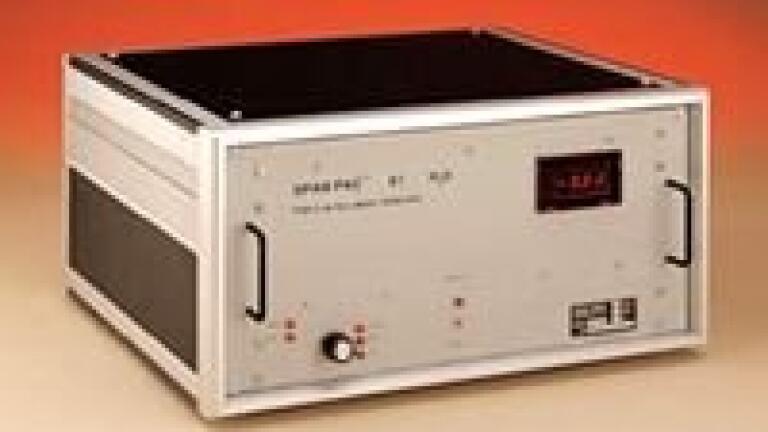
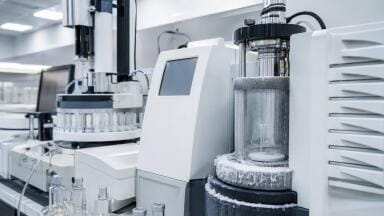
Kin-Tek`s (USA) Span Pacâ„¢ H2O-R Moisture Pat. Pending Standards Generators create known calibration standards of trace moisture
in reactive gases such as chlorine and HCL. These systems use Trace Sourceâ„¢ permeation tubes to dynamically add a known amount of water vapour to a flow of dried reactive matrix gas. Concentrations from below 10ppb to over 100ppm are possible by selecting suitable permeation tubes. At any concentration level, multipoint calibrations over a 400:1 range are easily achieved.
The Span Pacâ„¢ H2O-R method is based on the standard additions technique.
A small flow of dry inert gas flows over the Trace Sourceâ„¢ permeation tube to create a base moisture standard. A variable portion of the base mixture is added to a flow of the reactive gas to form the calibration standard.
Calibration is based on the change in concentration due to addition of
moisture from the Trace Sourceâ„¢ permeation tube. This method compensates for residual moisture in the dry matrix gas. Mixture concentrations are traceable to NIST through physical standards. Applications include on site moisture monitor calibration and production of controlled atmosphere for catalysis studies, corrosion rate studies and filter capacity tests.


 Product directory


.jpg)












.jpg)




.jpg)