Lubricant analysis
Published over 16 years ago. See the latest and most current information on Lubricant analysis.
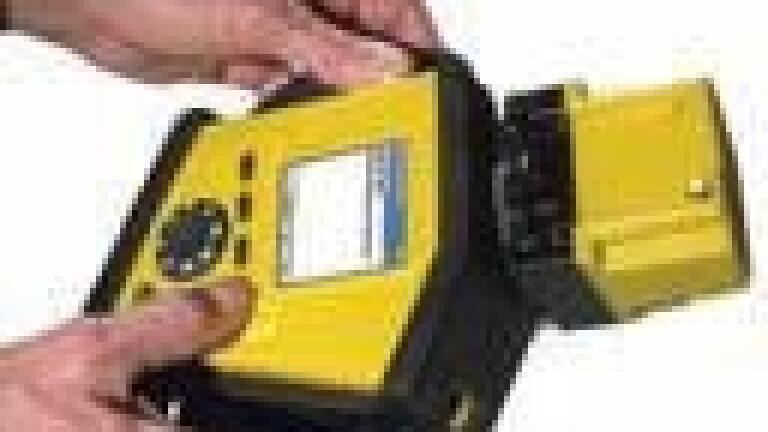
The handheld FluidScan from Spectro (Germany) can achieve laboratory-quality lubricant condition results at the point of sampling, and in seconds, eliminating the potentially costly delays that can arise from laboratory
testing. All of Spectro’s many years of experience in this field are packed into this small (only 4 lbs or 1,8 Kg), hand-held infra-red spectrometer that can determine key lubricant condition parameters like TBN, TBN, contamination, additive depletion and many others. It is also suitable for the analysis of a wide range of other materials from biodiesel to greases.
The flip-top sample cell (patent pending) not only accommodates all these different sample types with ease, but its unique optical design eliminates the fringing effects found with conventional cells. Sample spectra are compared with an extensive library of spectra from a huge database of commonly used lubricants, and chemometric techniques are used to automatically correct for interferences, giving improved quantitative accuracy.
Results are displayed on the same integral colour screen that provides the intuitive user interface for the FluidScan, and a built in lithium battery gives 6 to 8 hours use dependent upon conditions.
PIN 27.5 Oct/Nov 26



 Product directory


.jpg)















.jpg)