Gas detector
Published over 12 years ago. See the latest and most current information on Gas detector.
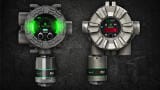
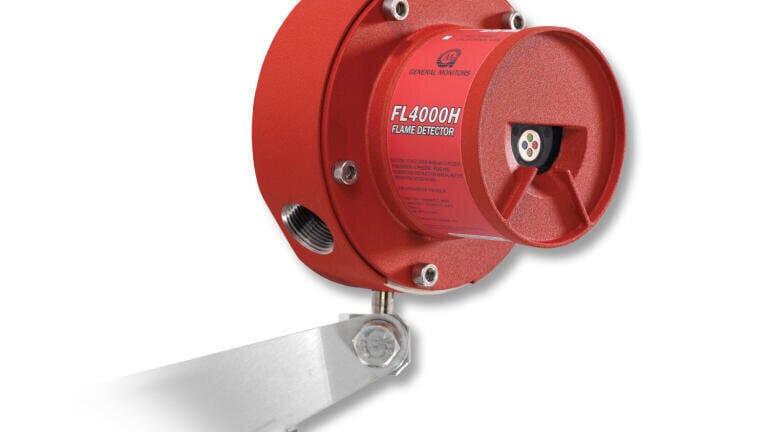
The Multi-Spectrum Infrared (MSIR) FL4000H Flame Detector from General Monitors (USA), with its next-generation MSIR sensor incorporating neural network technology (NNT), provides reliable flame monitoring with superior false alarm immunity, a wide field of view (FOV), and one of the industry’s longest detection ranges.
Designed with an exceptionally reliable NNT flame discrimination algorithm, the FL4000H detector is highly immune to false alarms while at the same time offering extended range (up to 230 feet) and wide field-of-view (FOV) characteristics (100° at 50 feet). For example, the FL4000H MSIR flame detector provides false alarm immunity to arc welding as close as 5-15 feet. Other features include built-in COPM (Continuous Optical Path Monitoring), a self-testing feature designed to check the optical path integrity of the detector elements and the related electronic circuitry once every two minutes. Serial ports allow up to 128 units (247 using repeaters) to be linked up to a host computer using either HART or Modbus.
The advanced FL4000H combines an MSIR sensor array with NNT processing. The flame detector’s detection algorithm is based on artificial neural networks (ANN), which are mathematical models that correlate certain patterns of infrared and visible radiation with the incidence of flame. The optical IR sensor array and the neural network function together as an adaptive and intuitive decision-making mechanism, resulting in one of the industry’s most reliable schemes for discrimination between actual flames and costly false alarm sources.
The MSIR sensor array in the FL4000H allows the detector to sample different IR spectral areas to detect a flame. Each sensor’s analog signal is sampled and then converted into digital format for initial signal pre-processing to extract time and frequency information. The time and frequency information are used by the FL4000H’s proprietary neural network classification algorithm to identify if input IR signals are emitted from a flame or non-flame source. The flame or non-flame decision is then reported as an output via LEDs, relays, HART and/or Modbus.
With its accurate and reliable flame detection, the FL4000H sets a high standard for performance, reliability, safety, and value for protecting people, equipment, and facilities from dangerous hydrocarbon flame sources. It features a wide range of global approvals including ATEX, CSA, FM, IECEx, Inmetro, BV, CE, EN 54-10, ULC, VNIIPO, and is FM certified as SIL 3 suitable.
PIN 27.4 Aug/Sept 2026




 Product directory