Analytical instrumentation
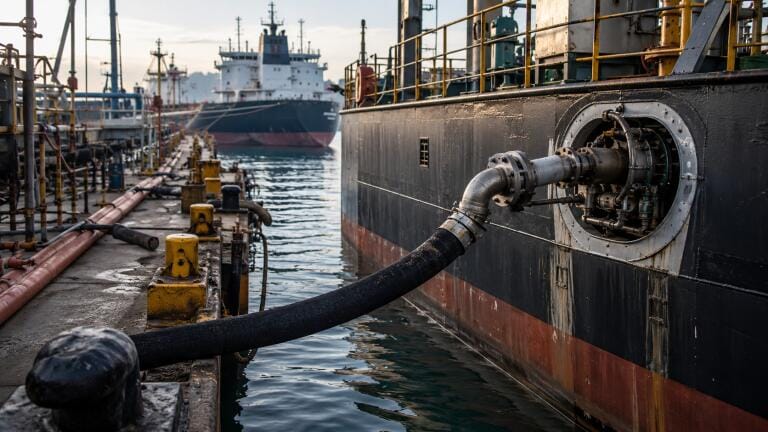
Bunker fuel testing and marine surveying firm Maritec‑Naias issued an alert on 12 August after testing eight samples taken from vessels that bunkered in Indonesia between 21 July and 4 August 2026.
The samples, representing Low Sulphur Marine Distillate Oil (LSMDO) and B40 biofuel blend deliveries, recorded flashpoints as low as 39.5°C.
All eight came from a single supplier. SOLAS and ISO 8217 set a minimum flashpoint of 60°C for fuel carried in a ship's tanks; every sample fell short, some by more than 20°C.
Flashpoint is not a routine bunker-delivery-note figure the way sulphur content is.
MARPOL Annex VI requires the bunker delivery note to state the actual flashpoint or confirm it is at least 70°C, and from January 2026 SOLAS amendments additionally require suppliers to sign a declaration confirming the fuel meets the applicable flashpoint requirement before bunkering proceeds.
In principle, the paperwork should have caught this before the fuel was loaded. In practice, it did not; the fuel was only shown to be non-compliant after Maritec-Naias's own testing programme picked it up, independently of any port-state or flag-state control action.
That gap is the substance of the story.
A flashpoint below the SOLAS minimum is not a marginal quality defect: it raises the risk of vapour ignition in tank spaces, particularly around vents and other potential ignition sources, and is treated by surveyors as a direct safety issue rather than a commercial one.
Maritec-Naias's advisory recommended that vessels carrying suspect fuel maintain flame screens on tank vents in good condition, eliminate ignition sources in the vicinity of vents, and notify both the supplier and the vessel's P&I club.
For a vessel already at sea, the practical options are limited to seeking a flag-state dispensation until the next port, since the fuel cannot simply be exchanged mid-voyage.
The repeated sourcing from one supplier is the detail that turns this from an isolated bad batch into a verification-gap story.
Eight separate deliveries from the same origin over a two-week window suggests either a systemic issue at the supply point – blending practice, storage conditions or a batch that was never properly tested before it reached the barge – or a supplier continuing to ship known non-compliant fuel because the declaration and delivery-note system was not independently checked against it.
Both readings point to the same underlying weakness: declarations and paperwork are only as reliable as the testing regime backing them up, and in this case, that testing came from a third-party surveyor rather than from any regulatory checkpoint.
This is not the first time Indonesian bunkering has produced a low-flashpoint alert. Maritec's predecessor entity flagged flashpoints as low as 35°C from four different suppliers in December 2023, and a further alert in October 2023 recorded flashpoints as low as 41°C from mostly a single supplier.
The recurrence across separate incidents, spanning different suppliers and testing periods, suggests the issue is not confined to one bad actor but reflects a more persistent quality-control weakness in parts of the Indonesian bunkering market.
For buyers, the practical takeaway is straightforward, if unwelcome: a compliant bunker delivery note and supplier declaration are not, on their own, sufficient assurance.
Maritec-Naias's advice is to request actual flashpoint values from the supplier directly, rather than relying on a compliance statement alone.
For an operational risk this specific – vapour ignition risk in an enclosed tank space – independent verification is the only check that has actually caught the problem, in this case and in the ones before it.
PIN 27.4 Aug/Sept 2026



 Product directory

















.jpg)