Analytical instrumentation
Published over 10 years ago. See the latest and most current information on Analytical instrumentation.
D445: The method for calculating kinematic viscosity dates from the 19th century and was first standardized with ASTM as D445 in 1965. It is based on the measurement of time for a fixed volume of liquid to flow through the capillary of a calibrated viscometer under gravity and at a closely controlled and known temperature.[1] The kinematic viscosity is then calculated as the product of the measured flow time and the calibration constant of the viscometer.
The method relies on gravity. However, when handling liquids one can rarely rely only on gravity – for example pumpability. Here, the right parameter for the liquid’s behavior is in fact dynamic viscosity.
Comparison to Manual or Automated D445: D445 provides the following statement on the precision of automated D445: ‘The precision for automated instruments is no worse than that for the manual instruments.’ There is no statement in D445 on accuracy (not precision, see below) of automated instruments compared to manual D445.
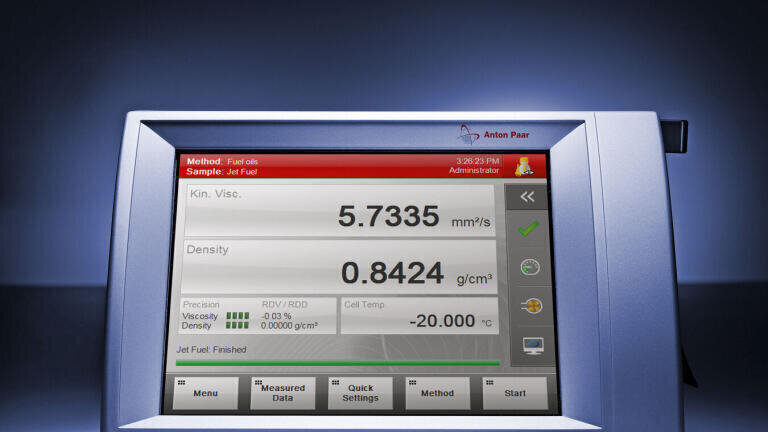
D7042+D4052 in one fast measurement: Stabinger Viscometer™ employs a much newer measuring principle with interconnected viscosity and density cells that revolutionized viscosity measurement, first standardized with ASTM in D7042-04. SVM™ 3001 simultaneously measures dynamic viscosity and the digital density of the sample and calculates kinematic viscosity by dividing dynamic viscosity by density. What is the potential ‘error’ that could come from density when calculating kinematic viscosity? It is negligible, since D4052 states 0.0005 g/ml which corresponds to an approximate kinematic viscosity error of 0.05%.
In fact, one measurement of SVM™ 3001 delivers more parameters than any other kinematic viscometer:
Accuracy: True value is often not exactly known and is most commonly an agreement on an accepted reference value[2]. Bias to true value has not been determined for either D445 or D7042.
The viscosity precision, which is comprised of the repeatability and reproducibility of the measurements, is given for different classes of compounds such as base oils, formulated oils, diesel, jet fuel etc. For every single round robin test where D445 and D7042 were tested on the same sample set, both repeatability and reproducibility of D7042 were better than those of D445[3].
Contact us if you have any further questions in this regard.
Expect more: SVM™ 3001. Welcome to new viscometry.
-------------------------------------------------------------------------------------------------------------------------------------------------------
[1] ASTM D445-15
[2] ISO 5725: Accuracy (trueness and precision) of measurement methods and results
[3] Supporting data have been filed at ASTM International Headquarters and may be obtained by requesting Research Report RR: D02-1555/1742/1750/1776/.
PIN 27.4 Aug/Sept 2026


 Product directory


.jpg)










.jpg)

.jpg)

.jpg)
.jpg)