Safety
Published over 11 years ago. See the latest and most current information on Safety.
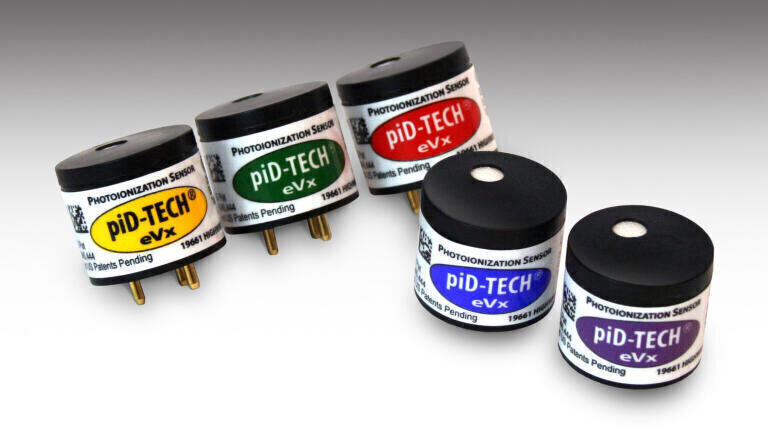
Baseline, a MOCON company (USA), introduces the piD-TECH eVx, a new line of OEM Photoionization Detectors. In an effort to continue to improve our products and bring value to our customers, Baseline has developed a new version of the piD-TECH Photoionisation Sensor. The new version is the piD-TECH eVx.
The eVx has improvements in both performance and price. Key improvements are; greater stability over temperature changes, minimal humidity effects, internal shielding and an internally regulated supply voltage able to accept input voltages from 3.2V to 5.5V.
The piD-TECH eVx detection capabilities and minimum detection quantity (MDQ) are denoted by colour: Green: Range 10,000 ppm - MDQ 1,000 ppb, Purple: Range 2,000 ppm - MDQ 500 ppb, Red: Range 200ppm - MDQ 50 ppb, Yellow: Range 20 ppm - MDQ 5 ppb, Blue: Range of 2 ppm - MDQ 0.5 ppb.
Baseline’s line of OEM detectors is designed with a 4P platform for design and installation ease in portable or stationary gas detection equipment.
Some common applications for the piD-TECH eVx sensor include safety monitoring, spills and low-concentration leak detection indoor air quality, industrial hygiene, confined space entry, soil contamination, remediation, and hazmat sites.
PIN 27.4 Aug/Sept 2026






 Product directory