Analytical instrumentation
Published over 7 years ago. See the latest and most current information on Analytical instrumentation.
This report describes the measurement of lead (Pb) in gasoline as per ASTM D5059 (Standard Test Methods for Lead in Gasoline by X-Ray Spectroscopy) using the Bi internal standard method Part C (ultra-low lead for MoGas, motor gasoline) and Part A (high Pb for AvGas, aviation gasoline).
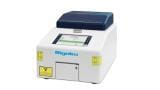
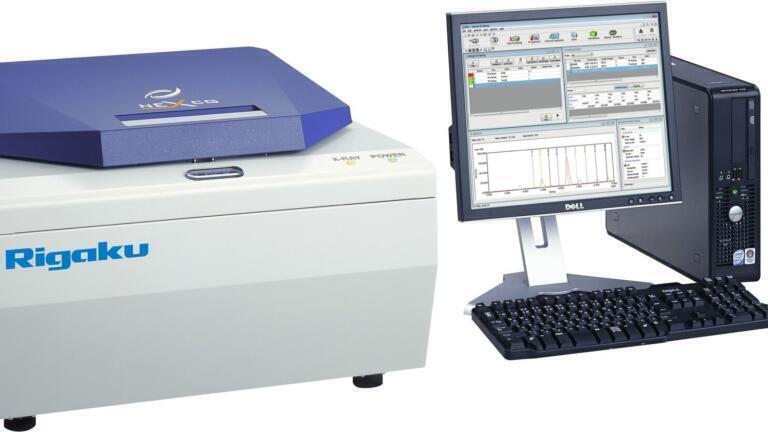
Tetraethyl lead (TEL) is an anti-knock agent added to gasoline, or petrol. Lead is a toxic metal that interferes with anti-pollution devices and contributes to lead poisoning. In the 1970s regions around the world began phasing out lead in motor gasoline, beginning in the United States and Europe. Lead is still used in AvGas for some piston engine propeller aircraft, however efforts are being made to lower and remove lead in this fuel as well. One of the main international standard test methods for the measurement of lead in gasoline is ASTM D5059 using X-ray Spectroscopy, XRF (X-ray Fluorescence). As efforts continue to reduce and remove lead from gasoline fuels around the world, Applied Rigaku Technologies offers the NEX CG Cartesian geometry EDXRF spectrometer using indirect excitation for the measurement of lead by ASTM D5059 as well as many other applications in the petroleum and fuel industries.
Model: Rigaku NEX CG
X-ray tube: 50 W Pd-anode
Detector: SDD
Sample Type: Gasoline (Petrol)
Film: Chemplex Etnom™ (3um)
Analysis Time: 300 sec
Environment: Air
Bi Internal Standard (0.793 g/l Bi in Mineral Oil)
Ensure each sample is homogeneous and stable. Shake sample gently and allow any bubbles to settle. Fill an XRF sample cup with 4.0g of sample. Chemplex Etnom™ film (3um) is used, which does not react with isooctane, gasoline or oxygenated gasoline. The sample cup lid is vented with a small hole to ensure vapor pressure does not build. It is recommended to make the measurement immediately after filling the cup.
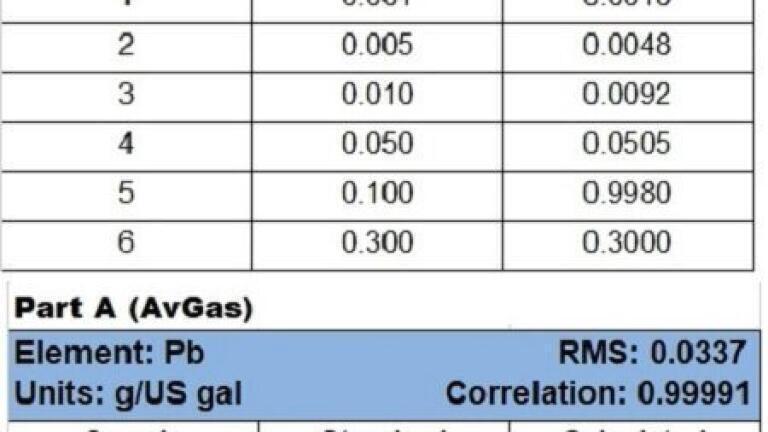
Empirical calibration was made using commercially available standards. The user spikes each standard and the blank with the Bi IS as described for Part C or A. Calibration is then g/US gal Pb vs. I, where I is the X-ray intensity expressed as (Pb net cps / Bi gross cps).
*See Table 1: ASTM D5059 Calibration
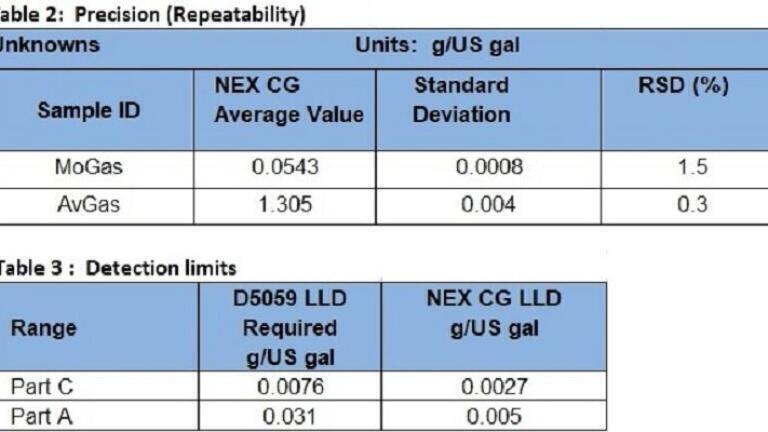
Unknown MoGas and Avgas samples were used to demonstrate precision. To minimize evaporation error each sample was measured 5x repeat measurements in static position using 300 sec measurement time per analysis.
Detection limits depend on the calibration concentration range and measurement time. The empirical method is used to determine detection limits using 300 sec measurement time. Ten repeat analyses of a blank isooctane sample with the IS addition are taken with the sample in static position and the standard deviation (σ) is determined. The Lower Limit of Detection (LLD) is then defined as three times the standard deviation (3σ). To minimize evaporation error 5 repeat measurements were taken for demonstration.
Standard Test Methods for Lead in Gasoline by X-Ray Spectroscopy
The test methods cover the determination of the total lead content of a gasoline within the following concentration ranges:
The results shown here indicate that the NEX CG analyser easily meets ASTM D5059 Parts A and C using the Bi internal standard method for the measurement of MoGas and Avgas samples. The Instrument is optimised for numerous other petroleum analysis applications
PIN 27.4 Aug/Sept 2026


 Product directory


.jpg)










.jpg)

.jpg)