Analytical instrumentation
Published over 11 years ago. See the latest and most current information on Analytical instrumentation.
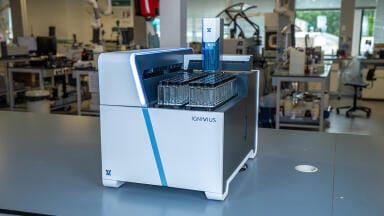
Analysing Intrinsic Viscosity of polymeric materials, can sometimes require temperatures up to 200ºC for
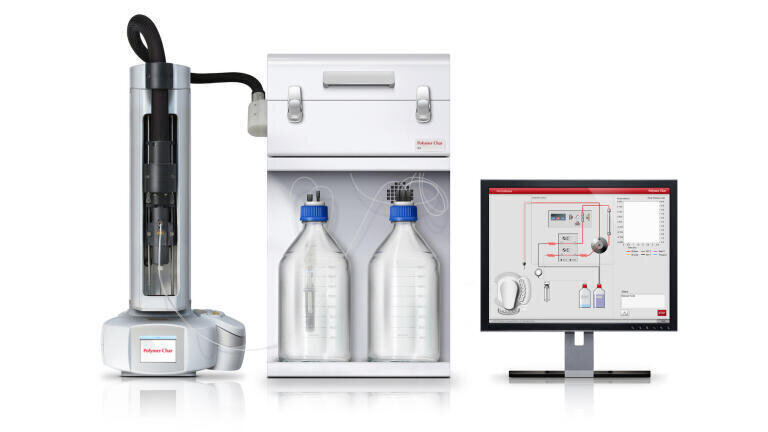
dissolution. This instrument, from Polymer Char (Spain), is a reliable and automated viscosity analyser that integrates in a reduced footprint, a robust dual-capillary relative viscometer combined with a high temperature
autosampler of demonstrated reliability in several applications. As an option, the infrared detector IR4 can also be added, so the analysis of polyolefins and other polymers with a significant C-H content is improved.
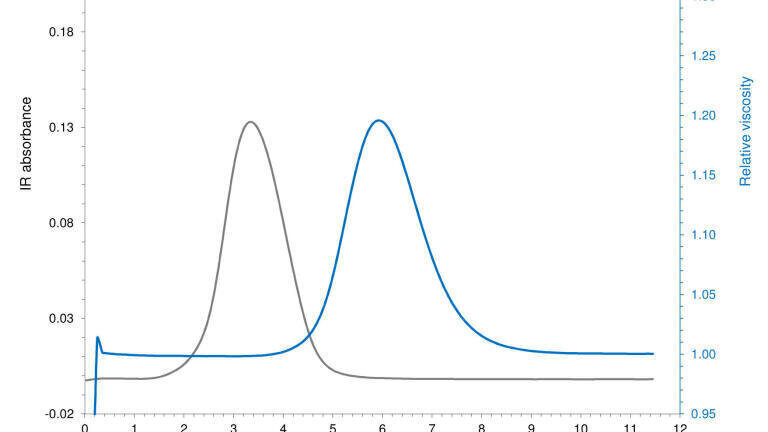
The principle of a relative viscometer is simple: the pressure drop across a stainless steel capillary tubing caused by the flow of polymer solution is compared to the one produced by the solvent, which is measured
simultaneously by a twin reference capillary. The relative viscosity of polymer solution is derived from the ratio of pressure, and intrinsic viscosity is calculated taking into account the injected mass.
Unlike the glass capillaries used in Ubbelohde viscometers, IVA has a self-cleaning design based on dual
capillary relative viscometer. The careful design of the heated compartment and transfer lines ensure that no
cold spots are found, thus, even the most challenging polymers can be analysed.
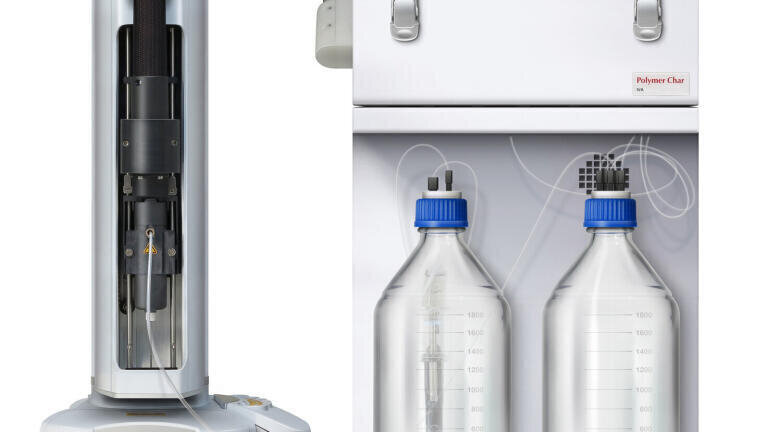
When using IVA, dissolution temperature, shaking intensity, and time are accurately controlled so that the
analyst can select the optimum conditions to achieve full dissolution while minimising thermal degradation.
Besides, up to 42 samples can be analysed sequentially without user intervention.
The IR4 quantifies accurately the injected polymer mass, which ultimately results in upgraded precision and
accuracy of viscosity results.
PIN 27.4 Aug/Sept 2026

 Product directory


.jpg)









.jpg)

.jpg)