Analytical instrumentation
Published over 13 years ago. See the latest and most current information on Analytical instrumentation.
Since 1980 the ASTM D3921 infrared method was the standard method for the determination of total petroleum hydrocarbon (TPH) concentrations in water. As the extraction solvent the ozone layer depleting chemical Freon 113 is used. In 1989 the phasing out of such chemicals was decided by the Montreal protocol to save the earth’s ozone layer. Therefore the infrared test methods using CFC solvents had to be replaced by time-consuming gravimetric methods (e.g. EPA 1664A) or complex gas chromatography (e.g. ISO 9377-2).
In February 2013 the outdated ASTM D3291 was finally withdrawn to account for its harmfulness for the environment. But with the new ASTM D7678, infrared spectroscopy undergoes a revival since it uses cheap, easily available and non-harmful solvents (Cyclohexane or Cyclopentane) for sample preparation.
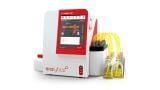
The success of this new ASTM D7678 standard is based on a new era of light sources for the mid-infrared spectral region: The Quantum Cascade Laser (QCL). ERACHECK a portable stand-alone analyser by eralytics (Austria) uses such a QCL in an innovative and patented measurement assembly. It detects TPH concentrations between 0.5 and 2000 ppm with an unmatched repeatability of <0.2 ppm correlating to ASTM D3921 and D7066. Offering latest communication technologies it can be fully integrated in a LIMS system, data can be saved to a USB flash drive or printed directly.
PIN 27.5 Oct/Nov 26

 Product directory