Measurement and testing
Published over 12 years ago. See the latest and most current information on Measurement and testing.
In the growing industrial areas a good water quality is important. Through the production of various products, there are a lot of different kinds of waste water, for example with high salt or high particle concentrations. To avoid pollution of river water and complications in cleaning process of waste water treatment systems, the waste water has to be analysed before. In order not to influence the balance of water and waste water cycle in a negative way, economic activities for industry and process waste water must be made. The parameter TOC (total organic carbon) is an essential sum parameter, that reflects the total organic pollution of water. The TOC is used for the monitoring, management and control of waste water. Using fast online determination helps to recognise contaminated waste water streams before they may cause further damage within processes.
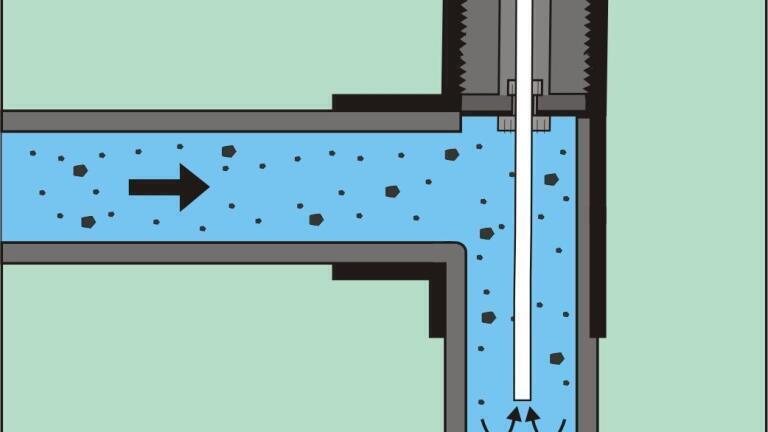
The sample extraction, its preperation and the measurement system itself are especially important to determine TOC in industrial and process waste water. They influence the validity and accuracy of the parameter. The German Institute for Standardisation (DIN) has not defined all details about sample extraction and its preparation, resulting in different methods that change the samples compostion so far that important carbons are excluded from the sample. Consequently, the TOC results are not significant enough. In order to determine all relevant components, it is important to take of the sample filtration-free, like LAR's FlowSampler system. Its operation is based on the principle of mass separation: Big and small solid particles flowing past the tube due to the flow speed. That enables to detect all important particles. Therefore, the taken sample corresponds to 98% to a grabbed sample. These results can't be reached by any kind of filter, filter sieve or rotating sieve. The FlowSampler allows easy transport even of strongly polluted waste water.
Two measuring principles have been primarily established for the TOC analysis of waste water - the “catalytic combustion” and the “high temperature combustion”. Both comprise the combustion of carbon compounds to carbon dioxide (CO2) by using high temperatures and a following detection of the produced CO2 by use of a NDIR detector. The applied combustion temperature constitutes the main difference. On account of this at temperatures of 680°C – 950°C catalysts are needed in the “catalytic combustion” because the power to oxidise all carbon compounds is not enough. Using significantly higher temperatures of 1200°C does not require catalysts. The temperature enables the complete oxidation of all carbon compounds. That saves time and money. Additional the following applies: The higher the temperature, the better the oxidation. LAR's QuickTOCultra use the ultra high temperature combustion method at 1200°C and have proven themselves successfully in practical use. Due to the high temperature salts are easily melted and moved through oven in fluid form and are carried out of the oven together with the condensate. Moreover, the innovative injection system enables the handling of samples with high particle density. Hence, the QuickTOCultra is best suited for complex waste water.
PIN 27.5 Oct/Nov 26

 Product directory


.jpg)






.jpg)



.jpg)