Measurement and testing
Published over 12 years ago. See the latest and most current information on Measurement and testing.
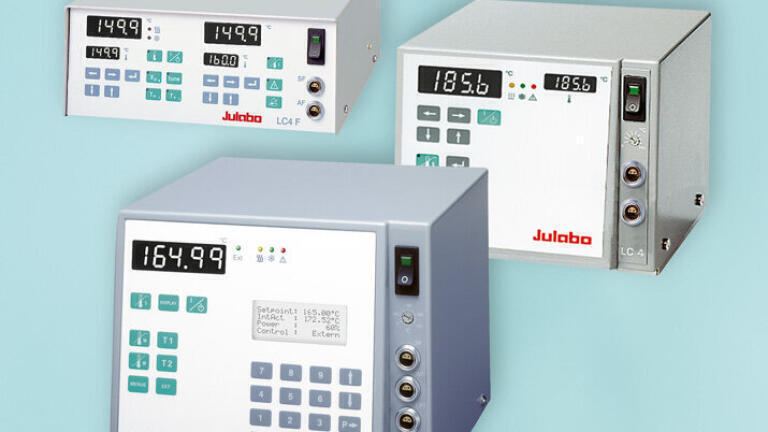
JULABO Laboratory temperature controllers perform a wide range of tasks in laboratories. They are perfect for the temperature control of heating mantles and heating collars. For example, they control the temperature of oil baths in combination with distillation or pilot plants. The can also control indirect tap water cooling with a solenoid valve.
JULABO temperature controllers are designed to measure, control and monitor. A display thatcan be viewed from a long distance, simple operation, highly precise and reliable control electronics and a wide range of accessories make day-to-day laboratory tasks easier.
The models LC4, LC4-F and LC6 offer a RS232 interface as well as high/low temperature warning and cut-off. In addition to analog inputs and outputs the model LC4-F features 4 LED displays for actual values and setpoints (separate displays for working and safety circuit) The model LC6 also permits the connection of two working sensors for different measuring point, e.g. for cascade temperature control. Furthermore, the LC6 features Stakai connection for cooling water control via solenoid valve and an integrated programmer for 6 x 60 program steps.
Further information on JULABO temperature controllers is available online.
PIN 27.5 Oct/Nov 26


 Product directory


.jpg)







.jpg)





.jpg)