Fuel for thought
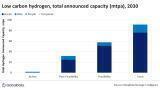
After years of limited momentum, the global low-carbon hydrogen market is entering a period of rapid expansion. According to GlobalData’s Low-Carbon Hydrogen Market Report, Update 2025, production rose to 0.84 million tonnes per annum (mtpa) in 2024, marking a notable inflection point for the sector.
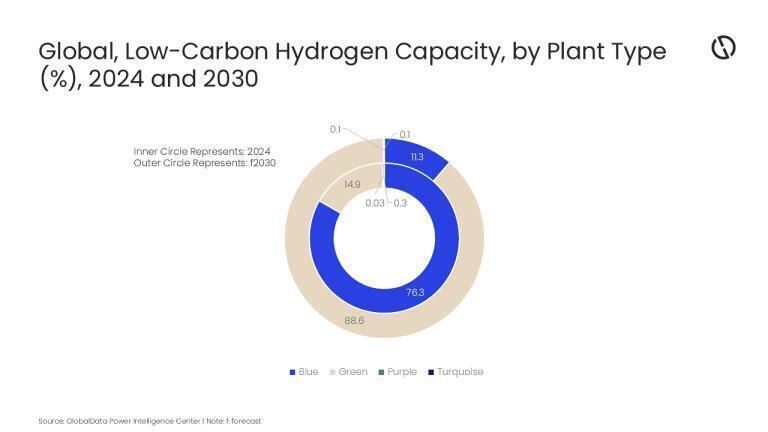
Global low-carbon hydrogen production capacity stood at 1.7mtpa in 2024 and is projected to scale dramatically by 2030 — reaching 65.3mtpa under a high-case scenario and 42mtpa under a low-case outlook. The expansion will be driven primarily by green hydrogen, which is expected to command 88.6% of total low-carbon hydrogen production by 2030.
In 2024, blue hydrogen dominated the mix with a 76.3% share. However, its contribution is forecast to fall sharply to 11.3% by the end of the decade as electrolyser-based green hydrogen capacity accelerates. Green hydrogen, which accounted for just 14.9% in 2024, is positioned to overtake all other production pathways. Purple and turquoise hydrogen are expected to remain marginal, each holding around 0.1% share by 2030.
Attaurrahman Ojindaram Saibasan, Power Analyst at GlobalData, highlights the Americas as a central growth engine.
“The hydrogen market in the Americas has grown significantly over the last few decades, supported by federal and state-level initiatives in the US, strong national backing in Canada, and emerging policy frameworks in Mexico,” he notes. “The region is now one of the most dynamic hydrogen markets globally.”
The US has taken a long-term, policy-led approach to hydrogen development. Early foundations were laid under the Energy Policy Act of 2005, which introduced tax credits and loan guarantees for hydrogen production and infrastructure. This was reinforced by the American Recovery and Reinvestment Act of 2009, which directed funding toward hydrogen and fuel cell R&D.
Momentum accelerated with the Infrastructure Investment and Jobs Act in 2021, significantly boosting funding for clean hydrogen production, infrastructure and research. The Inflation Reduction Act of 2022 further strengthened the business case through generous tax credits for clean hydrogen production and utilisation. In parallel, the US government launched the National Clean Hydrogen Strategy and Roadmap to articulate a national vision for hydrogen deployment.
Hydrogen is expected to play a pivotal role in decarbonising hard-to-abate sectors, including heavy industry and long-haul transport. At state level, California, New York and Massachusetts are leading deployment, with California investing heavily in hydrogen fuel cell vehicles and refuelling infrastructure.
Canada has similarly positioned hydrogen as a pillar of its energy transition. The Hydrogen Strategy for Canada outlines a roadmap for large-scale clean hydrogen production, infrastructure development and export growth, targeting demand centres in Europe and Asia.
Federal commitments, including substantial allocations in Budget 2023, have reinforced investment signals. Provincial leadership is also critical: British Columbia leverages abundant renewables, Quebec draws on hydroelectric capacity, and Ontario integrates hydrogen into its industrial base. This decentralised yet aligned approach enables region-specific deployment while supporting national ambitions.
Mexico remains in the early stages of hydrogen policy development but is evaluating how its renewable resources and geographic position could support competitive production and export markets, particularly as global demand for green hydrogen rises.
While the outlook points to exponential capacity growth, execution risks remain. The industry must scale projects rapidly to reduce production costs, displace high-carbon hydrogen in existing applications such as refining and ammonia, and unlock new demand in steel, chemicals, shipping and heavy transport.
If project pipelines materialise as anticipated, green hydrogen’s projected 88.6% share by 2030 would mark a structural shift in the low-carbon hydrogen landscape — and redefine competitive dynamics across global energy markets.
PIN 27.4 Aug/Sept 2026


 Product directory























.jpg)