Analytical instrumentation
Oxidation stability is a critical property that directly affects the quality, storage life, and performance of diesel and spark-ignition fuels. While the compounds most susceptible to oxidation vary among fuel types, the effects are largely the same: Increasing acidity can promote rust and corrosion, and polymeric byproducts can thicken the fuel or form insoluble deposits, disrupting viscosity control and contributing to the blockage of filters and fuel injection nozzles.
The Rapid Small Scale Oxidation Test (RSSOT) determines the induction period (IP) of diesel fuels from B0 to B100 and spark-ignition fuels, providing an indication of their oxidation and storage stability. Compared with traditional methods, RSSOT delivers significantly shorter testing times. For diesel fuels, test duration is reduced to 60 minutes, making the method up to 20 times faster than EN 15751 for fuels covered by EN 590 (B0–B7), EN 16734 (B10), and EN 16709 (B20–B30). For gasoline, ASTM D4814 now recognises RSSOT as an alternative to ASTM D525, reducing the required test time from 240 minutes to 31 minutes – nearly eight times faster.
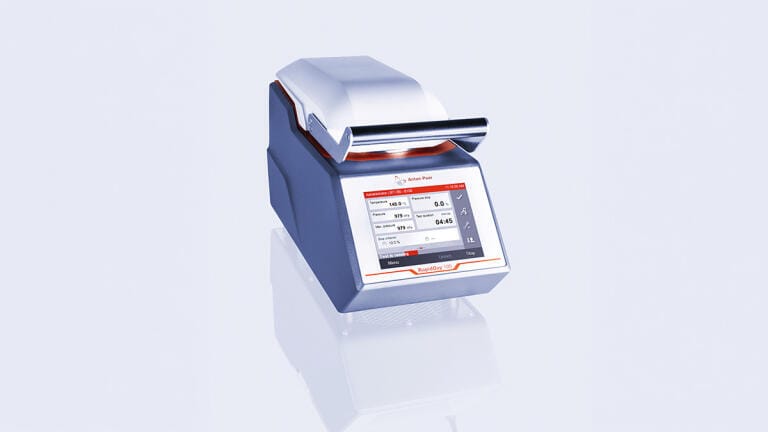
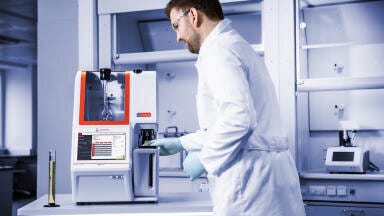
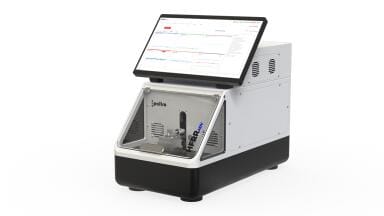
Anton Paar’s RapidOxy 100 Fuel is the only oxidation stability testing instrument that performs RSSOT in full compliance with EN 16091, ASTM D7545, and ASTM D7525. Suitable for all fuel types, regardless of feedstock or the presence of ethanol or other oxygenated blending components in gasoline, it reduces operator effort to less than five minutes per test through simple setup, automated analysis, and quick wipe-clean maintenance. With minimal sample consumption and built-in overpressure and overtemperature protection, it delivers reliable, reproducible results while helping fuel laboratories perform oxidation stability testing safely, efficiently, and accurately.
In accordance with EN 16091, ASTM D7545, and ASTM D7525, only 5 mL of sample is required for each test. The sample is placed in the test chamber, and the appropriate preconfigured method – either “B0–B100” or “Gasoline” – is selected. From this point onward, the analysis proceeds fully automatically.
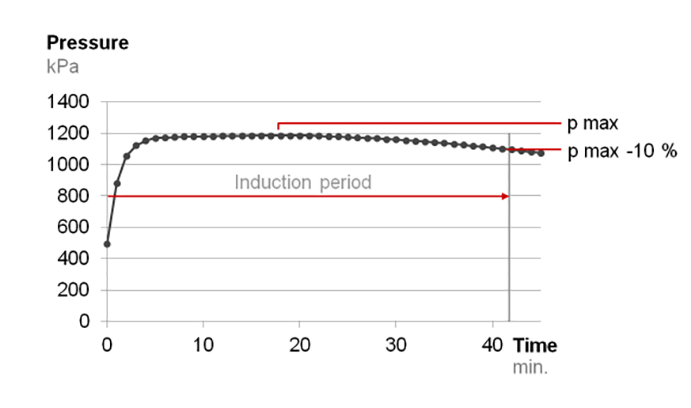
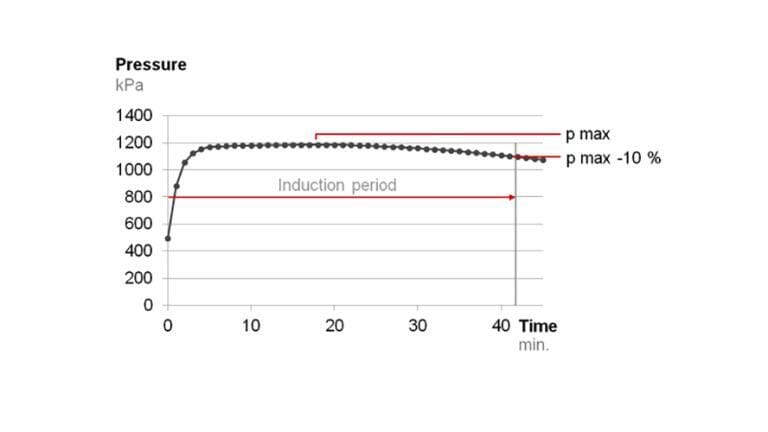
Figure 1: RSSOT (ASTM D7525) induction period – time elapsed between starting the heating procedure of the sample pressure vessel and a pressure drop of 10 % from p-max.
The sealed test chamber is automatically pressurised with oxygen to 700 kPa for diesel fuels or 500 kPa for gasoline and then heated to 140 °C. The test ends when the break point is reached, defined as a 10 % pressure drop from the maximum pressure (Figure 1). The induction period corresponds to the time elapsed between the start of heating and the break point (Figure 1). Interpretation is straightforward: The longer the induction period, the greater the resistance to oxidation and the better the storage stability.
PIN 27.4 Aug/Sept 2026



 Product directory



.jpg)











.jpg)
.jpg)

.jpg)