Measurement and testing
They measure everything from BTU content and product purity to VOC emissions and process safety parameters.
But as more facilities introduce hydrogen blends into their processes, many GC systems are being pushed beyond their original design assumptions.
Hydrogen changes how gases behave and that has direct implications for effective chromatography.
So, is your GC ready for this transition?
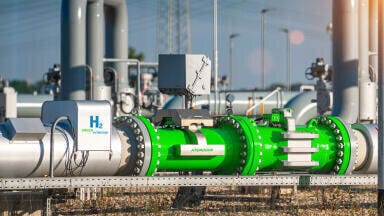
Driven by decarbonisation targets and tightening methane emissions regulations, operators are increasingly blending hydrogen with natural gas.
This is happening in process heaters to reduce CO₂ intensity, in fuel gas networks across refineries and chemical plants, as well as in pilot trials for hydrogen-ready furnaces and turbines.
In most cases, H₂ is being injected at 10–30% by volume but even small additions change the physical properties of gas mixtures.
Changes to density and diffusivity have ripple effects across GC performance.
Some GCs use hydrogen as a carrier gas for faster separations.
But when hydrogen is already present in the sample matrix, it can interfere with flame ionisation detectors (FID) and thermal conductivity detectors (TCD),
In hydrogen-rich samples, FID baselines may rise and TCD sensitivity may shift.
Operators may need to switch to helium or nitrogen carrier gases, recalibrate flame settings or re-optimise detector configuration.
Capillary columns designed for hydrocarbon separations may struggle with high-hydrogen samples.
Faster gas velocities and altered elution profiles can compress peaks or create coelution artifacts, especially in complex blends.
This may require longer columns to restore resolution, lower oven temperatures to slow down peak emergence and alternative stationary phases tailored for light gas separation
Hydrogen’s low molecular weight and high diffusivity mean that leaks from sample lines or conditioning systems are more likely — and more dangerous.
Many legacy GC sample systems were not built with hydrogen service in mind.
Risk factors include permeation through tubing (especially PTFE or silicone lines), dead volumes and venting issues in valves or regulators as well as undetected leaks in heated enclosures, creating fire hazards.
Facilities may need to upgrade to 316L stainless steel, implement hydrogen-rated pressure regulators, and enhance ATEX/IECEx compliance in GC shelters.
Hydrogen’s presence complicates GC calibration in several ways.
Firstly, standard gas blends may need to be re-specified to match new process compositions.
Response factors for other gases (e.g. methane, ethane, CO) may shift in hydrogen matrices.
Retention times may change, requiring new peak identification and software templates.
In some plants, the switch to hydrogen blending has triggered unexpected misreads.
For example, operators have encountered incorrect BTU or Wobbe index calculations and overestimation of methane content.
To adapt your GCs for hydrogen-rich operation, you have a few options.
Consider using models to predict separation impacts, engaging vendors to optimise for lighter gas, retrofit systems to use helium or nitrogen safely, pair GCs with TDLAS or mass spec for cross checking.
Where budgets allow, some operators are segmenting GC applications, using one GC for H₂-rich streams and another for traditional hydrocarbons, to preserve accuracy and avoid trade-offs.
As hydrogen blending becomes more widespread, process gas chromatographs will need retuning to be effective.
Facilities that treat their analysers as static assets risk generating data that’s no longer valid.
In a hydrogen-enhanced world, even your most trusted instruments may need a recalibration of their own.
PIN 27.4 Aug/Sept 2026


 Product directory














.jpg)





.jpg)