Fuel for thought
Published over 12 years ago. See the latest and most current information on Fuel for thought.
A new chemical cleaning process that can maintain the efficiency and extend the working life of heat exchangers by several years is now available to oil and gas industry customers from chemical cleaning specialists Surface Processing Ltd (SPL) (UK).
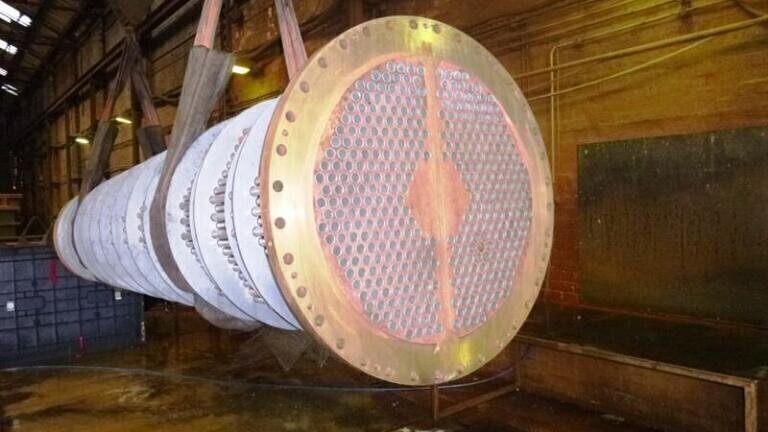
Heat exchangers of various types are used in the oil and gas sector for both heating and cooling applications. In this sector, heat exchangers are used in harsh environments and are prone to fouling, namely, the accumulation of organic and/or non-organic material deposits within heat transfer equipment (commonly on the cooling water side where in some cases sea water is used), inside tubes and on external surfaces. This causes blockages, corrosion or leaks, which affects flow and pressure levels and ultimately impairs heat transfer.
“Fouling inevitably leads to a reduction in the efficiency of the heat exchanger, increasing energy consumption and operational costs, adding to wear and tear, and reducing its working life if not cleaned at regular intervals,” says Adrian McMurray, managing director of SPL, the UK’s largest chemical cleaning company. “These are sited in difficult locations, often at the centre of complex plants, making minimal downtime essential.”
“Our new chemical-based process for cleaning heat exchangers can save customers time and money compared to traditional mechanical cleaning methods. First and foremost, it can maintain the efficiency which ultimately lowers operating costs.”
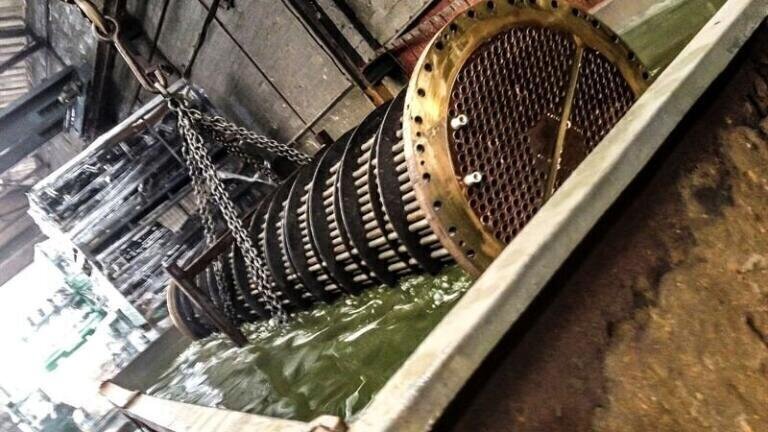
Unlike traditional jetting methods, SPL’s immersive process offers consistent cleaning power on both inner and outer surfaces. “Once a jet of water reaches a bend its pressure and effectiveness weakens,” adds McMurray. “We offer better penetration to remove unwanted material including rust, hydrocarbons, scale, oils, acids, and other organic and inorganic matter. With no need to dismantle and then reassemble the individual components of a heat exchanger, SPL claims its process results in less downtime and unlike blasting, there is no mess left behind, saving on clean-up costs.
SPL can treat small heat exchangers at its Dudley facility using its proven fully immersive process. Equipment too large to be moved or dipped in tanks can be treated on-site by a team of technicians who can achieve effective results through immersion by pumping SPL’s cleaning products through the entire system. Using the latter method, the company has successfully cleaned a 13-metre long heat exchanger weighing 34 tonnes.
SPL’s cleaning fluids are safe to use on a variety of materials including brass, copper, iron, steel, stainless steel and aluminium, making them ideal for treating heat exchangers. “Heat exchangers can be designed to minimise fouling, but it can never be entirely eliminated and periodic cleaning as part of a preventative maintenance programme will always be necessary to ensure optimum efficiency and costs,” adds McMurray.
“Whether treated at our facility or at the customer’s premises, our chemical cleaning process will ensure that equipment is returned to optimum operating performance in the minimum amount of time possible.”
Since 1994, SPL has been delivering high-quality and reliable tooling and component cleaning to all areas of industry with a growing interest from the energy sector in recent years.
PIN 27.4 Aug/Sept 2026



 Product directory


.jpg)