Fuel for thought
Published over 15 years ago. See the latest and most current information on Fuel for thought.
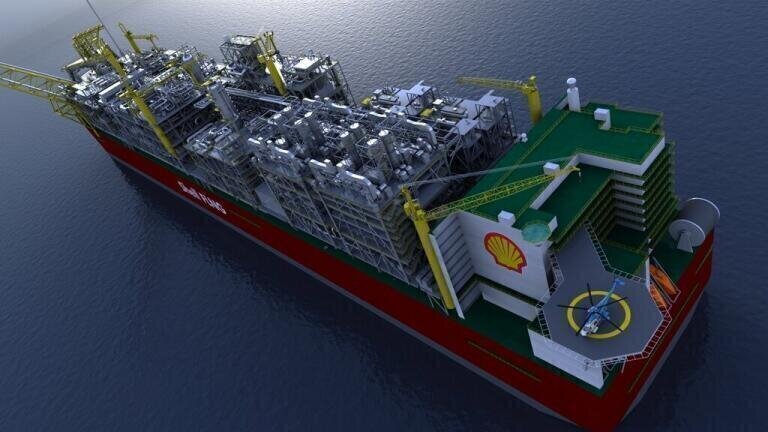
The Board of Shell (Netherlands) has taken the final investment decision on the Prelude Floating Liquefied Natural Gas (FLNG) Project in Australia (100% Shell), building the world‘s first FLNG facility. Moored far out to sea, some 200 kilometres from the nearest land in Australia, the FLNG facility will produce gas from offshore fields, and liquefy it onboard by cooling.
The decision means that Shell is now ready to start detailed design and construction of what will be the world‘s largest floating offshore facility, in a ship yard in South Korea.
From bow to stern, Shell‘s FLNG facility will be 488 metres long, and will be the largest floating offshore facility in the world – longer than four soccer fields laid end to end. When fully equipped and with its storage tanks full, it will weigh around 600,000 tonnes – roughly six times as much as the largest aircraft carrier. Some 260,000 tonnes of that weight will consist of steel—around five times more than was used to build the Sydney Harbour Bridge.
“Our innovative FLNG technology will allow us to develop offshore gas fields that otherwise would be too costly to develop,” said Malcolm Brinded, Shell‘s Executive Director, Upstream International. “Our decision to go ahead with this project is a true breakthrough for the LNG industry, giving it a significant boost to help meet the world‘s growing demand for the cleanest-burning fossil fuel.”
Brinded continued “FLNG technology is an exciting innovation, complementary to onshore LNG, which can help accelerate the development of gas resources.”
The facility has been designed to withstand the severest cyclone - those of Category 5. Ocean-going LNG carriers will offload liquefied gas, chilled to minus162 Celsius and shrunk in volume by 600 times, and other products, directly from the facility out at sea for delivery to markets worldwide. Until now, the liquefaction of offshore gas has always involved piping the gas to a land-based plant.
Shell has progressed the Prelude FLNG project at a rapid pace, with first production of LNG expected some ten years after the gas was discovered.
The FLNG facility will tap around 3 trillion cubic feet equivalent of resources contained in the Prelude gas field. Shell discovered the Prelude gas field in 2007.
Some 110,000 barrels of oil equivalent per day of expected production from Prelude should underpin at least 5.3 million tonnes per annum (mtpa) of liquids, comprising 3.6 mtpa of LNG, 1.3 mtpa of condensate and 0.4 mtpa of liquefied petroleum gas. The FLNG facility will stay permanently moored at the Prelude gas field for 25 years, and in later development phases should produce from other fields in the area where Shell has an interest.
Ann Pickard, Country Chair of Shell in Australia said “this will be a game changer for the energy industry. We will be deploying this revolutionary technology first in Australian waters, where it will add another dimension to Australia‘s already vibrant gas industry.”
The Prelude FLNG project will be the first Australian upstream project in which Shell is the operator. Australia is one of Shell‘s key growth provinces, and Shell‘s upstream investment in Australia should reach some $30 billion over the next five years, including the Prelude and Gorgon projects, and on-going exploration and feasibility studies in the country.
PIN 27.4 Aug/Sept 2026



 Product directory


.jpg)


















.jpg)