Fixed gas monitor
Published over 9 years ago. See the latest and most current information on Fixed gas monitor.
Further reinforcing its position at the forefront of gas detection instrumentation for global occupational health and environmental monitoring applications, Ion Science has doubled sales of its high performance fixed photoionisation detectors (PIDs) compared to 2015. This latest success is being attributed to the launch of the company’s Falco series of fixed continuous volatile organic compound (VOC) monitors and MiniPID 2 sensor earlier this year.
Duncan Johns, Managing Director at Ion Science comments: “We continue to see the industry respond favourably to our latest innovations in gas detection instrumentation. This increase in sales of our fixed PIDs reflects the breadth of knowledge in the business and the proven success of our sensor technology. It also underlines our commitment to driving new product development for the on-going protection of workers, plant and the environment.
“Finishing the year in such a great position provides an excellent platform for further growth in 2017,” he concludes.
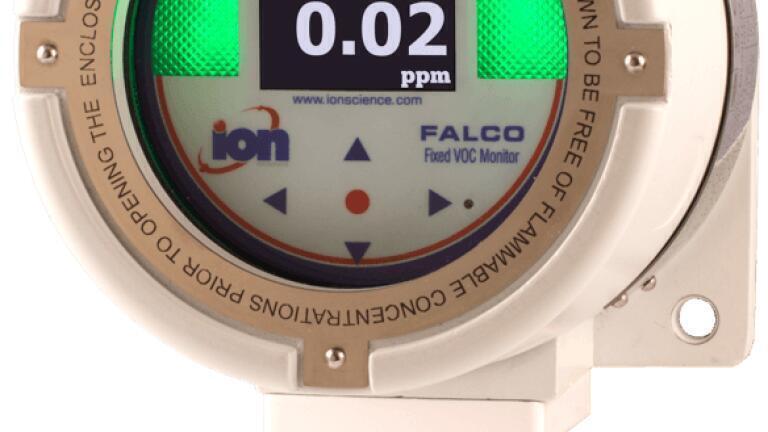
Designed for the protection of workers operating in potentially hazardous environments, such as refineries, petrochemical plants, chemical facilities and laboratories, Ion Science’s Falco incorporates first of a kind ‘typhoon’ technology for added reliability and accurate operation in condensing atmospheres and extreme weather conditions.
At the heart of Falco is Ion Science’s unrivalled PID technology with advanced patented fence electrode system. The three-electrode format also ensures increased resistance to humidity and contamination for ultimate safety, reliability and accuracy in the field.
An externally located intrinsically safe sensor ensures quick and easy servicing without the need for a hot work permit. It is operated using an intuitive user interface with a high contrast OLED display. Unique and highly visible red, amber and green status LED’s provide a warning to personnel so they can quickly react to unsafe conditions. With Modbus® and 4~20mA communications as standard, Falco can be incorporated into existing DCS and SCADA systems to provide ‘real-time’ process feedback.
Falco is supplied as either a diffusive or pumped sample unit. There are four detection ranges in the Falco series going as low as 0 - 10ppm with ppb sensitivity or as high as 0 – 3000 ppm. The Falco’s flame and explosion proof enclosure is certified to EX d IIC T4 II and the external sensor to EX ib IIC T4 Gb II.
Ion Science’s MiniPID 2 sensor provides improved temperature stability, greater sensor-to-sensor consistency and more repeatable performance, as well as a new long life 10.6 eV lamp for 10,000 hours continuous operation. An innovative self-diagnostic feature also indicates whether the lamp is failing to illuminate or the electrode stack is contaminated.
Ion Science’s fixed instrument range also includes TVOC, for accurate measurement over three different detection ranges. A user adjustable duty cycle means TVOC can be used for a diverse range of applications within intrinsically safe environments. TVOC employs a diffusive sample technique or an optional flow adaptor can be purchased so the instrument can be used with a pumped sampling system. The 4-20 mA analogue output enables the TVOC to be integrated into a DCS or SCADA system to give warning of high VOC levels or to provide loop feedback for process.
PIN 27.4 Aug/Sept 2026




 Product directory















-EN-2.jpg)