Analytical instrumentation
Published over 17 years ago. See the latest and most current information on Analytical instrumentation.
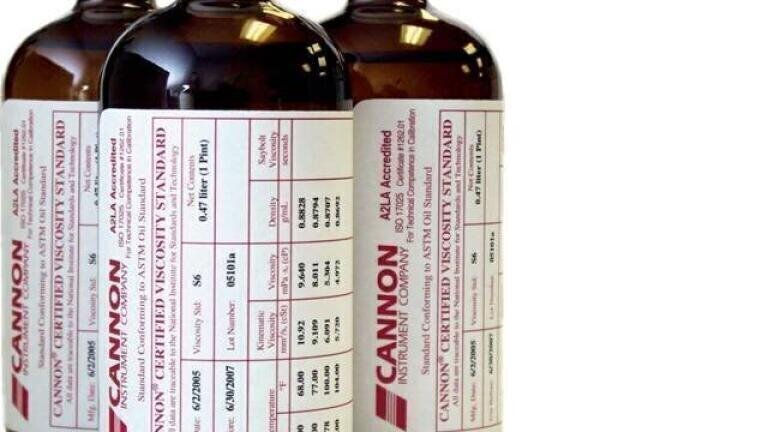
There are hundreds of different types of viscometers: glass capillary, rotational, viscosity cup, falling ball, and many others. All viscometers should be checked periodically with a certified viscosity standard to ensure that the accuracy of the instrument is being maintained. Cannon Instruments’ (USA) certified viscosity standards provide kinematic viscosities (in cSt or mm2/s) and viscosities (in cP or mPa•s) at many temperatures, ranging from –55°C to 150°C.
All Cannon viscosity standards, whether stock or custom, are traceable to the NIST (National Institute of Standards and Technology) and are prepared in Cannon’s ISO 9001-registered and A2LA-accredited laboratory. Most viscosity standards supplied by Cannon are hydrocarbon oils. The lower viscosity standards consist of mineral oil base stocks, and the higher viscosity standards are polybutenes with the exception of N1000, which is a poly-alpha-olefin. Cannon’s hydrocarbon standards can be used for calibrating any glass capillary viscometers if the specifications and procedures found in ASTM D 445 and ASTM D 446 are strictly followed. Alternatively it is often more convenient and cost effective to purchase viscometers which have already been calibrated by Cannon.PIN 27.4 Aug/Sept 2026



 Product directory


.jpg)











.jpg)


.jpg)