Safety
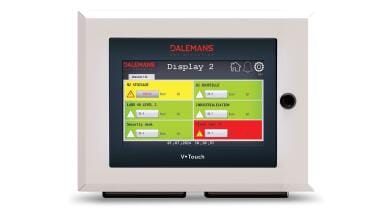
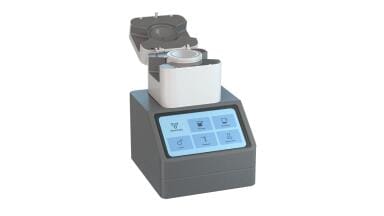
Gas monitoring devices are used in various environments and are specialised depending on the gas requirement or location of hazardous gases.
Gas monitors range from detecting a single gas to detecting multiple gases with some used continuously, and others designed for use in certain situations.
Monitors also vary in their gas sensing technology based on the gas and accuracy of detection.
It is critical for health and safety that facilities perform routine performance checks and calibrations on any gas monitor used in areas where leaks may occur such as in chemical or gas processing plants (MSA Safety, 2024).
Performing routine calibration protocols or validation checks can be cumbersome, especially when some gas monitors are fixed in precarious positions or difficult to reach.
This article describes a lightweight, portable, permeation system as a proposed solution for performing routine calibration or verification protocols for different gas monitoring devices.
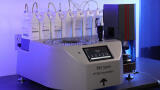
With features such as rugged casing, and enhanced capabilities, the SC2400 portable permeation system performs more accurately than its predecessor SC8700.
The SC2400 operates on core permeation tube technology using a small capacity oven with a PID temperature controller capable of controlling temperature set points from 5 °C above ambient temperature to 60.0 °C with +/- 0.10 °C accuracy (or better) for up to 8 hours while on battery charge.
Operating temperature can be increased to 100.0 °C while plugged into the charger and used in place.
Up to 4 permeation tubes can be placed within the small adapter bottle and used simultaneously at the same temperature, therefore creating a wide range of calibration gas mixtures and concentrations.
The maximum allowable flow range is up to 3000 cc/min covering a broad range of dilution capabilities while using only one set permeation device.
Different concentration points can be checked with one permeation tube by simply adjusting the flow.
The SC2400 is built within a lightweight weather resistant portable carrying case, is self-contained, and equipped with a long-lasting rechargeable battery.
It operates using a small pump to draw in ambient air for diluting permeation tube output and delivering it to the detection or analytical device, thus creating the gas in a real life scenario that would include any ambient humidity or conditions.
Gas concentration (ppm) is created dynamically and are varied with flow changes.
 Figure 1
As shown in Figure 1, air enters the unit and is purified by passing through a chemical cartridge intake filter.
Filtered air is pumped through a flow measurement device and into the permeation tube adapter bottle where it picks up pure analyte gas permeating from the tube(s) and dilutes it.
Variations in flow volume provide dilution capabilities that create a range of output gas concentrations.
A manual (or electronic) valve is used to route the span gas (calibration gas) through the Span Gas Out port for calibration/bump checking.
The span gas output flow is directly connected to an analyser, placed over a sensing head, or exposed to a passive detector (KIN-TEK Analytical, Inc, 10/2025).
Alternatively, the span gas is diverted to a scrubber before going to the vent when calibration gas is not needed.
The system can be built with an optional Teflon® electronic valve and Teflon® adapter bottle for use with HF or other acid gases, if needed.
1. The SC2400 should be fully charged for portable applications or remain on the charger, as needed. To operate at oven temperatures above 60 °C, maintain charge to the system.
2. Connect Teflon® (or similar inert output tubing) to the Vent Out port and the Span Gas Out port for use in calibration/bump checks. Note: Vent flow is routed through an internal scrubber before it exits the Vent Out port.
3. Install the front panel filter corresponding to the analyte used.
4. Install the permeation tube of choice. See Figure 2.
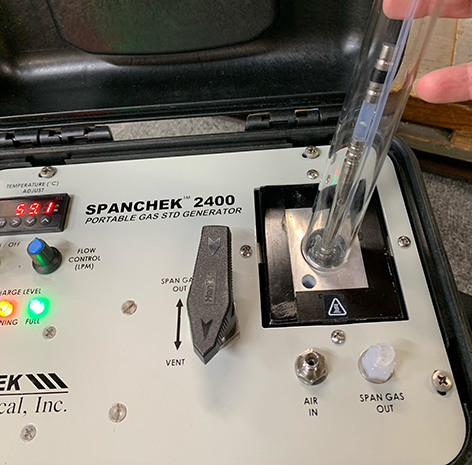 Figure 2
5. The system is powered on by inserting and turning the safety key provided.
6. Adjust the oven to the desired temperature corresponding to the permeation tube(s) certification. (NOTE: It is recommended to select permeation tubes that operate at a minimum of 40 °C for use outdoors).
7. Adjust the selector valve to Vent and adjust the flow rate require to deliver the calibration gas. Adequate time should be allowed for permeation tube(s) to equilibrate while in the Vent position. Excess gas should vent to a fume hood or use in a well-ventilated area.
8. Output concentration is calculated related to the permeation tube installed. Below is an example of a simple permeation tube calculation.
C = (ER X K25) / Flow
Where C is the resulting concentration in ppm, ER is the emission rate of the permeation tube in ng/min, K25 relates to 24.45/Molecular Weight of perm tube analyte at ambient conditions (estimated at 25 ⁰C) and flow rate measured in ml/min.
9. When ready to use the system, switch to Span Mode and adjust the output flow to the calculated volume to deliver span gas concentration corresponding with the above calculated value for checking the detector(s)/monitor(s).
10. Direct the Span gas out tubing to the detector/monitor for achieving the qualitative or quantitative response. See Figure 3.
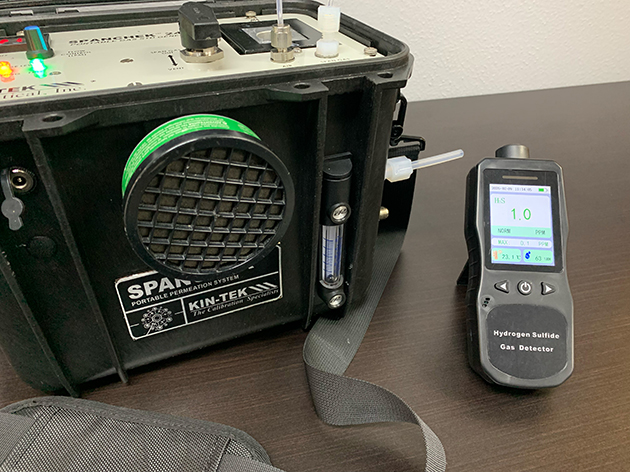 Figure 3
11. Adjustment to a low flow will provide higher concentrations and higher flows will provide lower concentrations. Easy flow adjustments are made on the fly to check minimum and maximum concentration requirements of a detector.
12. Switch to Vent when moving between locations or between calibrations to divert permeating gas through the scrubber.
13. For convenience, use the top-mounted handle or the provided shoulder strap to carry the SC2400 between locations or the system can be used in place, as needed.
14. For shut down, the oven is adjusted to a lower temperature, permeation tube(s) are removed from the system, and the instrument power key is switched off. Permeation tubes should be stored as indicated.
15. General maintenance requires periodically changing the filter cartridge and scrubber, and annual recertification/calibration to NIST Traceability.
While a variety of Trace Source™ disposable permeation tubes can be used within the portable SC2400, the below table indicates those Trace Source™ permeation tubes commonly used when checking detector performance.
Gas Compound1 | KIN-TEK Compound Code | Operating Temp ˚C | Molecular Weight |
Hydrogen sulfide | 1002 | 30°C - 50°C | 34.08 |
Sulfur dioxide | 1001 | 30°C - 60°C | 64.063 |
Methyl mercaptan | 1004 | 30°C - 50°C | 48.107 |
Chlorine | 4001 | 30°C - 40°C | 70.906 |
Hydrogen cyanide | 2010 | 30°C - 50°C | 27.026 |
Hydrogen fluoride | 4006 | 30°C - 40°C | 20.006 |
Ammonia | 2003 | 30°C - 50°C | 17.03 |
Ethylene oxide | 3023 | 30°C - 50°C | 44.053 |
Nitrogen dioxide | 2002 | 30°C - 50°C | 46.006 |
Benzene | 3018 | 30°C - 100°C | 78.11 |
Toluene | 3019 | 30°C – 100°C | 92.13 |
Ethyl benzene | 3041 | 30°C – 80°C | 106.16 |
m-Xylene | 3042 | 30°C – 100°C | 106.17 |
Methanol | 3020 | 30°C – 100°C | 32.04 |
Ethanol | 3021 | 30°C – 100°C | 46.07 |
Isopropyl alcohol | 3022 | 40°C – 100°C | 60.09 |
| 1Others available but not listed. 2Emission rate values are approximate and may vary depending on length and type of permeation tube. 3Connection to battery charger required for higher temperatures. | |||
Response times related to qualifying a detector or monitor will vary with each device depending on the manufacturer specifications but when in the Span Mode, the SC2400 will be generating gas relative to those tubes loaded in the oven.
Users should be aware of associated hazards and always work in a well-ventilated area.
Trace concentrations up to ~100 ppm can be generated depending on the permeation tube and application requirements.
Verifying gas monitors and detectors regularly is important for ensuring proper operation and human safety.
The SC2400 (Span Chek™ 2400) is a rugged, portable, permeation system designed to provide dynamic generation of accurate calibration gas for verifying or “bump testing” fixed, portable, or personal gas monitoring devices.
It can be used with several different disposable type permeation tubes, as described, to easily test different concentrations of single gases or up to four components held at the same operating temperature.
Operation is easy but users should be aware of the hazards associated with any gases while testing gas monitoring devices.
The SC2400 replaces the need for carrying gas canisters and provides a real time, real atmospheric test that incorporates surrounding conditions.
Incorporating real conditions for gas calibration or verification means an extra layer of safety and assurance.
1. KIN-TEK Analytical, Inc. (2025, October). KT-SC2400datasheet (R0001)[PDF]. https://kin-tek.com/wp-content/uploads/2025/10/KT-SC2400-Datasheet-R0001-Web-1.pdf
2. MSA Safety. (2024, April 22). What are calibration and bump tests for portable gas detectors: Key differences and ways to help streamline compliance. https://blog.msasafety.com/what-are-calibration-and-bump-tests-for-portable-gas-detectors/ (blog.msasafety.com in Bing)
3. PK Safety. (n.d.). Bump testing and calibration of your gas monitors. https://pksafety.com/blogs/pk-safety-blog/bump-testing-and-calibration-of-your-gas-monitors (pksafety.com in Bing)
PIN 27.5 Oct/Nov 26


 Product directory


.jpg)























.jpg)