Gas detection
Nils Bernhagen, Bora Özkan, Alain Barillet and Professor Gerhard Wiegleb introduce the GreenFlow System from Ipsen and explain how it can perform high-quality surface treatments on steels.
Hardening steel is a process for enhancing mechanical resistance by specifically altering and transforming the microstructure.
The most important alloying element added to iron to produce steel is carbon.
The hardening process can be carried out very efficiently and reproducibly by heat treatment in a defined reaction gas atmosphere, which makes it possible to specifically adjust the carbon content at the surface of the workpiece.
Atmosphere furnaces are therefore increasingly being used in hardening technology to ensure a controlled gas atmosphere for an optimal hardening process.
However, this also requires a gas supply system that can meet these high demands.
During the hardening process, elemental carbon [C] is deposited and embedded in a thin layer of the workpiece through a defined surface reaction at T>750°C.
Carbon monoxide CO can be used, for example, to initiate this chemical reaction from the gas phase.
First, the CO is adsorbed on the surface and then decomposes into its elemental components.
CO→[C]+O2- (1)
This process can be optimised by measuring oxygen in situ [1,2].
The elemental oxygen O2- then reacts immediately with another CO molecule to form CO2.
This process is described by the Boudouard equation (1):
2CO→[C]+CO2 (2)
This process can therefore be monitored and controlled by measuring CO2.
Furthermore, carbon monoxide can also react with hydrogen (H2) to form water vapour and release elemental carbon.
This reaction is described as heterogeneous water gas equilibrium:
CO+2H2→[C]+H2O (3)
This reaction pathway can therefore also be monitored using water vapour measurement.
The embedded carbon must have narrowly defined carbon content (C level) to achieve a high-quality surface finish.
A typical value for the edge carbon content is 0.7% C.
However, in order to accelerate the carburisation process, which takes several hours, carburisation is carried out at C levels of approximately 1.1% C and only reduced to 0.7% C towards the end of the process for about one hour.
During this process, some of the initial excess carbon diffuses into the interior of the component, while another part is removed again by the gas.
Precise and rapid control of the atmosphere in all process steps is therefore a basic prerequisite for the success of the process.
The GreenFlow system [3] measures and regulates the gases present in equations 1-3. In particular, the required gas supply is reduced to a minimum.
Figure 1 shows a typical design of an industrial hardening furnace with a specified gas atmosphere.
The gas flow is adjusted so that there is an excess of process gas, even if this is not always needed.
Gas consumption is therefore very high, resulting in unnecessary operating costs.
Figure 1: Basic design of an atmospheric furnace with a specified excess gas flow
The Ipsen GreenFlow system is an innovative solution that significantly reduces process gas consumption and optimises furnace processes.
This innovative system reduces the amount of gas required by up to 80%1, which not only significantly lowers operating costs but also makes a sustainable contribution to environmental protection (fewer CO2 emissions).
The following options are available for use in a gasification system:
The endo gas is produced on site using a generator (EndoSave®) from natural gas (CH4) or propane (C3H8). For catalytic conversion, air oxygen O2 is also added to a ratio of 1:2.5.
CH4+2.5(0.2O2+0.8N2 )→CO+2H2+2N2 (4)
Endogas produced from natural gas (CH4) then has the following composition at a dew point of 5°C:
After loading the system, the furnace atmosphere is analysed in detail.
Once the optimal conditions are reached, adaptive gas reduction is activated automatically.
The intelligent system reacts dynamically to changes, such as door movements or deterioration of the furnace atmosphere, and adjusts the gas volume in real time.
This ensures that an ideal protective gas atmosphere is always present in the furnace.
As a result, despite the reduced gas flow, the furnace atmosphere is of even better quality than with conventional gas flow control.
Figure 2: Schematic representation of the GreenFlow system with a controlled gas atmosphere and associated gas measurement technology (INFRA.sens®)
Another advantage of the GreenFlow system is the combination of colder carrier gas and reduced heating energy, as well as better temperature uniformity in the furnace.
The longer the process takes and the larger the furnace, the greater the savings will be.
In order to optimally control the reduced gas supply, the respective gas flow is set via the flow controllers (MFC3) and dynamically adjusted to the current operating conditions.
This requires highly accurate gas analysis at the furnace.
The NDIR gas measuring device based on INFRA.sens® technology selectively detects the different concentrations of carbon monoxide CO, carbon dioxide CO2, and methane CH4.
The gas supply is then regulated on the basis of this gas analysis.
Figure 3: Illustration of furnace system with corresponding component description
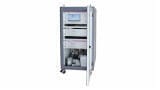
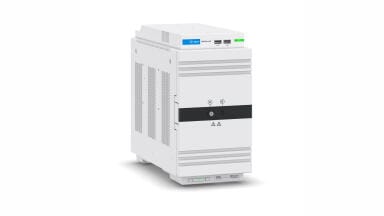
The Ipsen IGA 5.2 gas analyser was developed specifically for the innovative GreenFlow gas injection process and sets new standards in precision, flexibility, and ease of maintenance.
The gas analyser was designed not only to measure quickly and reliably, but also to offer significantly more functionality than other products available on the market.
At the heart of the IGA 5.2 is an INFRA.sens® gas measurement module that can simultaneously detect a total of five gases.
All measured values are transmitted digitally in real time to a Siemens PLC, which makes these values available via TCP/IP.
This enables particularly dynamic control behaviour. This feature is crucial for efficiency and process stability in the GreenFlow process.
All components of the IGA 5.2 gas analyser are integrated into a robust sheet metal housing that meets protection class IP65 and can therefore be used even under harsh operating conditions (Figure 4).
An IGA 5.2 gas analyser can be used to control two hardening furnaces simultaneously, which significantly reduces investment costs and increases plant efficiency.
In addition, an OPC UA connection is available, allowing the IGA 5.2 to be optimally integrated into modern Industry 4.0 infrastructures.
A novelty in industrial gas analysis technology is the complete integration of all three common C-level calculation methods:
The analyser completely covers all relevant measured variables for heat treatment.
The IGA 5.2 thus offers a comprehensive basis for precise gas analysis and all common calculation methods for atmosphere adjustment in the hardening process.
The INFRA.sens® gas measurement module supplies the key parameters CO, CH4, CO₂ O2 and residual moisture, enabling the simultaneous use of all three calculation methods.
The three C-level measurements can be compared, visualised, and optionally transferred to higher-level systems on the integrated touch panel.
This enables unprecedented transparency, safety, and redundancy in process control real technological advantages.
Another unique feature of the IGA 5.2 is the innovative calibration and replacement service, which was specially developed to completely avoid downtime.
The device replacement process consists of the following steps:
This concept offers enormous advantages for the user:
This service concept is as innovative as it is efficient and clearly sets the IGA 5.2 apart from existing products on the market.
Gas concentrations are measured using the proven INFRA.sens modules.
All required gas concentrations (CO, CO2, and CH4) are determined using the NDIR5 method [5].
This method is based on the selective absorption of infrared radiation by different gas molecules.
Figure 5 shows the absorption spectra of the three gases.
Spectral overlaps that could lead to cross-sensitivities are found between CO and CO2 in the range around 4.5µm.
Methane measurement is not affected by this. CO2 measurement therefore takes place at 4.25µm, CO measurement at 4.75µm, and CH4 measurement at 3.3µm.
Spectral overlaps are ruled out by the use of narrow-band interference filters, ensuring that this type of gas measurement guarantees high selectivity [4].
The INFRA.sens® uses a multi-channel detector that can simultaneously detect the three gases in a single measuring cuvette.
This has the advantage that all gas concentrations are measured at exactly the same time.
With gas sensors connected in series, there would inevitably be a time lag, which would cause a significant error in dynamic processes, especially at low gas flow rate.
Figure 5: High-resolution IR spectrum of the gases CH4, CO2, and CO to be analysed
The INFRA.sens® has a very high measurement accuracy of 2%.
To achieve this, all measurement errors are compensated electronically. These include in particular:
The use of a gold-plated analysis cuvette also effectively prevents changes in the reflection properties, thereby significantly improving long-term stability.
The basic design of the INFRA.sens® gas measurement module is shown in Figure 6. Figure 7 shows the entire measurement setup.
Figure 6: Schematic diagram of the INFRA.sens NDIR gas measurement module. 1. IR emitter, 2. Analysis cuvette (AK), 3. IR detector with preamplifier, 4. Evaluation electronics, 5. Signal outputs (CAN, Modbus, RS232, analogue), 6. Gas output, 7. Gas input
Fig. 7: INFRA.sens with a 100 mm analysis cuvette (AK100) and integrated moisture and oxygen measurement
Oxygen measurement is performed using an electrochemical cell (EC).
In this process, a chemical reaction takes place between the oxygen to be measured and a liquid electrolyte.
This reaction releases four electrons per oxygen molecule.
The resulting sensor current increases proportionally with the number of reacting O₂ molecules.
This produces a sensor characteristic curve that rises linearly with increasing O₂ concentration.
The O2 concentration is transmitted to the INFRA.sens base electronics via an I2C data interface and processed.
Figure 8: O2.sensD with gas connections and I2C data cable
The HUMI.sens® is based on a capacitive humidity sensor.
This sensor consists of a hygroscopic polymer material in which water vapour from the measured gas is stored.
This storage changes the dielectric properties of the polymer material.
The polymer material is located between the electrodes of an electrical capacitor and thus also changes the capacitance of the capacitor.
The capacitance increases almost linearly with humidity.
An equilibrium is established between the humidity in the measured gas and the humidity in the polymer, which adapts reversibly to varying humidity levels.
Data communication also takes place via an I2C interface.
The hardening process described above can be controlled and regulated very effectively using the GreenFlow System.
Figure 10 shows a typical curve for the temperature, gas concentrations, and volume flows.
After the furnace has been loaded, there is a stabilisation phase of approximately one hour with a high gas supply (100%).
The gas supply is then continuously reduced to values between 10-20%.
This low gas flow remains constant throughout the entire carburising process, which can take several hours.
This results in the gas and energy savings described above.
The entire process is documented and can also be used for further quality checks.
However, these savings also depend on the size and loading of the furnace and therefore varies between 80 and 96%.
Figure 11 shows examples of this for different sizes of hardening furnace.
Figure 12 shows the potential savings over a period of one month.
Depending on the furnace load, savings of 70-98% can be achieved.
The average value in this TQ-XL(1200) system was 82%.
Ipsen’s GreenFlow system is an innovative way of performing high-quality surface treatments on steels under a controlled atmosphere.
This process also enables significant energy savings of over 80%.
This is made possible by the use of high-quality and accurate gas analysis based on the proven INFRA.sens® modules from Wi.Tec-Sensorik GmbH.
This technology has been of successful use for over two years and opens up a wide range of possibilities for users in terms of product quality and cost reduction.
[1] Vogelei, K., Hanzlik, K.: Control of C level in gas carburizing systems – A new route for holistic observation? GASWÄRME International (55) Nr. 7/2006
[2] Mikulović, D., Živanović, D., Ehmeier, F.: C-Pegelregelung mit der O2-Sonde und der L-Sonde. GASWÄRME International (58) Nr. 4/2009
[3] Özkan, B., Hellwig, M.: Hybrid Furnace Technology for Intelligent Energy Use. Proceedings from the 33rd Heat Treating Society Conference and Exposition 2025. Paper No: ht2025p0074, pp. 74-80; 7 pages https://doi.org/10.31399/asm.cp.ht2025p0074
[4] Wiegleb, G.: Gas Measurement in Theory and Practice. Springer 2023 https://doi.org/10.1007/978-3-658-37232-3
[5] Kampschulte, A. Wiegleb, G.: Use of Innovative NDIR Gas Analysis for Monitoring Industrial Gas Mixing Equipment. International Environmental Technology IET January/February 2025, p.38-39
PIN 27.2 Apr/May 2026



 Product directory