Environmental laboratory
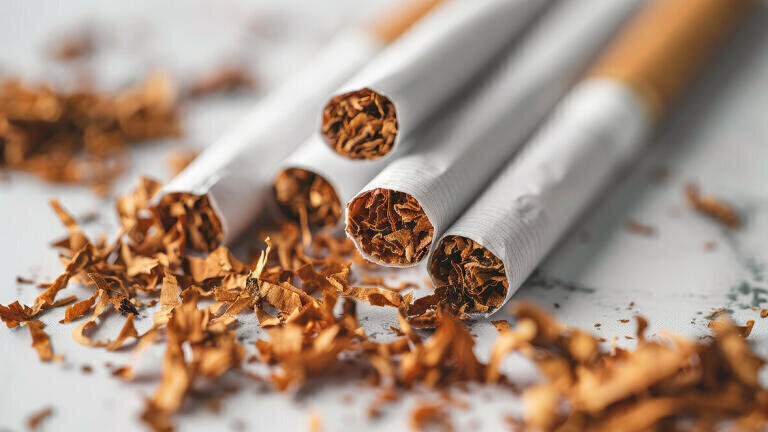
A cigarette is a smokable tobacco product made from the fermented, dried and finely cut leaves of the tobacco plant, which are stuffed, twisted, folded or rolled in paper. Tobacco smoke is used as a stimulant and was particularly widespread in the 20th century [1]. In addition to the nicotine present in tobacco smoke, an average cigarette contains up to 12,000 different substances, including the chemical compounds listed in Table 1 in the gas phase. The content data for cigarette smoke refer to mechanical smoking according to ISO 4387 [2].
The gas analysis of carbon monoxide (CO) as an indicator gas is of great international importance in the context of legal requirements, quality assurance and comparability of different types of cigarettes. ISO 8454 describes the determination of the carbon monoxide content in the gas phase of cigarette smoke in detail [3]. In the following, the practical requirements and metrological limits of NDIR technology (Wi.Tec-Sensorik GmbH) as used in commercially available smoking machines (e.g. the fully automatic RM200A2 smoking machine from Körber Technologies Instruments GmbH) are discussed.
Körber Technologies Instruments, a leading supplier of measuring instruments for the tobacco industry, offers a complete range of high quality equipment for research, development, quality assurance and production. Körber instruments have been successfully used in the tobacco industry all over the world. Constant improvements and continuing development as well as integration of the latest innovations are routine at Körber resulting in optimized, state-of the-art products.
The smoking machine RM200A2 is a fully automatic 20 port rotary smoking machine (Fig. 1). It is designed to support routine smoking for determination of nicotine, tar and CO and optional NOx. The rotary smoking principle provides the most efficient platform for the collection of mainstream particulates as well as gas phase.
The smoking machine RM200A2 meets the requirements of ISO 3308. It is not only suitable for routine smoking according to ISO 4387 and ISO 8454; it also allows smoking of Fine Cut Smoking Articles (FCSA’s) according to ISO 15592-3 and in addition to the ISO smoke regime, the conditions of the Massachusetts and Canada Intense methods are also met and preinstalled.
The automatic handling of filter traps and cigarette cassettes as well as the integrated scale and the fully automated performance of the smoke runs from cigarette loading to butt extraction enables the machine to perform 10 consecutive smoke runs without any operator interference. Optionally all kind of alternative trapping systems like liquid traps and electrostatic traps can be connected to the machine as well.
The documentation of results and the statistic evaluation thereof is done via touch panel PC. The Ethernet and USB interface allows the RM200A2 to be directly linked to the user’s lab data management systems.
The smoking system incorporates the following component assemblies:
Dead volume reduced smoking ring with 20 labyrinth cigarette holders (Fig. 2), which can be replaced by special cigarette holders for Fine Cut Smoking Articles (FCSA) or by vent blocking cigarette holders for intense smoking regimes,
Electric lighter incl. light position adjustment and butt length sensor, automatic leakage tester, anemometer sensor for adjustment and control of ambient air flow conditions and, of course, the piston pump system (Fig.3).
The piston pump and the CO gas analyser (INFRA.sens®) and optional NOx modules are installed in a drawer, where they are readily accessible (Fig.4). The piston pump is easily removed because all connections are pluggable.
RM200A2 is equipped with a cassette magazine accommodating up to 10 cassettes for 20 cigarettes each. The cigarette loading device is situated next to the smoke ring and transports the cigarettes from the cassettes into the cigarette holder. The loading device is easily adjustable to different cigarette diameters.
A storage magazine of 10 filter holders is part of the RM200A2 as well as a trap handling arm to automatically move the traps to the different positions required for a smoke run. Beside the trap storage magazine these are the integrated scale for TPM determination, the smoking position, the filter sealing system as well as the filter exit storage.
1. The smoke trap (filter holder with 92 mm Cambridge filter) is conveyed fully automatically into the smoking position. After passing an integrated balance for determination of tare weight.
2. A leakage test is carried out automatically before each smoking process.
3. Cigarettes from the storage cassettes are automatically loaded into the cigarette holders.
4. Cigarettes are light electrically with automatic monitoring. The light position is adjusted for each cigarette according to cigarette end detection result.
5. Puffing is carried out by integrated piston pump. ISO as well as Massachusetts and Canada intense are possible. Puff profile is adjustable.
6. An infrared sensor monitors the set butt length. Puffing stops immediately after the butt length has been reached.
7. Butts are automatically removed from cigarette holder.
8. Smoke loaded smoke trap is removed from the smoking position automatically and passed to the scale for determination of TPM. Afterwards the trap is transported to the filter sealing unit, locked with caps and stored for cigarette smoke analyses.
9. During smoking, the smoke gas can be collected in a bag. At the end of the smoking cycle, the gas is sucked out of the gas collection bag and analysed in the CO module using the NDIR method (INFRA.sens®). Alternatively, the NO/NO2/NOx concentration in the smoke gas can also be determined during smoking using the NOx analyser using the chemiluminescence method. Both analyses can be carried out in parallel. The results are output in mg/cigarette.
The gas phase can be trapped with a gas collecting bag connected to RM200A2. Carbon monoxide CO can be determined afterwards with the optional CO module. This instrument works
in accordance with NDIR principle (INFRA.sens®) as defined in ISO 8454.
The gaseous components present in cigarette smoke can be detected in the UV and IR spectrum. For this purpose, the smoke from several cigarettes is collected in a gas collection bag and fed one after the other to a UV spectrometer and an FTIR spectrometer. Fig. 5 shows the entire IR spectrum from 2-12µm. In particular, the CO and CO2 bands at 4.6µm and 4.3µm stand out clearly from the other absorption bands. In addition, alkanes (HC) can be detected at 3.31µm. The CO gas analysis in particular is influenced by the strong CO2 band. For a selective CO measurement, the CO2 measurement is therefore also carried out simultaneously and offset against the CO result. This results in a very selective CO analysis, which is necessary to meet the requirements of ISO 8454.
In the UV range, however, no individual components can be selectively detected. The UV spectrum (Fig. 6) shows a continuous absorption band between 190nm and 265nm. The broadband absorption band is mainly caused by aromatic hydrocarbons (HC), nitrogen oxides (NOx) and acetaldehyde, which have very pronounced absorption bands in this spectral range. Due to the overlapping of the different bands, selective gas analysis is therefore not possible.
The CO measurement is carried out in the spectral range at 4.65µm, while the CO2 measurement is carried out at 4.3µm. In addition, a reference measurement is required to compensate for ageing effects of the radiation source and contamination in the measuring cuvette. For this purpose, a photometric setup (INFRA.sens®) from Wi.Tec-Sensorik GmbH with 3 active pyroelectric detector elements is used [6]. Fig. 7 shows the basic set-up. The IR radiation source is electrically modulated with a frequency of 1-10 Hz.
The current pressure pG and the current temperature TG are also recorded in the area of the measuring cuvette. This additional information is required to be able to calculate the exact amount of substance per cigarette. The µP.sens sensor element records both physical parameters (pG and TG) with a high degree of accuracy and transmits this information to the microcontroller of the basic electronics via an I2C interface.
This is where the further calculations for standardizing the CO concentration in % by volume take place. This information is important in order to be able to calculate the carbon monoxide volume per cigarette in milliliters (Eq.1). Air pressure changes between 600-1100 hPa are almost completely compensated for in the evaluation electronics. The same applies to the influence of the ambient temperature between 5°C and 45°C. Fig. 8 shows the INFRA.sens® with a 100mm cuvette (AK100). The detailed view (right) shows the integrated pressure and temperature measurement (µP-sens).
The total CO volume per cigarette is of great importance for the assessment of a cigarette. ISO 8454 provides the necessary basis for calculation. The carbon monoxide volume per cigarette in milliliters (ml) can be calculated from the total gas volume (V·N) per cigarette using the CO concentration C and the general gas equation. The average carbon monoxide volume per cigarette, Vas expressed in milliliters (ml), is then obtained from equation (1):
with
Vas Carbon monoxide volume per cigarette in milliliters (ml)
C Carbon monoxide content in percent by volume (vol.%)
V Puff volume in milliliters (ml)
N Number of puffs, including cleaning puffs,
in the measured sample
p Ambient pressure in kilopascals (kPa)
p0 Standard atmospheric pressure in kilopascals (kPa)
T0 Temperature for the triple point of water in Kelvin (K)
t Ambient temperature, in degrees Celsius (°C)
The following values can be used in the calculation: V=35 ml and rounded values for p0 =101.3kPa and T0 =273K.
ISO 8454 also provides for the conversion of the carbon monoxide volume per cigarette into mass content. The average mass content of carbon monoxide per cigarette, 𝑚cig, expressed in milligrams, is given by equation 2:
with
𝑚cig average mass content of carbon monoxide per cigarette in milligrams (mg)
𝑀co molar mass of carbon monoxide, in grams per mole (g/mol)
𝑉m molar volume of an ideal gas in liters per mole (l/mol)
The following values can be used in the calculation: Rounded values for 𝑀co =28g/mol and 𝑉m =22.4l/mol.
The determination of the CO content (C=0-10 vol.%) with the INFRA.sens® OEM gas analyser offers a very good and precise way of specifying the carbon monoxide volume per cigarette in millilitres (ml) as specified in ISO 8454. Furthermore, the average mass content 𝑚cig of carbon monoxide per cigarette can also be calculated in milligrams (mg). The interaction between the INFRA.sens® OEM gas analyser from Wi.Tec-Sensorik GmbH and the fully automatic RM200A2 smoking machine from Körber Technologies Instruments GmbH was impressively demonstrated. In addition to the use for conventional cigarettes, the described measuring system also shows the possibilities to cover other areas of application such as e-cigarettes (0-2000 ppm CO) and cigars (0-15 vol.% CO).
[1] WIKIPEDIA https://en.wikipedia.org/wiki/Cigarette
[2] ISO 4387 Cigarettes — Determination of total and nicotine-free dry particulate matter using a routine analytical smoking machine
[3] ISO 8454 Determination of carbon monoxide in the vapour phase of cigarette smoke- NDIR method, March 2025
[4] Morton, H. J., Schmidt, T.: Technical Report 2022 Collaborative Study of CORESTA Monitor 9 (CM9) for the Determination of Test Piece Weight, TPM, Water, Nicotine, NFDPM, Carbon Monoxide and Puff Count Obtained under Mainstream ‘Non-Intense’ and ‘Intense’ Smoking Regimes
[5] Wiegleb, G.: Gas Measurement Technology in Theory and Practice, Springer Verlag Wiesbaden 2023 (https://doi.org/10.1007/978-3-658-37232-3)
[6] Datenblatt INFRA.sens® (Wi.Tec-Sensorik GmbH, Wesel, Germany) https://www.witec-sensorik.de/downloads/data-sheet-infra.sens-ak100/
[7] Hoffmann D, Hoffmann I, El-Bayoumy K (2001) The less harmful cigarette: a controversial issue. A tribute to Ernst L. Wynder. Chem Res Toxicol, 14, 767-790
PIN 27.2 Apr/May 2026



 Product directory