Fuel analysis
According to the United Nations Climate Action, fossil fuels are the largest contributor to global warming, with 68% of greenhouse gas emissions deriving from the petroleum refinement process. As a result of the greenhouse gas effect of harmful emissions trapped within the atmosphere, Earth experiences hotter temperatures, increased droughts, ocean level rising, biodiversity loss, as well as increased rates of global poverty [1]. At the same time, increasing demand for energy at the cost of heightened pollutant emissions makes it relevant to evaluate the extent to which fuel chemistry affects emissions and particulate formation. In this paper, the combustion reaction is introduced, followed by an introduction to environmental concerns and fuel chemistry and varieties. After evaluating fuel chemistry based on molecular variation in linearity, the presence of alkenes, and aromatic content, as well as the structural carbon/hydrogen ratios of gasoline, liquified petroleum gas, and diesel, it was determined that the addition of oxygen-rich ethanol blends to standard gasoline fuels served to minimize CO and NOx emissions while maintaining optimal combustion efficiency.
i. Fuel and fuel chemistry.
The term “fuel” refers to any substance that can be used to provide energy that can be used for other processes. Since the mid-nineteenth century, hydrocarbon natural gas and liquid petroleum systems have been developed to respond to the increasing demand for energy. These hydrocarbon systems can have a wide range of chemical properties that affect the performance of the fuel types, resulting in varied rates of increasing demand by type. In a Monthly Energy Review published by the US Department of Energy, it was determined that global demand for fossil fuel (petroleum and natural gas) sources has steadily increased since 1980, while coal sources have declined and nuclear electric and renewable alternatives have experienced a less steep increase. Data from 2000 found that 69.262 quadrillion British Thermal units (Btu) of energy were produced across the fossil fuel production sectors (57.307 quadrillion Btu from coal, natural gas, crude oil, and natural gas pipeline). As indicated in Figure 1, the demand from 1980 has steadily increased for all fuel types except coal through 2015 (71.4 quadrillion Btu produced from fossil fuels) and maintained an upward trend in 2025 statistics (84.46 quadrillion Btu from fossil fuels) [2].
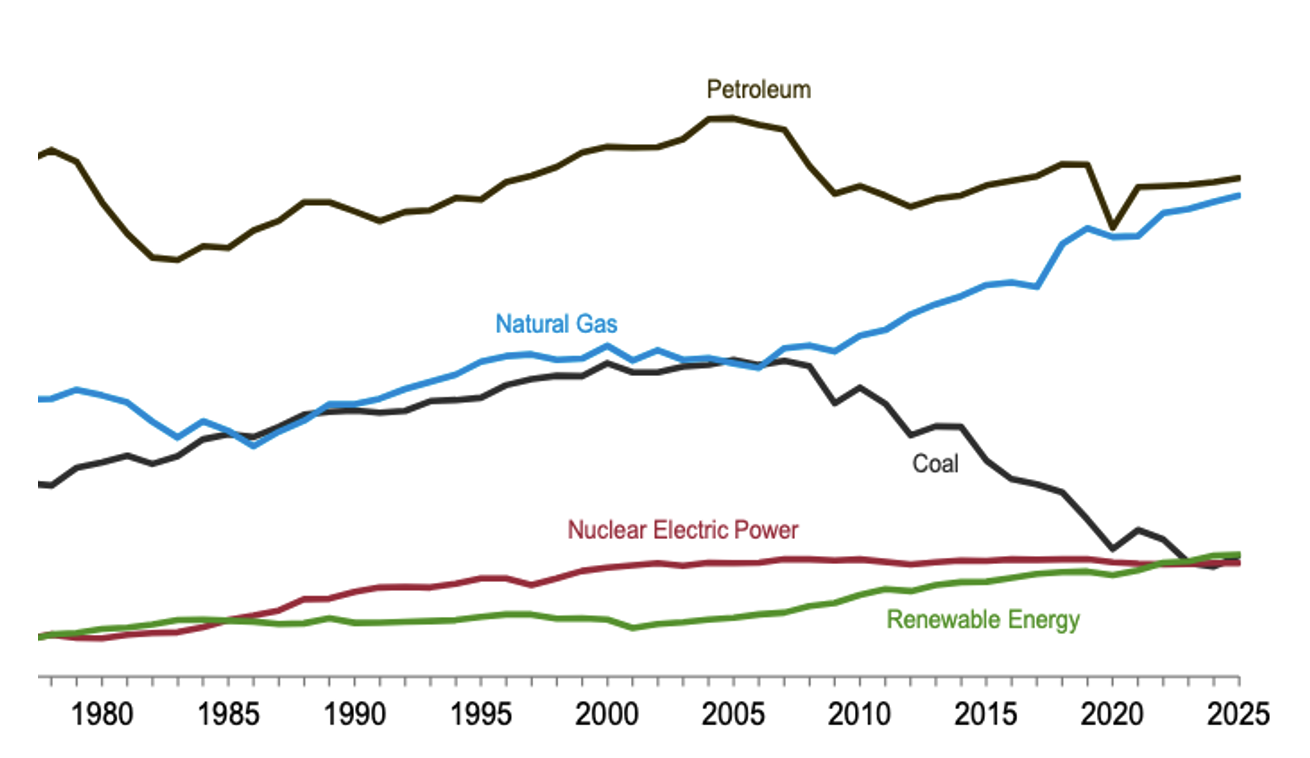
Fig. 1. Trends in energy demand by fuel type (1980-2025) [2]
Despite the increasing demand for alternatives to fossil fuel petroleum and natural gas systems, Figure 1 demonstrates that petroleum and natural gas demand still vastly outweigh renewable and nuclear electric energy alternatives. The fundamental processes required to convert crude petroleum and natural gas into energy is the hydrocarbon combustion reaction (Reaction 1):
C + O2 → CO2 (Reaction 1)
In combustion reactions, oxygen gas is reacted with another molecule, releasing energy through heat or light. For instance, the combustion of propane, a hydrocarbon derived from natural gas, can produce 23,726 Btu energy/gal [3]:
C3H8 + 5O2 → 3CO2 + 4H2O
To maximize the energy released from the combustion reaction, it is necessary to react O2 with molecules with high heats of combustion, or molecules that have high potential energy stored within their bonds. Molecules with high heats of combustion include hydrocarbons (Reaction 1), as well as hydrogen.
As a result, effective fuel sources have three major composition constituents: hydrocarbons, oxygenates, and other trace molecules.
Hydrocarbons are molecules that contain only hydrogen and carbon, with fuels derived from crude petroleum typically containing five major classes of hydrocarbons:
1. Unbranched alkanes, or n-paraffins, are considered “straight-chain” hydrocarbons connected only by single bonds (Figure 2). As such, these molecules are saturated with the maximum number of hydrogen atoms for a given number of carbon atoms. Unbranched alkanes are denoted as CnH2n+2 (n = the number of carbons in the molecule).
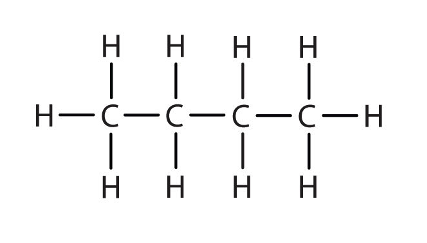
Fig. 2. Unbranched alkane [65]
2. Branched alkanes (Figure 3) are found within petroleum. The “iso-paraffins” are also denoted by CnH2n+2 but are nonlinear due to the presence of alkyl branches extending from the main hydrocarbon chain.
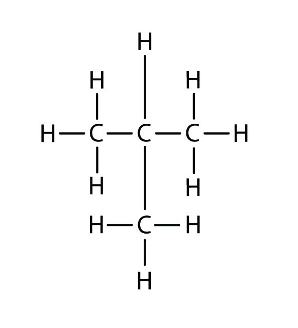
Fig. 3. Branched alkane [65]
3. Cyclic alkanes, or “cycloalkanes” and “naphthenes” (Figure 4), are saturated hydrocarbons that have ring-shaped carbon structural configurations. Ring structures generally have 3-9 carbon atoms, and are denoted as CnH2n. 5-membered and 6-membered rings are the most stable ring types due to minimized ring strain from favorable bond angles.
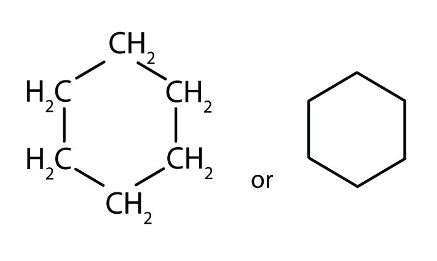
Fig. 4. Cyclic alkane [65]
4. Olefins, or “alkenes” (Figure 5), are hydrocarbons with at least one double carbon-carbon bond. These molecules can be branched, unbranched, or cyclic and are not often found in high concentrations within crude petroleum but can be produced through refining processes including cracking.
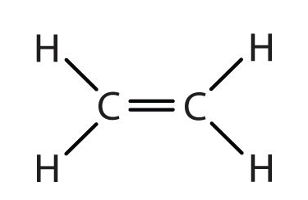
Fig. 5. Alkene [65]
5. Aromatics (Figure 6), or unsaturated hydrocarbons in ring structures, are cyclic with at least one double carbon-carbon bond. The most stable aromatic ring is a benzene ring (C6H6), with all six carbon atoms in the same plane.
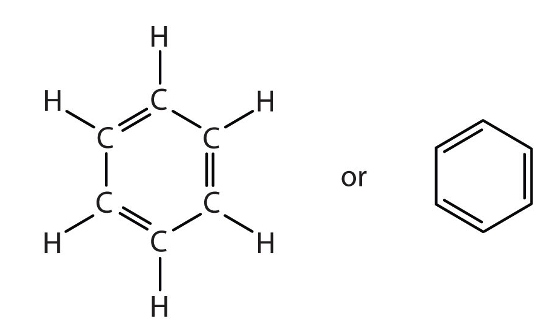
Fig. 6. Cyclic Alkene [65]
The second class of molecules found in fuel sources are oxygenates, or molecules containing carbon, hydrogen, and oxygen atoms. Four main groups include alcohols (Fig. 7.(a)), esters (Fig. 7.(b)), ethers (Fig. 7.(c)), and ketones (Fig. 7.(d)), all of which serve to enhance properties of the fuel through additive functions. For instance, ethers (Fig. 7.(c)) were used extensively prior to the Clean Air Act of 1990 to lower soot emission in diesel fuel.

Fig. 7. Alcohol (a), ester (b), ether (c), ketone (d) [65]
Additionally, trace additives can be introduced to fuel sources to support various functions of the fuel. Cetane improvers, fuel stabilizers, lubricity improvers, metal deactivators, and detergent-related functions are primarily enhanced by additives, though increasing concentrations of additives can present threats of corrosion, deposit formation, cloud point elevation, and autoignition time delays.
The fuel used to produce energy is extracted from the earth through upstream petroleum refining processes, which are later channeled through oil refineries to produce three major fuel types:
1. Liquified petroleum gas (LPG)
2. Gasoline
3. Diesel
First, crude oil inputs are subject to the fractional distillation of petroleum through a distillation tower, visualized in the leftmost step of Figure 8. The typical percent by volume of crude petroleum feed stream is 4-8% alkanes, 2-5% alkenes, 25-40% iso-alkanes, 3-7% cycloalkanes, 1-4% cycloalkenes, and 20-50% total aromatics [4]. Then, differences in the boiling points of the components of the petroleum are exploited, as the broad range of volatility (38-205 degrees celsius) allows for up to 50% yields of gasoline. Heavier crude oil, or fractions with more carbon atoms, less branched chains, and higher boiling points remain at the bottom of the column (including resid and fuel oil), while lighter species leave through the top of the column (including LPG and straight-run gasoline) [5].
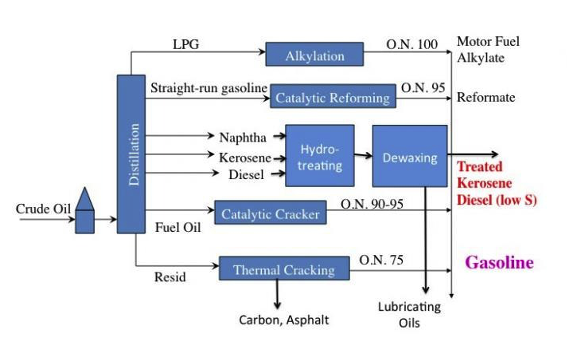
Fig. 8. Oil refining process flow diagram [6].
LPG (distillation tank outlet stream 1, Fig. 8.) is a hydrocarbon gas-based mixture of propane (C3H8), butane (C4H10), and isobutane (C4H10) is a fuel produced as a byproduct of natural gas and crude oil refining that is stored under pressure in a tank as a colorless, odorless liquid. The liquid vaporizes as pressure is released, converting the fuel into a gas that can be used in combustion. Propane has a particularly high-octane rating, making it useful for internal combustion engines. For use in vehicles, propane must meet standards of HD-5 propane, or a composition with 90% propane, <5% propylene, and 5% other gas. Propane requires more fuel by volume to drive the same distance as gasoline-powered vehicles, yet the fuel maintains a higher-octane rating than gasoline making it more effective in resisting engine knocking [10].
Gasoline is extracted from straight-run gasoline, fuel oil, and resid reforming and cracking processes (distillation tank outlet streams 2, 6, 7 in Fig. 8.). There isn’t a singular chemical formula for gasoline, but it is instead a mix of a wide range of hydrocarbons and additives [7]. Catalytic reforming of straight-run gasoline (distillation tank outlet stream 2, Fig. 8.) is a process that relies on the manipulation of crude petroleum into liquid reformate products at high temperatures and in the presence of catalysts. The linear hydrocarbon feedstocks are dehydrogenated to form branched and cyclic hydrocarbons, improving the octane number of the resultant gasoline [8]. Fluid catalytic cracking (distillation tank outlet stream 6, Fig. 8.) utilizes a fluid catalyst to create smaller molecules from larger fuel oil feedstocks to make gasoline. At high temperatures (315-430 degrees celsius), the catalyst breaks the large molecules of oil into lighter hydrocarbons (including butane and propane). Once cracked, the output can be separated based on boiling point differences [8]. Similarly, thermal cracking (distillation tank outlet stream 7, Fig. 8.) occurs as large hydrocarbon molecules in resid are heated in a furnace to break the viscosity of the resid and exploit differences in boiling points of the resid constituents [9].
Diesel (carbon chains ranging from 9-25; distillation tank outlet streams 3-5, Fig. 8.)) is generated through transesterification reactions, with either nucleophilic substitution of an alcohol group of a triglyceride (creating biodiesel), or substitution with hydrogen (creating renewable diesel). Hydrotreatment and dewaxing methods serve to selectively remove alkenes, sulfur-containing, and nitrogen-containing compounds from un-refined diesel and naphtha feedstocks without disrupting aromatic hydrocarbon concentrations [11]. The standards organization American Standards for Testing and Materials specifies several test methods for diesel fuel oils suitable for the market, including flash point, cloud point, water and sediment, carbon residue, ash, distillation, viscosity, sulfur (grade maximum of either 500 or 5000 ppm), copper corrosion, cetane number, cetane index, aromacity, lubricity, and conductivity [12].
Octane number (ON) and olefin content are two metrics used to evaluate refined fuel products further. When refining crude petroleum, producers aim to have a high yield of fuel that burns evenly, completely, and without knocking, or the premature combustion of a fuel fraction that causes noise from pressure fluctuations in the combustion chamber of an internal-combustion engine. ON is a measure of the performance of a fuel with respect to the percent of iso-octane in a standard fuel value, with a higher ON corresponding to less knocking. Another aim of producers is to prevent deposit formation in engines from carbon buildup over time. As such, low olefin content is favored to promote combustion efficiency and avoid clogging [13].
ii. Environmental concerns.
The effect of the petroleum refining industry on global warming and climate change is primarily due to the release of greenhouse gases and other harmful emissions into the atmosphere during hydrocarbon combustion. According to estimates from a 2022 report from the US Environmental Protection Agency (EPA), 28% of the total US greenhouse gas emissions (CO2 and nitrous oxides) come from the transportation sector, with petroleum fuel comprising 94% of this sector [14]. In evaluating CO2 emissions by petroleum fuel type, a 2024 report from the US Energy Information Administration determined that 20.86 pounds of CO2 were emitted per gallon of gasoline, 12.68 pounds of CO2 were emitted per gallon of propane, and 22.45 pounds of CO2 were emitted per gallon of diesel [15]. Based on these high CO2 emission contributions visualized in Figure 9, it has been increasingly popular for legislators to focus on mitigating the effect of the petroleum industry on global emissions.
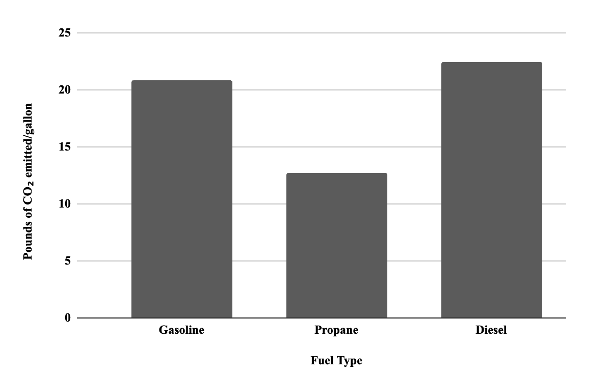
Fig. 9. Carbon dioxide emissions by fuel type [15]
The major governing legislation in the United States regarding pollutants is the Clean Air Act of 1970 (and subsequent amendments in 1977 and 1990). Its key functions include establishing standards for air quality and dictating the burden of compliance to the states to protect humans and the environment from 187 air pollutants. Amendments in 1970 and 1977 provided for renewed standards for air quality, a 90% reduction in vehicle emissions by 1975, and expanded federal enforcement jurisdiction. In 1990, amendments reinforced standards and associated deadlines, as well as revised terminology of air toxins and associated causes. Most significantly, Section 109 of the act provided for the establishment of the National Ambient Air Quality Standards, which the EPA issued for six groups considered the most harmful pollutants: carbon monoxide, sulfur dioxide, nitrogen dioxide, particulate matter, ozone, and lead [16].
1. Carbon monoxide (CO) is a molecule formed during the incomplete combustion of fuel. This substance is considered the main component of “smog” or thick smoke fog pollution. Increasing exposure to high concentrations (100-1000 parts per million or ppm) of CO in air can result in effects ranging from headaches to unconsciousness and death.
2. Sulfur oxides (SOx) are molecules formed during the oxidation of sulfur in sulfur-based fuels. Sulfur dioxide (SO2) generally only causes irritation but can react with atmospheric oxygen to form sulfur trioxide. Sulfur trioxide (SO3) in concentrations as low as 1 ppm can cause choking and the potential for bronchitis.
3. Nitrous oxides (NOx) are products formed from oxidation during combustion. This product can form from nitrogen within the fuel source or from reaction with O2 gas in the air, both of which can produce gas that is known to cause lung inflammation and death.
4. Particulate matter (PM) refers to particles smaller than ten micrometers that can become trapped in lungs and cause inflammation or death. The major sources of PM include soot–which forms when oxygen supplies are insufficient for the complete combustion of carbon–and fly ash–which are silica, alumina, iron oxide, or calcium-based particles formed as a byproduct of residual coal combustion [17,18]. Fuel sources with greater carbon content have a greater tendency to produce soot, while fuels with higher concentrations of hydrogen and oxygen reduce the potential for soot formation, as illustrated in Figure 10 [19].
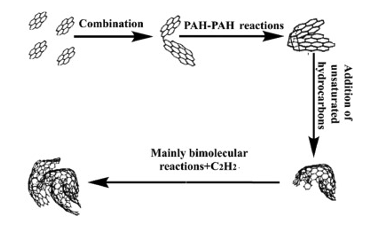
Fig. 10. Diagram of soot formation [22]
The United States Environmental Protection Agency (EPA) divides PM pollution into two major categories based on size:
i. Inhalable particles (PM10) with diameters of 10 micrometers or less.
ii. Fine inhalable particles (PM2.5) with diameters 2.5 micrometers or less.
PM2.5 is noted to pose the greatest risk to human health due to the threat of death, heart attack, asthma, and decreased lung function. Both PM10 and PM2.5 can disrupt the environment through water acidification and soil nutrient depletion, as well as maintain the risk of oxidation interactions with NOx species [20,21]. According to researchers Querol et al. (1998), more than 900 tons of fly ash are released into the atmosphere as PM annually. Notably, these particles maintain long atmospheric residence times enabling the dispersion of local PM input populations on a global scale [22].
5. Ozone (O3) is a pollutant that is not directly emitted during the fuel combustion reaction but is instead a consequence of reactions of molecules that are emitted during combustion (Ox and unburned hydrocarbon (HC)). O3 exists in Earth’s atmosphere in two layers:
i. Stratospheric ozone forms naturally in the upper atmosphere (ranging from 4-12 miles above the
ii. Earth’s surface to 31 miles above the Earth’s surface [23]) and shields the surface of the Earth from solar ultraviolet (UV) radiation [24]. This form of ozone is considered essential to life, as the National Oceanic and Atmospheric Administration notes that without UV-absorbing stratospheric ozone, the risk of skin cancer in humans and aquatic ecosystem disruption would be prevalent [25].
iii. Tropospheric (“Ground-level” [26]) ozone is formed during the reaction of volatile organic compounds (VOCs) and NOx:
NO2 + photons (sunlight) → NO + O
O + O2 (atmospheric) → O3
Based on the equilibrium distribution after ozone formation, O3 and NO can also react to regenerate NO2, O2, and HCs, contributing to the overall increase in NOx and HCs atmospheric concentrations [27]. Peak concentrations of tropospheric ozone are often observed as thick smog layers of dense urban regions [28]. If inhaled, smog can have adverse effects the human respiratory system and has been correlated with asthma, lung cancer, and cardiopulmonary mortality [27,29].
6. Modern lead (Pb) emissions can be traced to the continued use of leaded aviation fuel, as well as metals processing facilities [30]. Pb (as tetraethyl lead (Pb(C2H5)4)) was initially introduced into gasoline blends as an additive to support the even combustion of fuels during the twentieth century but was banned in the US as an on-road gasoline additive in 1996 [31]. However, lead is still acceptable in low concentrations in non-road fuels, including those intended for aviation or farming. Exposure to lead in high concentrations can negatively affect human nervous, immune, and cardiovascular systems, particularly in infants and children [30,32]. Additionally, accumulation of lead in the environment can contribute to soil contamination and have a negative influence on the global food web.
i. Comparison based on molecular chemistry
Given that the three major petroleum fuel types (LPG, gasoline, and diesel) are composed of the same organic atoms (C, H) in varying ratios and spatial configurations, it is necessary to evaluate the effects of molecular chemistry on atmospheric emissions prior to an evaluation of the effects of fuel type-specific chemistry.
The most elementary effect molecular chemistry has on emissions is rooted in the differing spatial configurations of alkanes. For a given hydrocarbon with the same number of carbon atoms, the varying characteristics of linear, branched, and cyclic configurations can influence the CO, HC, NOx and PM emission profiles associated with the molecule.
Generally, when comparing the combustion of linear alkanes to branched alkanes, greater emission profiles have been found to be associated with linear alkanes. In 2019, researchers Yuan et al. (2019) found that branched alkanes react earlier and faster during combustion [33] and produce less NOx emissions than linear alkanes. The relationship between reaction rate and emissions was explored further by Yao and Tsai (2024), who found that alkanes with higher reaction rates (1) have more complete reactions and thus (2) emit less CO, HC, and NOx emissions at the cost of increased CO2 emissions [34]. Consequently, increasing concentrations of branched alkanes within a fuel source results in an increase of CO2 and decrease in NOx emissions [35,43,44].
A key environmental concern associated with the amount of NOx present in the atmosphere is the potential formation of Secondary Organic Aerosols (SOA), a major component of PM2.5 pollution [36]. SOAs are formed when hydroxyl (OH) radical species react in atmospheric conditions that are sufficiently rich with NOx and organic molecules [37]. Research focused on SOA formation has identified carbon skeleton branching as the primary factor influencing the propensity of organic molecules to react with NOx in sufficient conditions [38]. In work by Madhu et al. (2024), it was determined that linear alkanes were responsible for a greater proportion of SOA mass compared to branched alkane populations [39]. Additionally, it was found that cyclic alkanes had the highest propensity to be SOA precursors, supporting earlier work by Lim and Ziemann (2009) and Tkacik et al. (2012), who argued that in a given alkane configuration, SOA yield was highest from concentrated cyclic alkanes, then linear alkanes, and lowest in branched alkane isomer mixtures [40,41]. Further, quantification of SOA composition based on alkane configuration by researchers Manavi and Pandis (2022), supported earlier suggestions of branching hierarchies, as cyclic alkanes had the highest SOA emissions (63% of total emissions), followed by branched alkanes (15%) and aromatic compounds (13%) [42].
Similar differences in emission data have been attributed to linear alkenes (olefins) and cyclic alkenes (aromatics). A 1990 Auto/Oil Air Quality Improvement Research Program (AQIRP) initiative of seventeen domestic auto and petroleum companies to evaluate the emissions from fuels recognized the following relationships:
1. Increased olefin content results in reduced HC emissions.
2. Change in olefin content does not significantly impact CO emissions.
3. Reduced olefin content results in reduced NOx emissions.
4. Reduced aromatic content results in reduced HC emissions.
5. Reduced aromatic content results in reduced CO emissions.
6. Change in aromatic content does not significantly impact NOx emissions [45].
Recent research by Hajbabaei (2013) conducted similar olefin-related emission analyses as the AQIRP. Significant CO2 increase with increasing olefin content was observed, but no statistically significant impact of olefin content on CO emissions was found [46]. To evaluate the CO emissions further, work by researchers Schifter et al. (2013) analyzed the effects of variable fuel olefin and aromatic content on CO and NOx emissions in gasoline used in light duty vehicles. It was determined that decreasing olefin concentration from 11% to 1% resulted in a significant decrease in CO emissions (12% decrease) and NOx emissions (8% decrease). This observation was attributed to the replacement of olefins with less reactive paraffins, resulting in a less-complete combustion reaction occurring at a slower rate [47].
Alternatively, with respect to aromatic components, Schifter et al. (2013) found that lower aromatic fuel content resulted in an increase of NOx (1%) emissions, a 22% increase in ozone forming potential [47]. The observed ozone forming potential relates to the alkane data reported by Lim and Ziemann (2009) and Tkacik et al. (2012), as ringed structures demonstrated a greater propensity (relative to linear structures) to react with atmospheric NOx to form ground-level ozone molecules [40,41].
Similarly, Karavalakis et al. (2015) found that increasing aromatic character resulted in increasing HC emissions. This was attributed to the heightened difficulty in vaporizing aromatics relative to paraffins, resulting in a greater fraction of uncombusted HC. Additionally, the researchers noted that aromatic content significantly affected PM formation as the boiling points of the hydrocarbons increased, leading to their conclusion that fuel with higher aromatic content evaporates at a slower rate, encouraging PM formation [48]. The findings of Schifter et al. (2013) and Karavalakis et al. (2015) directly support the earlier hypotheses of the AQIRP, drawing a direct relationship between increasing aromatic content and emissions.
With respect to particulate matter formation, work by Calcote and Manos (1983), later supported by Gomez et al. (1987) and Botero et al. (2014), established a clear relationship between molecular structure and the tendency of soot formation in premixed and diffusion flame systems past a particular threshold value [44,49,50]. Qualitatively, Calcote and Manos (1983) proposed that a general tendency to form soot follows the pattern: Alkanes < Branched Alkanes < Alkenes < Cycloalkanes < Alkynes (triple bonded carbon atoms) < Aromatics [44]. As demonstrated in Figure 11, when quantitatively testing varying molecular structures, Calcote and Manos (1983) found that:
1. Increase the number of carbon atoms (molecular weight) resulted in a greater tendency of soot formation in both flames.
2. Increasing isomerization (increase in the spatial compactness of the respective molecule) resulted in greater tendency of soot formation in both flames. [44]
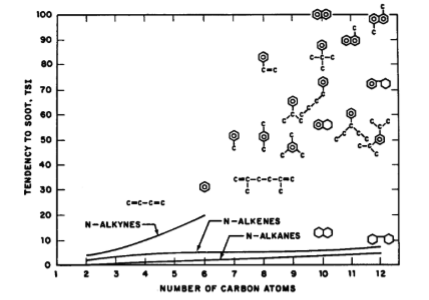
Fig. 11. Effect of number of carbon atoms on tendency of soot [44].
Beyond the influence molecular chemistry can have on emissions, considerations have been made regarding adjustments to fuel chemistry to mitigate increasing emissions.
ii. Comparison based on fuel type chemistry
The chemistry of different fuel types also plays a role in emissions. With respect to LPG emissions, research by Díaz et al. (2000) demonstrated that CO and NOx emissions are most dependent on propane concentrations of the fuel blends. As illustrated in Figure 12, the optimal propane concentration was determined to be 70 vol.% to avoid higher NOx emissions while minimizing HC and CO emissions [57].
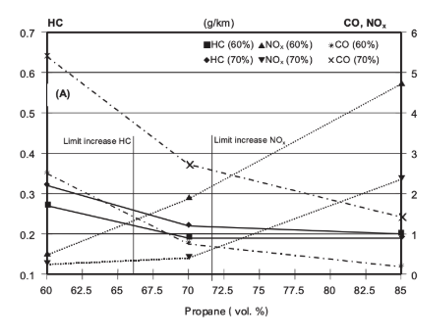
Fig. 12. Effect of increasing propane vol. % on emissions [57].
Subsequent efforts by Chang et al. (2001) found that LPG emissions are reliant on molecular chemistry, accounting for the trends observed by Díaz et al. (2000). Specifically, the researchers found that in non-methane hydrocarbon emissions, reactive alkenes and aromatics constituted at least 70% of the total emissions released from gasoline-powered test vehicles, while vehicles powered by LPG emissions contained less than 22% reactive alkenes and <1% aromatic compounds. Based on this, Chang et al. (2001) concluded that the ozone formation potential of the fuel could be lowered by 47% if LPG replaced gasoline [58]. In studies of vehicle emissions, researchers Gamas et al. (1999) and Chikhi et al. (2014) found that when compared to gasoline emission compositions, LPG-powered vehicles demonstrated marginally lower HC, NOx, and CO emissions at an optimal 70.52 vol.% concentration of propane LPG due to greater and more complete combustion of gaseous fuel [59,60]. This volume percentage mirrors the findings of Díaz et al. (2000), highlighting the potential for emission minimization at this concentration.
To reduce the effect of gasoline on global emissions, the introduction of ethanol to gasoline blends has been studied in recent years. Ethanol (CH3CH2OH) is a clear, liquid fuel produced from fermentation of feedstocks sourced from corn, sugar beets, sugar cane, and other biomass plant derivatives. To promote oxygenation of gasoline at lower combustion temperatures, most gasoline in the US is blended with ethanol in various ratios (such as “E10” blends, which indicates 10 vol.% ethanol and 90 vol.% gasoline). Ethanol has a higher-octane number than gasoline and costs less energy per gallon to produce, as the energy needed to produce ethanol is lower than the amount of energy available within the fuel itself [51-53].
To determine the effect of ethanol on CO and CO2 emissions, researchers Mejeras et al. (2026) and Najafi et al. (2009), found that the lean combustion of fuel blends with increasing concentrations of ethanol resulted in increased completeness of combustion. Consequently, the leaner blends (E10-E30) were found to directly result in a decrease in both CO and HC emissions, at the cost of increasing CO2 emissions. However, the researchers noted that as the combustion reaction approaches the correct stoichiometric values, the temperature of the flame increases and the NOx emissions increases relative to standard gasoline (E0) [52,56].
To determine the effect of ethanol concentrations in gasoline on emissions, researchers Meherzi et al. (2025) examined the effect of ethanol added to commercial gasoline at a range of concentrations (10-40 vol.%) and concluded that increasing ethanol concentration directly led to the reduction of NOx emissions (up to 7.5%) without significant decreases in engine performance. This conclusion was based on the lower heating value of ethanol relative to gasoline, which promotes the even combustion of oxygen at lower temperatures [54]. Similarly, researchers Lattimore et al. (2016) concluded that NOx and HC emissions for E20 (20 vol.% ethanol) blends were lower than an unleaded gasoline blend due to the greater oxygen content of E20, promoting the HC oxidation during combustion. As seen in Figure 13, when compared to a butane blend (blue) and unleaded gasoline fuel (green), E20 blends (red) consistently showed lower NOx and HC emissions independent of compression ratios [55].
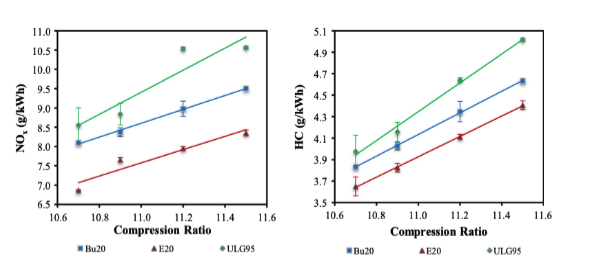
Fig. 13. Comparison of Butanol (Bu20), Ethanol (E20), and unleaded gasoline blend (ULG95) NOx and HC emissions [55].
Despite the ability of diesel fuels to outperform the fuel economy of gasoline fuels, diesel has a greater tendency to produce PM and NOx, motivating innovation in catalytic reduction technology [61]. NOx emissions can vary based on diesel or biodiesel use, researchers Chen et al. (2018) argue that combustion temperature is most influential. In analyzing the effect of engine speed and temperature on biodiesel NOx emissions, the researchers found that an increase in temperature and speed to 1000-1500rpm resulted in a 12.7 vol.% increase in NOx emissions [62]. To account for variable NOx emissions, Lešnik et al. (2013) found that increased oxygen content of biodiesel leads to more complete combustion, thereby reducing CO emissions at the cost of heightened NOx emissions [63]. Similar work by He (2016) supported these conclusions, as it was determined that increased biodiesel character resulted in reduced NOx emissions, though marginally. However, He (2016) also concluded that greater methyl ester saturation (characteristic of biodiesel blends) of the fuel resulted in larger particulate formations during combustion, resulting in holistic PM concentration increases [64]. As such, it is evident that the widespread use of diesel as an alternative fuel source to gasoline must take into account the NOx and PM cost to minimizing CO and HC emissions.
To meet the increasing demand for energy supplied by the petroleum refining industry while balancing the necessity of minimizing CO, SOx, NOx, PM, O3, and Pb emissions, fuel chemistry was evaluated at both the molecular and variety scale of fuels.
At the molecular level, differences in configurations were found to be most influential in emission calculations. Branched alkanes were found to react faster but emit greater quantities of CO than linear alkanes [32,33], while an increase in linear alkane concentration results in greater CO2 and NOx emissions [34]. When comparing chain and ring structures, it was determined that increasing olefin content reduces HC and NOx emissions [35-37], and that reduced aromatic content correlates with reduced HC and CO emissions [35,37,39]. In evaluation of PM formation, a relationship between increasing molecular weight and spatial compactness was found to be related to the tendency of a fuel to produce soot [40-42].
With respect to fuel variety, gasoline emissions have been found to be mitigated by adding ethanol in a range of concentrations, increasing the oxygen content of the fuel and reducing NOx, HC, and CO emissions [44-48]. Research pertaining to LPG emissions suggests that increasing propane concentrations results in a significant decrease in HC, NOx, and CO emissions [50-52]. Similarly, recent work supports increased oxygen content in diesel blends to promote complete combustion and reduced NOx emissions and PM formation [54-56].
The findings of this study suggest that fuel chemistry can significantly influence the emission profiles associated with the petroleum refinement industry, promoting the efforts of the UN and EPA in mitigating the effects of climate change while retaining combustion efficiency in an increasingly energy-dependent society.
Layla Intenzo: B.S. candidate Chemical Engineering, University of California, Berkeley. Layla Intenzo is an undergraduate Chemical Engineering student at the University of California, Berkeley, interested in developing sustainable water treatment solutions for the petroleum refinement process and addressing global water insecurity. Her research experience includes water quality analyses utilizing GF-AAS, development of water pasteurization indicators for global distribution, and as well as work in legislative policy research and advocacy regarding the housing crisis in California.
Dr. Raj Shah: Koehler Instrument Company, Inc.; Ph.D. Chemical Engineering, Pennsylvania State, University. Dr. Raj Shah is a Director at Koehler Instrument Company in New York. He was elected as a Fellow by his peers at ASTM, IChemE, CMI, STLE, AIC, AOCS, NLGI, INSTMC, the Energy Institute, and the Royal Society of Chemistry. He recently co-edited the bestseller "Fuels and Lubricants Handbook". He obtained a Ph.D. in Chemical Engineering from Penn State University. He is also a Chartered Scientist with the Science Council, a Chartered Petroleum Engineer with the Energy Institute and a Chartered Engineer with the Engineering Council, UK. He is an adjunct professor of Material Science and Chemical Engineering at the State University of New York, Stony Brook. He has over 700 publications and has been active in the petroleum field for three decades.
Prinika Kondoju: B.E. candidate Chemical Engineering, University of Massachusetts Amherst. Prinika Kondoju is an undergraduate Chemical and Biomolecular Engineering student at the University of Massachusetts Amherst, interested in pursuing graduate school and pharmaceuticals after graduation. She is involved in research for the Bai Group at UMass Amherst, with an emphasis on materials discovery, catalysis and electro-chemistry, and is on Jazba, a Bollywood fusion dance team on campus.
[1] United Nations, “Causes and Effects of Climate Change”, https://www.un.org/en/climatechange/science/causes-effects-climate-change.
[2] U.S. Energy Information Administration, “Monthly Energy Review”, (2026).
[3] U.S. Department of Energy, “Fuel Properties Comparison”, https://afdc.energy.gov/fuels/properties.
[4] Dorosheva, E. V., et al., “Upgrading Cat-Cracked Gasoline Fractions to Increase the Production of High-Octane Number Motor Gasoline”, (2025), https://doi.org/10.1007/s10553-025-01902-2.
[5] “Gasoline”, Funk & Wagnalls New World Encyclopedia, (2018).
[6] Clifford, C. B., “Simple flow diagram of an oil refinery”, Penn State, https://courses.ems.psu.edu/egee439/node/7.
[7] Meherzi, R., et al., “Numerical simulation of the effect of adding oxygenated fuel (ethanol) to commercial gasoline on engine performance and NOx emissions”, (2025) https://doi.org/10.1093/ijlct/ctae065.
[8] U.S. Energy Information Administration, “Natural Gas”, https://www.eia.gov/dnav/ng/TblDefs/ng_enr_sum_tbldef2.asp.
[9] Sadighi, S. and Reza, S., “Modeling of thermal cracking process in a crude oil refinery”, (2013), https://academicjournals.org/journal/JPGE/article-full-text-pdf/466BD168875.
[10] Lim, M., et al., “A comparative study of the elemental composition of the exhaust emissions of cars powered by liquefied petroleum gas and unleaded petrol”, (2006), https://www.sciencedirect.com/science/article/pii/S1352231006000598?ref=pdf_download&fr=RR-2&rr=a559c82d09178775.
[11] Dorosheva, E. V., et al., “Upgrading cat-cracked gasoline fractions to increase the production of high-octane number motor gasoline”, (2025), https://doi.org/10.1007/s10553-025-01902-2.
[12] American Society for Testing and Materials, “D975 Standards Specification for Diesel Fuel”, (2022), https://store.astm.org/d0975-21.html.
[13] Du, B., et al., “Determining Olefin Content of Gasoline by Adaptive Partial Least Squares Regression Combined with Near-Infrared Spectroscopy”, (2025).
[14] U.S. Environmental Protection Agency, “Sources of Greenhouse Gas Emissions”, (2026), https://www.epa.gov/ghgemissions/sources-greenhouse-gas-emissions.
[15] U.S. Energy Information Administration, “Carbon Dioxide Emissions Coefficients”, (2024), https://www.eia.gov/environment/emissions/co2_vol_mass.php.
[16] U.S. Congress, “Clean Air Act: A Summary of the Act and Its Major Requirements”, (2022), https://www.congress.gov/crs-product/RL30853.
[17] National Energy Strategy, “Chapter 11 - Fossil Fuels: Environmental Effects”, https://personal.ems.psu.edu/~radovic/Chapter11.pdf.
[18] Meyers et al., “Fly Ash a Construction Material for Highways: A Manual”, (1976), https://rosap.ntl.bts.gov/view/dot/68054.
[19] Calcote, H.F., and Manos, D. M., “Effect of molecular structure on incipient soot formation”, Combustion and Flame, (1983), https://www.sciencedirect.com/science/article/pii/0010218083901724?fr=RR-7&ref=pdf_download&rr=a559a75aef6f33dc.
[20] U.S. Environmental Protection Agency, “Health and Environmental Effects of Particulate Matter (PM), (2026), https://www.epa.gov/pm-pollution/health-and-environmental-effects-particulate-matter-pm.
[21] U.S. Environmental Protection Agency, “Particulate Matter (PM) Basics”, (2026), https://www.epa.gov/pm-pollution/particulate-matter-pm-basics.
[22] Wang, Yu, and Chung, Suk Ho, “Soot formation in laminar counterflow flames”, Progress in Energy and Combustion Science, (2019), https://www.sciencedirect.com/science/article/pii/S0360128518301734?ref=pdf_download&fr=RR-2&rr=a559a7dfebd833dc.
[23] Querol, W., et al., “Seasonal evolution of suspended particles around a large coal-fired power station: particulate levels and sources”, (Atmospheric Environment, (1998), https://www.sciencedirect.com/science/article/pii/S1352231097005049?ref=pdf_download&fr=RR-2&rr=a559a7fa787b33dc.
[24] National Oceanic and Atmospheric Administration, “Layers of the Atmosphere”, (2026), https://www.noaa.gov/jetstream/atmosphere/layers-of-atmosphere.
[25] U.S. Environmental Protection Agency, “Ground-level Ozone Basics”, (2026), https://www.epa.gov/ground-level-ozone-pollution/ground-level-ozone-basics.
[26] National Oceanic and Atmospheric Administration, “Why do we care about atmospheric ozone?”, (2010), https://csl.noaa.gov/assessments/ozone/2010/twentyquestions/Q3.pdf.
[27] U.S. Environmental Protection Agency, “What is Ozone?”, (2026), https://www.epa.gov/ozone-pollution-and-your-patients-health/what-ozone.
[28] Johnson, E, “Cars and ground-level ozone: How do fuels compare?”, (2017), 1–13. https://doi.org/10.1007/s12544-017-0263-7.
[29] Pope, C. A., et al., “Lung Cancer, Cardiopulmonary Mortality, and Long-term Exposure to Fine Particulate Air Pollution”, (2002), https://pmc.ncbi.nlm.nih.gov/articles/PMC4037163/.
[30] U.S. Environmental Protection Agency, “Basic Information about Lead Air Pollution”, (2026), https://www.epa.gov/lead-air-pollution/basic-information-about-lead-air-pollution.
[31] “Prohibition on gasoline containing lead or lead additives for highway use”, (1996), https://www.govinfo.gov/content/pkg/FR-1996-02-02/pdf/96-2231.pdf.
[32] Chen, M., et al., “Environmental lead risk in the 21st century”, (2025), https://pmc.ncbi.nlm.nih.gov/articles/PMC12484081/#CR60.
[33] Yuan, C., et al., "Comparison of oxidation behavior of linear and branched alkanes”, (2019), https://www.sciencedirect.com/science/article/pii/S0378382019300700.
[34] Chan, W. H., et al., “Detailed chemical characterization of unresolved complex mixtures in atmospheric organics: Insights into emission sources, atmospheric processing, and secondary organic aerosol formation”, (2013), https://agupubs.onlinelibrary.wiley.com/doi/full/10.1002/jgrd.50533.
[35] Abu-Jrai, A. M., et al., “Combustion, performance, and selective catalytic reduction of NOx for a diesel engine operated with combined tri fuel (H2, CH4, and conventional diesel)”, (2017), https://www.sciencedirect.com/science/article/pii/S0360544216316553.
[36] Carter, W. P. L., “Investigation of the ozone formation potentials of selected branched alkanes and mineral spirits samples”, (2002) Safety-Kleen Corporation, University of California, Riverside, https://intra.engr.ucr.edu/~carter/pubs/msrpt2.pdf.
[37] Chan, A. W. H., et al., “Detailed chemical characterization of unresolved complex mixtures in atmospheric organics: Insights into emission sources, atmospheric processing, and secondary organic aerosol formation”, (2013), J. Geophys. Res. Atmos., 118, 6783–6796, doi:10.1002/jgrd.50533.
[38] Aumont, B., et al., “Modeling the influence of alkane molecular structure on secondary organic aerosol formation”, (2013), Faraday Discuss. 2013;165:105-22. doi: 10.1039/c3fd00029j. PMID: 24600999.
[39] Madhu, A., et al., “Modeling the influence of carbon branching structure on secondary organic aerosol formation via multiphase reactions of alkanes”, (2024), Atmospheric Chemistry and Physics, https://acp.copernicus.org/articles/24/5585/2024/acp-24-5585-2024.pdf.
[40] Lim, Y. B., and Ziemann, P. J., “Effects of molecular structure on aerosol yields from OH radical-initiated reactions of linear, branched, and cyclic alkanes in the presence of NOx”, (2009), https://pubmed.ncbi.nlm.nih.gov/19452882/.
[41] Tkacik, D. S., et al., “Secondary organic aerosol formation from intermediate-volatility organic compounds: cyclic, linear, and branched alkanes”, (2012), https://pubmed.ncbi.nlm.nih.gov/19452882/.
[42] Manavi, S. E. and Pandis, S. N., “A lumped species approach for the simulation of secondary organic aerosol production from intermediate-volatility organic compounds (IVOCs): application to road transport in PMCAMx-iv (v1.0)”, (2022), Geoscience Model Development, https://gmd.copernicus.org/articles/15/7731/2022/gmd-15-7731-2022.pdf.
[43] Yao, Y. and Tsai, J., “Influence of Gasoline Aromatic Content on Air Pollutant Emissions from Four-Stroke Motorcycles”, (2024), Aerosol and Air Quality Research, https://link.springer.com/article/10.4209/aaqr.2012.04.0104.
[44] Calcote, H. F. and Manos, D. M., “Effect of molecular structure on incipient soot formation”, (1983), https://www.sciencedirect.com/science/article/pii/0010218083901724?ref=pdf_download&fr=RR-2&rr=a559ddaf3963d019.
[45] Auto/Oil Air Quality Improvement Research Program, “Technical Bulletin No.1”, (1990).
[46] Hakababaei, M., et al., “Impact of olefin content on criteria and toxic emissions from modern gasoline vehicles”, (2013), https://www.sciencedirect.com/science/article/pii/S001623611201054X.
[47] Schifter, I., et al., “Fuel formulation for recent model light duty vehicles in Mexico base on a model for predicting gasoline emissions”, (2013), https://www.sciencedirect.com/science/article/pii/S0016236112008435?ref=pdf_download&fr=RR-2&rr=a559d52a28ecd019.
[48] Karavalakis, G., et al., “Evaluating the Effects of Aromatics Content in Gasoline on Gaseous and Particulate Matter Emissions from SI-PFI and SIDI Vehicles”, (2015), https://escholarship.org/uc/item/2mg124qk.
[49] Gomez, A., et al., “Comparative study of soot formation on the centerline of axisymmetric laminar diffusion flames: Fuel and temperature effects”, (1987), https://www.sciencedirect.com/science/article/pii/0010218087900812?ref=pdf_download&fr=RR-2&rr=a559ddc29cc5d019.
50] Botero, M. L., et al., “Sooting tendency of paraffin components of diesel and gasoline in diffusion flames”, (2014), https://www.sciencedirect.com/science/article/pii/S001623611400132X#b0045.
[51] U.S. Department of Energy, “Ethanol Fuel Basics”, https://afdc.energy.gov/fuels/ethanol-fuel-basics.
[52] Mejeras, G., et al., “Study of gasoline with 10% ethanol additive under different fuel supply strategies”, (2026), https://doi.org/10.3390/en19051118.
[53] Iodice, P. and Cardone, M., “Ethanol/Gasoline Blends as Alternative Fuel in Last Generation Spark-Ignition Engines: A Review on CO and HC Engine Out Emissions”, (2021), https://www.mdpi.com/1996-1073/14/13/4034.
[54] Meherzi, R., et al., “Numerical simulation of the effect of adding oxygenated fuel (ethanol) to commercial gasoline on engine performance and NOx emissions”, (2025), https://doi.org/10.1093/ijlct/ctae065.
[55] Lattimore, T., et al., “Investigation of compression ratio and fuel effect on combustion and PM emissions in a DISI engine”, (2016), https://www.sciencedirect.com/science/article/pii/S0016236115010492?ref=pdf_download&fr=RR-2&rr=a559e52599395e49.
[56] Najafi, G., et al., “Performance and exhaust emissions of a gasoline engine with ethanol blended gasoline fuels using artificial neural network”, (2009), https://www.sciencedirect.com/science/article/pii/S0306261908002407?via%3Dihub.
[57] Díaz, L., et al., “Optimizing automotive LPG blend for Mexico City”, (2000), https://www.sciencedirect.com/science/article/pii/S0016236199001052?ref=pdf_download&fr=RR-2&rr=a559eb4afdc05e49.
[58] Chang, C., et al., “Assessment of reducing ozone forming potential for vehicles using liquefied petroleum gas as an alternative fuel”, (2001), https://www.sciencedirect.com/science/article/pii/S1352231001003867?via%3Dihub#BIB4.
[59] Gamas, E., et al., “Exhaust emissions from gasoline and LPG-powered vehicles operating at the altitude of Mexico City”, (1999), Journal of the Air & Waste Management Association, https://www.tandfonline.com/doi/pdf/10.1080/10473289.1999.10463920?utm_source=sciencedirect_contenthosting&getft_integrator=sciencedirect_contenthosting.
[60] Chiki, S., et al., “On-board measurement of emissions from liquefied petroleum gas, gasoline and diesel-powered passenger cars in Algeria”, (2014), Journal of Environmental Sciences.
[61] Samosir, B., et al., “NOx emissions prediction in diesel engines: a deep neural network approach”, (2023), Environmental Science and Pollution Research, https://link.springer.com/article/10.1007/s11356-023-30937-3.
[62] Chen, H., et al., “NOx emission of biodiesel compared to diesel: Higher or lower?”, (2018), https://www.sciencedirect.com/science/article/pii/S1359431117379206?via%3Dihub.
[63] Lešnik, L., et al., “The influence of biodiesel fuel on injection characteristics, diesel engine performance, and emission formation”, (2013), https://www.sciencedirect.com/science/article/pii/S0306261913003991?ref=pdf_download&fr=RR-2&rr=a559f2ebff3a5e49
[64] He, B., “Advances in emission characteristics of diesel engines using different biodiesel fuels”, (2016), https://www.sciencedirect.com/science/article/pii/S1364032116001234?ref=pdf_download&fr=RR-2&rr=a559f300999c5e49.
[65] Lumen Candela, “The Basics of General, Organic, and Biologicla Chemistry”, https://courses.lumenlearning.com/suny-monroecc-orgbiochemistry/
PIN 27.5 Oct/Nov 26



 Product directory