Analytical instrumentation
“The world runs on diesel.” Many people have heard this quote being used in economic and agricultural settings, but many people have not paid much mind to how much diesel influences everyday lives.
Diesel powers the farm equipment that harvests food, the trucks that help food and goods travel from place to place, and the gas that heats our homes and everyday lives.
With every technologic advancement more choices for everyday items become available, which leads people to question what the best choice really is.
The choice of diesel is no different. Oil is generally one of the most sought-after resources in the world right now.
This drives people to work twice as hard to find alternatives to petroleum diesels, which are made using crude oil, and makes up more than 90% of all diesels produced worldwide.
Some of these alternatives are renewable and biodiesel. For this reason, it is important to understand the differences and similarities between these alternatives so that everyone can make the correct choice when fueling up.
This text will compare a few of the most used diesels in the world right now.
The most common type of diesel for many decades has been petroleum diesel which is typically used to move trains, delivery trucks, buses and farm equipment.
Along with this, petroleum diesel can even be used for many utilities inside homes, hospitals and office buildings.
Everyday 28 million barrels of petroleum diesel are produced worldwide, which is roughly 2 billion metric tons of diesel produced yearly.
Still to this day 90%-92% of all diesels used annually is petroleum diesel.[1] To form petroleum diesel you first start by heating raw crude oil in a distillation tower and separating the components based on their boilings points.
From this process we see that roughly a 42-gallon barrel of crude oil yields about 11 to 13 gallons of diesel that can then be sold and used in different areas.
Once the crude oil is separated into components that will work to produce petroleum diesel, these parts will then move to cracking and processing, before finally heading to hydrotreating.
This is when raw diesel is treated for impurities like sulfur and nitrogen to lower the damage that diesel will cause to the environment.[2]
This last step is mainly due to the Environmental Protection Agency publishing new laws and regulations regarding how much pollution can come from petroleum diesel to reduce the level of pollution in the atmosphere.[3]
Though there are downsides, petroleum diesel is popular for many reasons.
There are several aspects to the manufacturing of petroleum diesel that have led to its popularity.
One reason being is that it has a higher cold weather efficiency due to a much lower freezing point than any other diesel on the market right now.
Another perk is that due to the less expensive equipment required to make petroleum diesel it is much cheaper than alternatives.
Along with this crude oil is very abundant in places throughout the world making the cost much lower in the short term to fuel up with petroleum diesel.
Along with cost there is, on average, more energy per volume with petroleum diesel which means that a tank of petroleum diesel might actually last longer than a tank filled with other types of diesel.[4]
Overall, petroleum diesel still brings up a lot of issues due to the high rates of pollution per gallon of diesel, which has been shown to be as bad as 22.38 pounds of carbon dioxide could be released with every gallon of diesel being used, and when about 2 billion metric tons of diesel is produced yearly, this grows into a big issue very fast.[5]
Another issue that arises is that crude oil is not a renewable resource, so once it is all used up there will be no way to make more, which is why it is so important to find alternatives soon.
Along with this, crude oil can only be farmed in certain parts of the world.
When political discourse happens, or if natural disasters for example take place, then the price of diesel will grow a lot over a short time due to the lack of resources.
The last big reason that people are looking to turn away from petroleum diesel is the fact that it is much harder on equipment than many alternatives, which can lead to costly repairs down the line and having to change equipment much more frequently than with other diesels. Therefore, there are many perks to the use of petroleum, but some people think that the risk to the environment is too great to still be knowingly putting this much population in the air when there are other alternatives.
Renewable diesel is one of the most popular alternatives to petroleum diesel.
Renewable diesel is created from fats, common oils, and greases.
The most common path to the creation of renewable diesel is hydrotreating, which is when feedstock oils react with hydrogen under high temperatures with the use of a catalyst to create fuel.[6]
Although hydrotreating is the most common way to make renewable diesel, it is not the only way.
Other paths include biological sugar upgrading, which is the deconstruction of feedstock through biochemicals and gasification.
This is a process where feedstock is thermally converted to syngas, a combustible fuel mixture, and then catalytically converted to working fuels and hydrothermal processing, which uses high pressures and moderate temperatures to decompose the feed stock into working hydrocarbon fuels.
These are just a few of the many ways that scientists are now able to create renewable diesel without the harmful emissions that someone might see from typical petroleum diesels.[7]
While the process of making renewable diesel has been well researched throughout the years, there are still many downsides to making renewable diesel.
One big challenge in the manufacturing of renewable diesel is that harmful byproducts form, which lead to companies facing problems with disposal.
The cost of the materials and the process to make renewable diesel is more expensive, which raises another issue.
That being said, once it does reach the pump it is much cheaper in many countries.
Many trucks that typically use renewable diesel have reported a $0.23 per mile savings, but this is only in states or countries that have strong environmental laws that incentivize citizens to use these more environmental consensus choices.
These subsidies can range from $0.20 to $1.00 tax credit per gallon of renewable diesel used, which can add up quickly at the pump.
However in states that do not have these laws, renewable diesel is much more expensive than typical diesel.[8]
It is also very hard to find a place to make renewable diesel that has enough water for the whole process, which leads sceptics to wonder if this process uses too much clean water to begin with.[9] Along with this, renewable diesel has a much lower energy efficiency then petroleum diesel leading most people to not choose it at the pump.
Meaning that it extracts energy at a much slower rate which leads to less miles per gallon on a truck.
That being said, renewable diesel still has many advantages over alternatives.
One of the biggest perks is that it lowers the operating costs in a vehicle’s lifetime because it is easier on the machines than other diesels.
Renewable diesel also reduces soot by up to 30% and carbon emissions by up to 70%. It can also be used to reduce scope 1 emissions by up to 100% leading to near zero carbon emissions with the use of renewable diesel compared to petroleum diesel.[10]
All in all there are advantages and disadvantages to renewable diesels which is why it is only one of the most popular diesels at this time.
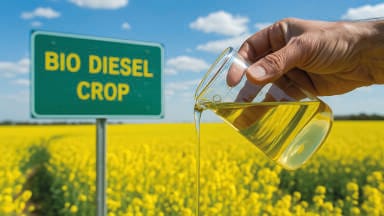
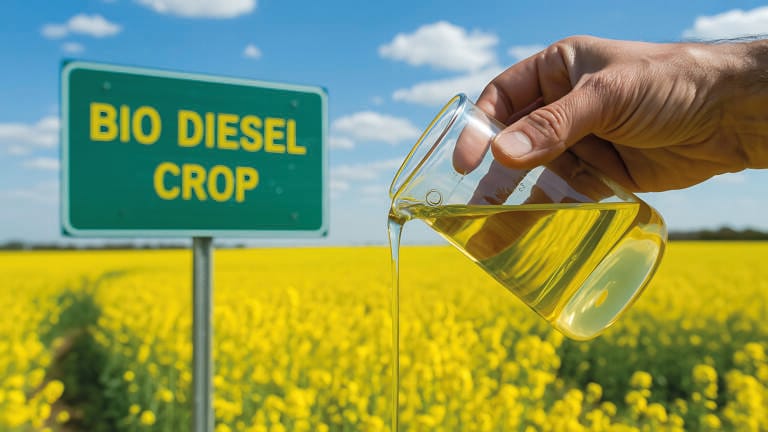
Biodiesel, a diesel produced from vegetable oils, old grease, used cooking oils and animal fat, has also become popular.
The first step when making any biodiesel is to filter and heat the oil or fat to remove any water or other impurities that might contaminate the batch.
The main way to make biodiesel is through a process called transesterification which is when a hundred pounds of grease or oil combine with ten pounds of a short-chain alcohol, usually methanol, in the presence of a catalyst to form a hundred pounds of biodiesel and ten pounds of the coproduct, glycerin.[11] Glycerin can then be sold to cosmetic companies who will use it for many household beauty products or soaps.
After this process, the oil is then cleaned again to remove any leftover material that might be harmful to trucks or machines later down the line. It is then shipped off, like any other diesel, to various fueling stations throughout the world.
Making biodiesel is a somewhat simple process, however this process requires much higher amounts of feedstock and expensive processing equipment than typical petroleum diesel.
Along with cost, there is also limited availability due to specialized storage and transportation needs because of the different chemical makeup compared to petroleum diesel.
Meaning that since biodiesel has a much higher freezing point it needs to be transported very differently to avoid crystallization.
Another big issue is that while biodiesel can decrease carbon emissions by up to 95% it also leads to higher levels of nitrous oxide, a greenhouse gas which damages the ozone layer over time.[12]
Another issue that arises from the use of biodiesel is that it leads to clogs in machines, mainly in fuel filters, fuel injectors, and storage tanks, which can cause costly repairs that will damage the machine’s efficiency in the long run.
Along with this, biodiesel has a much higher “cloud point”, which means it forms crystallized portions at much lower temperatures than petroleum diesel.
This leads to biodiesel gelling into clumps in colder temperatures, which leads to very poor cold weather efficiency and reduced energy efficiency in all weather.
In conclusion, there are many disadvantages to using biodiesel but there are still advantages too.
One such positive is if there was ever a spill or accident which caused diesel to run off, biodiesel does not cause run off that could damage surrounding ecosystems in the long run.
This is due to the fact it is biodegradable and made from nontoxic materials. Similarly to renewable diesel, biodiesel helps engines run much smoother due to the less harsh materials used to make the diesel compared to petroleum diesel.
This is because it causes fewer engine deposits and enhances lubrication inside the engines. Along with this, the process to make biodiesel helps countries
to remain independent on foreign oil because of that this diesel can be made from many common materials found throughout most countries.
In summary, there are perks and downsides to any diesel that someone decides to use.
Biodiesel burns much cleaner and more completely, has a higher cetane range, which is a chemical compound that determines how easily a type of diesel will ignite under high pressure.
Along with this. biodiesel is non-toxic and biodegradable, but the cost is much higher than petroleum diesel and has lower energy levels which leads some people to turn away from this cleaner option.
Renewable diesel, just like biodiesel, is much cleaner to use than typical petroleum diesel, but the cost is the main turn away when considering this as an alternate fuel source.
With this being said, most people would agree that typical petroleum diesel is not the wave of the future due to the high levels of greenhouse gasses it exerts a long with the fact that as a fossil fuel once the world uses up the last of the crude oil no more petroleum diesel can be made which is pushing scientist to come up with alternates like biodiesel and renewable diesel.
While there certainly still needs to be some advancements in alternate diesels to reduce the cost, most would agree that the advantages outweigh the cost with cleaner energy, more availability in resources and engine longevity.
Along with this, the market growth for alternative diesels will be much higher for biodiesel and renewable diesels because not many people have explored this industry yet.
Along with this, most vehicles are already running on some level of biodiesel and petroleum blend which will make it that much easier to transition fully when the time comes.
All in all, the use of biodiesel and renewable diesel will help extend fuel supplies while cleaning the air and help maintain the longevity of machines compared to petroleum diesel.
Dr. Raj Shah, is a Director at Koehler Instrument Company in New York, where he has worked for the last 25 plus years.
He is an elected Fellow by his peers at ASTM, IChemE, ASTM, AOCS, CMI, STLE, AIC, NLGI, INSTMC, Institute of Physics, The Energy Institute and The Royal Society of Chemistry.
An ASTM Eagle award recipient, Dr. Shah recently coedited the bestseller, “Fuels and Lubricants handbook”, details of which are available at ASTM’s Long-awaited Fuels and Lubricants Handbook https://bit.ly/3u2e6GY.
He earned his doctorate in Chemical Engineering from The Pennsylvania State University and is a Fellow from The Chartered Management Institute, London.
Dr. Shah is also a Chartered Scientist with the Science Council, a Chartered Petroleum Engineer with the Energy Institute and a Chartered Engineer with the Engineering council, UK.
Dr. Shah was recently granted the honorific of “Eminent engineer” with Tau beta Pi, the largest engineering society in the USA.
He is on the Advisory board of directors at Farmingdale university (Mechanical Technology), Auburn Univ (Tribology), SUNY, Farmingdale, (Engineering Management) and State university of NY, Stony Brook (Chemical engineering/ Material Science and engineering).
An Adjunct Professor at the State University of New York, Stony Brook, in the Department of Material Science and Chemical Engineering, Raj also has over 825 publications and has been active in the energy industry for over 3 decades.
Dr. Vikram Mittal, PhD is an Associate Professor in the Department of Systems Engineering at the United States Military Academy.
His research interests include energy modeling, technology forecasting, and Alternative fuels. Previously, he was a senior mechanical engineer at the Charles Stark Draper Laboratory. He holds a PhD in Mechanical Engineering from MIT, an MS in Engineering Sciences
from Oxford, and a BS in Aeronautics from Caltech. Dr. Mittal is also a combat veteran and a major in the U.S. Army Reserve.
Ava Ingram, is currently an undergraduate student studying chemical engineering and minoring in business at the University of Missouri.
Her current research focus is on petroleum and how it can be used in everyday life. Along with this she is a tutor for undergraduate students and a part of the Society of Women in Engineering. After graduation she hopes to focus on environmental sciences.
Car and driver. (2025, July 27). Biodiesel, renewable Diesel, and petroleum diesel: What’s the difference? Michigan Advanced Biofuels Coalition. https://www.miadvancedbiofuels.com/2025/07/biodiesel-renewable-diesel-and-petroleum-diesel-whats-the-difference/
Biodiesel production and distribution. Alternative Fuels Data Center: Biodiesel Production and Distribution. (n.d.). https://afdc.energy.gov/fuels/biodiesel-production
Environmental Protection Agency. (n.d.). Diesel Fuel Standards. EPA. https://www.epa.gov/diesel-fuel-standards/diesel-fuel-standards-and-rulemakings
Veolia North America (n.d.). Energy transition deep dive: Top 6 challenges renewable diesel producers face. Sustainable Stories. https://blog.veolianorthamerica.com/energy-transition-deep-dive-top-6-challenges-renewable-diesel-producers-face
Paz, C. (2025, February 12). The benefits of renewable Diesel. Mansfield Energy. https://mansfield.energy/2024/06/13/the-benefits-of-renewable-diesel/
Radimin. (2026, August 16). Biodiesel drawbacks: Pros and cons unpacked in detail. The Anaerobic Digestion & Biogas Blog. https://blog.anaerobic-digestion.com/biodiesel-drawbacks/
Renewable diesel. Alternative Fuels Data Center: Renewable Diesel. (n.d.). https://afdc.energy.gov/fuels/renewable-diesel
U.S. Energy Information Administration - EIA - independent statistics and analysis. Diesel fuel explained - U.S. Energy Information Administration (EIA). (n.d.). https://www.eia.gov/energyexplained/diesel-fuel/
[1] BA, A. (2025, July 27). Biodiesel, renewable Diesel, and petroleum diesel: What’s the difference? Michigan Advanced Biofuels Coalition.
[2] U.S. Energy Information Administration - EIA - independent statistics and analysis. Diesel fuel explained - U.S. Energy Information Administration (EIA). (n.d.).
[3] Environmental Protection Agency. (n.d.). Diesel Fuel Standards . EPA.
[4] EIA
[5] EIA
[6] Biodiesel production and distribution. Alternative Fuels Data Center: Biodiesel Production and Distribution. (n.d.). https://afdc.energy.gov/fuels/biodiesel-production
[7] U.S. Department of Energy
[8] Paz, C. (2025, February 12). The benefits of renewable Diesel. Mansfield Energy.
[9] Lessons. (n.d.). Energy transition deep dive: Top 6 challenges renewable diesel producers face. Sustainable Stories.
[10] Paz, C. (2025, February 12). The benefits of renewable Diesel. Mansfield Energy.
[11] Biodiesel production and distribution. Alternative Fuels Data Center: Biodiesel Production and Distribution. (n.d.)
[12] Radimin. (2026, August 16). Biodiesel drawbacks: Pros
and cons unpacked in detail. The Anaerobic Digestion & Biogas Blog.
PIN 27.5 Oct/Nov 26

 Product directory