Fuel analysis
According to the United Nations Climate Action, fossil fuels are the largest contributor to global warming, with 68% of greenhouse gas emissions deriving from the petroleum refinement process. As a result of the greenhouse gas effect of harmful emissions trapped within the atmosphere, Earth experiences hotter temperatures, increased droughts, ocean level rising, biodiversity loss, as well as increased rates of global poverty [1]. At the same time, increasing demand for energy at the cost of heightened pollutant emissions makes it relevant to evaluate the extent to which fuel chemistry affects emissions and particulate formation. In this paper, the combustion reaction is introduced, followed by an introduction to environmental concerns and fuel chemistry and varieties. After evaluating fuel chemistry based on molecular variation in linearity, the presence of alkenes, and aromatic content, as well as the structural carbon/hydrogen ratios of gasoline, liquified petroleum gas, and diesel, it was determined that the addition of oxygen-rich ethanol blends to standard gasoline fuels served to minimize CO and NOx emissions while maintaining optimal combustion efficiency.
i. Fuel and fuel chemistry.
The term “fuel” refers to any substance that can be used to provide energy that can be used for other processes. Since the mid-nineteenth century, hydrocarbon natural gas and liquid petroleum systems have been developed to respond to the increasing demand for energy. These hydrocarbon systems can have a wide range of chemical properties that affect the performance of the fuel types, resulting in varied rates of increasing demand by type. In a Monthly Energy Review published by the US Department of Energy, it was determined that global demand for fossil fuel (petroleum and natural gas) sources has steadily increased since 1980, while coal sources have declined and nuclear electric and renewable alternatives have experienced a less steep increase. Data from 2000 found that 69.262 quadrillion British Thermal units (Btu) of energy were produced across the fossil fuel production sectors (57.307 quadrillion Btu from coal, natural gas, crude oil, and natural gas pipeline). As indicated in Figure 1, the demand from 1980 has steadily increased for all fuel types except coal through 2015 (71.4 quadrillion Btu produced from fossil fuels) and maintained an upward trend in 2025 statistics (84.46 quadrillion Btu from fossil fuels) [2].
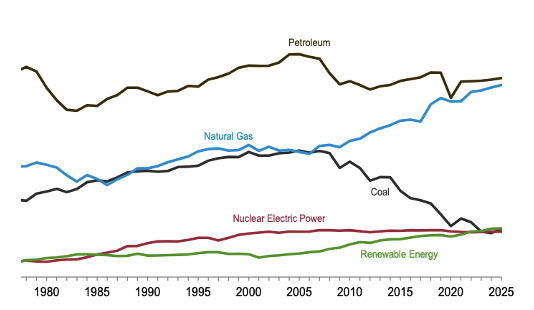
Fig. 1. Trends in energy demand by fuel type (1980-2025) [2]
Despite the increasing demand for alternatives to fossil fuel petroleum and natural gas systems, Figure 1 demonstrates that petroleum and natural gas demand still vastly outweigh renewable and nuclear electric energy alternatives. The fundamental processes required to convert crude petroleum and natural gas into energy is the hydrocarbon combustion reaction (Reaction 1):
C + O2 → CO2 (Reaction 1)
In combustion reactions, oxygen gas is reacted with another molecule, releasing energy through heat or light. For instance, the combustion of propane, a hydrocarbon derived from natural gas, can produce 23,726 Btu energy/gal [3]:
C3H8 + 5O2 → 3CO2 + 4H2O
To maximize the energy released from the combustion reaction, it is necessary to react O2 with molecules with high heats of combustion, or molecules that have high potential energy stored within their bonds. Molecules with high heats of combustion include hydrocarbons (Reaction 1), as well as hydrogen.
As a result, effective fuel sources have three major composition constituents: hydrocarbons, oxygenates, and other trace molecules.
Hydrocarbons are molecules that contain only hydrogen and carbon, with fuels derived from crude petroleum typically containing five major classes of hydrocarbons:
1. Unbranched alkanes, or n-paraffins, are considered “straight-chain” hydrocarbons connected only by single bonds (Figure 2). As such, these molecules are saturated with the maximum number of hydrogen atoms for a given number of carbon atoms. Unbranched alkanes are denoted as CnH2n+2 (n = the number of carbons in the molecule)
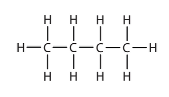
Fig. 2. Unbranched alkane [65]
2. Branched alkanes (Figure 3) are found within petroleum. The “iso-paraffins” are also denoted by CnH2n+2 but are nonlinear due to the presence of alkyl branches extending from the main hydrocarbon chain.
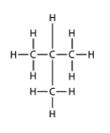
Fig. 3. Branched alkane [65]
3. Cyclic alkanes, or “cycloalkanes” and “naphthenes” (Figure 4), are saturated hydrocarbons that have ring-shaped carbon structural configurations. Ring structures generally have 3-9 carbon atoms, and are denoted as CnH2n. 5-membered and 6-membered rings are the most stable ring types due to minimized ring strain from favorable bond angles.
[1] United Nations, “Causes and Effects of Climate Change”, https://www.un.org/en/climatechange/science/causes-effects-climate-change.
[2] U.S. Energy Information Administration, “Monthly Energy Review”, (2026).
[3] U.S. Department of Energy, “Fuel Properties Comparison”, https://afdc.energy.gov/fuels/properties.
[4] Dorosheva, E. V., et al., “Upgrading Cat-Cracked Gasoline Fractions to Increase the Production of High-Octane Number Motor Gasoline”, (2025), https://doi.org/10.1007/s10553-025-01902-2.
[5] “Gasoline”, Funk & Wagnalls New World Encyclopedia, (2018).
[6] Clifford, C. B., “Simple flow diagram of an oil refinery”, Penn State, https://courses.ems.psu.edu/egee439/node/7.
[7] Meherzi, R., et al., “Numerical simulation of the effect of adding oxygenated fuel (ethanol) to commercial gasoline on engine performance and NOx emissions”, (2025) https://doi.org/10.1093/ijlct/ctae065.
[8] U.S. Energy Information Administration, “Natural Gas”, https://www.eia.gov/dnav/ng/TblDefs/ng_enr_sum_tbldef2.asp.
[9] Sadighi, S. and Reza, S., “Modeling of thermal cracking process in a crude oil refinery”, (2013), https://academicjournals.org/journal/JPGE/article-full-text-pdf/466BD168875.
[10] Lim, M., et al., “A comparative study of the elemental composition of the exhaust emissions of cars powered by liquefied petroleum gas and unleaded petrol”, (2006), https://www.sciencedirect.com/science/article/pii/S1352231006000598?ref=pdf_download&fr=RR-2&rr=a559c82d09178775.
[11] Dorosheva, E. V., et al., “Upgrading cat-cracked gasoline fractions to increase the production of high-octane number motor gasoline”, (2025), https://doi.org/10.1007/s10553-025-01902-2.
[12] American Society for Testing and Materials, “D975 Standards Specification for Diesel Fuel”, (2022), https://store.astm.org/d0975-21.html.
PIN 27.5 Oct/Nov 26



 Product directory