
Analytical instrumentation
Published over 11 years ago. See the latest and most current information on Analytical instrumentation.
Though the term “polymeric materials” may sound far too technical and obscure to most untrained ears who are not familiar with such scientific jargon, the truth is that we all encounter and interact with polymers (as they are more commonly known) every day of our lives.
Put simply, polymers are nothing more than substances comprised of a series of structurally repeating units. Because the links between the units are uniform and repetitive, polymeric molecular structure often takes the form of a chain. Polymers can be both naturally occurring and man-made, and play a big part in our daily existence.
There are countless examples of natural polymers which have been around since the dawn of creation. Indeed, if we wish to see examples, we need look no further than our own body. The helical structure of DNA, which many of us are familiar with an abstract way, is a great way to envisage an example of polymers, since it is a complex series of recurring units which combine together to form something greater than the whole of the parts.
Other polymers in our bodies include proteins, while cellulose, the main component of all plant life, is another polymer. Its purest natural form is cotton, while it also comprises the bark of trees and other structural parts of plants, making it the most abundant organic compound on our planet.
More examples of natural polymers include starch, natural rubber, wool, silk and amber.
On the other hand, man has also been studying and creating artificial polymers for almost 200 years. This is achieved by using small molecules, called monomers, to combine together to create a larger series of molecules, or a macromolecule. Synthetic polymers are often commonly referred to as “plastics”.
More often than not, the substance used as the backbone for the formation of plastics is carbon, although this is not always the case. Silicon and a variety of metals can also be used in their manufacture.
Some everyday examples of synthetic polymers include polyvinyl chloride (PVC), nylon, Teflon, neoprene, polystyrene and synthetic rubber.
Polymers are used in all sorts of fields and industries around the globe – both natural and synthetic. Here are just a handful of their potential uses:
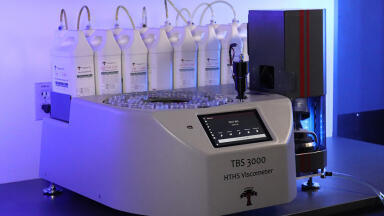
Since scientists are developing new types of polymeric substances all of the time, they must be thoroughly tested before entering the marketplace to determine how they will react in real-life situations. The article Fully Automated Instrument for Solution Viscosity in Polymeric Materials talks in detail about how one particular aspect of their performance can be measured using an innovative new device.
PIN 27.5 Oct/Nov 26

 Product directory



.jpg)










.jpg)


.jpg)







.jpg)