Measurement and testing
Recent advances in gas technology have changed how energy is stored, released, and utilized to reduce energy loss.
Using renewable sources such as wind energy, solar energy, and biofuels with the integration of advanced technology have been promising alternatives to reduce greenhouse gas emissions.
Some approaches are Power-to-Gas, Power-to-Methane, and uses of renewable natural gas allow for electricity conversion surplus.
The development, policies, and possible solutions involving environmental benefits and future trajectory are emphasized in this paper.
The deployment of RNG process reduces criteria pollutants by 99% and produces a very low carbon fuel in the base case and the most common feedstocks used to produce RNG are livestock manure and landfill.
Petroleum refineries manufacture gasoline from crude oil (also known as petroleum) through distillation and are then selectively reconfigured into new products.
Gasolines from different refineries are often transported through shared pipelines, where mixing of products occurs. As gasoline exits the pipelines, it needs to be tested to see if local, state or federal requirements are met.
If failed, it would need to be sent back to the refinery for reprocessing [1].
Renewable energy sources, such as hydroelectricity, geothermal energy, wind energy, solar energy, biofuels, and biomass, have been gradually replacing fossil fuel resources, offering alternative methods that reduce greenhouse gas emissions, yet its sustainability is still being debated.
Current technological limits in electric grid management, such as intermittency of renewables, storage limitations, and grid constraints, can reduce the production capacity of wind turbines (up to 100% during windless days) and solar power plants (up to 70% on cloudy days) [2].
As unprogrammed energy cannot be injected into the grid even when it is available, this results in energy wastage. It is then crucial for storage of electricity conversion surplus to maintain a continuous supply of electricity and reduce energy loss.
One such approach in gas technology is Power-to-Gas (P2G) technology, which encompasses the conversion of electricity through water splitting.
However, this technology has technical difficulties due to its low energy density and small molecular size, which then hampers H2 handling, transportation, and storage causing the unsafe maintenance of hydrogen gas [2].
Hydrogen contains less energy per unit volume than other fuels and due to its small molecular size, leakage through pipes and storage tanks, and safety concerns are in question during transportation.
An alternative approach is a bio electrochemical version of P2G (BEP2G), which offers the possibility of synthesizing and converting H2 and CO2 into “green” methane, with the infrastructure of the methane gas supporting the excess renewable energy which could be converted into an energy vector and extend the storage of surplus energy for a longer duration [2].
This would allow for Power-to-Methane approach, also known as the Sabatier process, which is another carbon capture and utilization strategy, through CO2 sequestration and reduction to CH4 by using surplus renewable electricity.
This technology is categorized as a thermochemical and biological process, based on the nature of the catalyst. The Sabatier process can be used to create renewable natural gas (RNG), also known as biomethane.
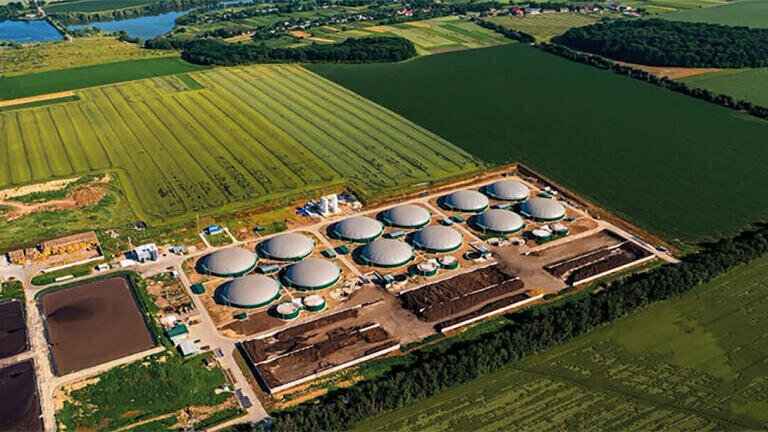
Renewable natural gas (RNG) is produced from waste and renewable sources such as livestock manure, municipal solid waste, food waste, and landfill gas.
Through using anaerobic digestion and advanced thermochemical processes, waste products can be converted into biogas, digestates, which is nutrient-rich residue after anaerobic digestion, and solid and liquid effluents through four steps: hydrolysis, acidogenesis, acetogenesis, and methanogenesis.
Biogas contains mainly methane with carbon dioxide and small amounts of ammonia, and when upgraded and purified into high-grade methane (95-99% concentration), they are considered RNG.
The most common feedstocks used to produce RNG through anaerobic digestion are livestock manure and landfill. Some parameters that may affect the production process are temperature, retention time, pH level, organic loading rate, and the feedstock type.
Although animal manure and landfill gases have low energy content and RNG yield, they have neutral pH, high-nutrient content, and naturally occurring microbes, which are characteristics that favor anaerobic digestion and reduces process complexity [3].
Co-digestion of cellulosic biomass, such as agricultural residues and energy crops, with livestock manure increases RNG yield due to higher carbon content and methane outputs.
Although the biomass gasification method is relatively new, a preliminary study conducted by Kramer et al. demonstrated that RNG from gasification of wood requires a capital investment of $340 million U.S. dollars, resulting in a production cost of $13.80 per million British thermal units (MMBTU) of RNG, which is about 50% more capital-intensive than anaerobic digestion [6].
Using the National Energy Modeling System (NEMS), the transportation market of RNG is studied, and the prospects of the U.S. energy production, consumption, import, and export are reported.
The advantage of using this model is to capture the complex market dynamics and varying conditions better than linear input-output models. Economic theories are then used to structure the modeling framework while modeling supply- and demand-side technologies with meticulous detail.
As many energy models have yet to model RNG as a competitor in the transportation fuel market, the ISU-NEMS model was developed through adopting and updating the EIA’s NEMS codes and building new pathways to represent various technologies [3].
RNG was modeled from three feedstock types, including corn stover, dairy manure, and swine manure. Connecting to each pathway, the relevant assumptions on economic parameters, carbon intensity scores, and learning rates were updated to reflect the current technologies producing RNG accurately.
In Table 1, the economic and environmental assumptions for RNG and cellulosic ethanol technologies are summarized. All the costs were converted to $2020 U.S. dollars and RNG produced from different sources estimated capital costs of $10-35 million [3].
Using linear programming, supply-side technologies are optimized, and the least cost options are chosen to meet the projected future energy demand. RNG produced from both manure feedstocks has negative emissions, representing CO2 removal from the atmosphere.
In particular, RNG Corn Stover is a relatively new technology, and the pathway uses cellulosic biomass and anaerobic digestion to produce biogas, which is then purified to RNG. There is no directly available lifecycle assessment (LCA) study on RNG produced from corn stover.
Corn stover feedstock emissions are considered positive emissions, attributed from feedstock production, fertilizer utilization and transportation to conversion.
RNGs have significant environmental benefits. During combustion, the carbon released is considered biogenic carbon, which is part of the natural carbon cycle and does not increase carbon emissions in the atmosphere.
In 2022, the agricultural sector contributed 10% of the total Greenhouse Gas (GHG) emissions, 13% of which are through manure management, which is the storage and treatment of manure from various livestock types and primarily releasing methane and nitrous oxide emissions [3].
This is crucial as methane and nitrous oxide emissions are respectively 25 and 298 times more potent than carbon dioxide in driving global warming.
Under current policy, RNG production in the U.S. is projected to grow to 2.7 billion gallons by 2050, leading to reduction in GHG by 58.56 million metric tonnes (MMT) of CO2 in 2050.
This reduction is about 29.7% of the GHGs from natural gas in 2022 [3]. Utilizing these gases as feedstocks for RNG could therefore greatly reduce total emissions.
In recent years, RNG has grown rapidly in the U.S., with the total number of RNG projects rising to 281 in 2022 and across 400 facilities in 2024 [3].
This rapid increase is primarily due to California’s Low Carbon Fuel Standard (LCFS), where they created a carbon market that provides a significant carbon credit of up to about $200 per metric ton of carbon dioxide.
RNG produced anywhere that is injected into the pipelines connected to California’s market would be eligible to receive a carbon credit under LCFS.
Carbon credit allows renewable gas projects to become more profitable, allowing for investments to increase and more people to research RNG.
RNG is also eligible for Renewable Identification Numbers credit, which are unique codes that track renewable fuel credits within the U.S. Renewable Fuel Standard program, if they are produced from verified pathways.
Though producing RNG has various benefits, the development of RNG is subject to market and policy uncertainties, such as the economic feasibility of RNG plants.
Anaerobic digesters are costly, and small-scale digesters typically fail the economic feasibility test. This leads to requiring large digesters and large-scale farms to be profitable.
Policy uncertainty would largely impact the development of RNG, as the current market depends on policy support. Adjustments and expiration of financial incentives would lead to high uncertainties that would hinder investment into RNG.
LCSF aims to reduce the carbon intensity of the state’s transportation sector and remove GHGs from the atmosphere.
The future trajectory of RNG is currently still uncertain. Extant literature has focused on solving project-level problems, such as technical and system optimization issues, economic viability evaluation, and life-cycle assessment for environmental impacts and emissions, yet these studies fail to provide an overall image of the technology development trajectory for RNG [4].
Recent developments, such as a numerical model based on trial data from the South China Sea NGH project, indicated that boosting well spacing and the number of wells in multicluster patterns would improve productivity [4].
A new microfluidic chip, designed by Rui, investigated methane hydrate formation and decomposition mechanisms, focusing on hydrate reformation and phase transition [4].
Other investigations presented a formation of non-combustible pentafluoroethane gas hydrate and its application as a fire suppression agent for class-B-type fires induced by liquid substances.
Though these developments have deepened the understanding of hydrates and industrial applications, the formation of hydrates remains a persistent challenge in the energy industry, as it leads to blockage of oil and gas production equipment and pipelines.
The near and long-term future productions of advanced biofuel streams in 2025, 2030, 2040, and 2050 are shown. The model indicates that the production of RNG Swine is the highest and grows the fastest over time.
The RNG Swine pathway follows studies by Argonne National Laboratory and assumes a biogas yield of 13 MJ/kg of dry feedstock and uses pressure swing adsorption for biogas purification [3].
The future development of renewable natural gas is analyzed and determined that production costs and emission factors are the critical drivers of technological advancement.
In Figure 2, the hydrate dissociation enthalpies and the predicted gas storage capacities for the selected agents are displayed. CO2 demonstrates the highest v/v capacity at 173.2 with FIC-13I1 at 157.9 v/v and HFC-125a exhibiting 118.2 v/v capacity.
The capacities depend on cage occupancies, emphasizing the need for research in guest gas occupancy using various analytical methods.
HFC-125a hydrate is a superior fire suppression agent and its hydrate powder effectively prevents reignition, showcasing practical feasibility through deploying hydrated powder using novel indigenous gun-type sprayer in pool fire scenarios.
The endothermic nature of the hydrate absorbs heat and released encapsulated HFC-125a gas, which reacts to remove oxygen, creating an inhospitable environment for combustion and prevented reignition.
The viability of gas hydrated-based technology is crucial for future fire extinguishment methods.
As greenhouse gas emissions increase and the supply of natural gas decreases, RNG is a sustainable alternative to fuel our economy. However, there are limitations due to unexpected circumstances, such as disruptions due to natural disasters, and this would largely impact the RNG supply chain.
During the winter season, there could be potentially increased demand for RNG. Future U.S. policy on advanced biofuel is unknown due to changing political and social factors, and advances in technologies can affect the development of RNG.
As gas technology advances, methods such as P2G, P2M, and RNG offer various ways to reduce greenhouse gas emissions and change the way energy is stored.
P2G offers conversion of electricity through water splitting and the bioelectrochemical approach of P2G (BEP2G) allows for excess renewable energy to be converted into an energy vector, extending the storage of surplus energy, reducing energy wastage.
RNG is produced from anaerobic digestion and feedstocks such as livestock manure and landfill gases. The carbon released from RNG during combustion is biogenic carbon, which does not increase carbon emission in the atmosphere as it is part of the natural carbon cycle.
As policy changes are unpredictable, the development of RNG may be impacted in the future as current market depends on policy support.
The future trajectory of gas technology depends on technology innovations and policy supports, allowing for renewable gas to reduce greenhouse gas emissions and lead to a more sustainable energy economy.
Dr. Raj Shah is the Director at Koehler Instrument Company in New York, where he has worked for the last 25+ years. He is an elected Fellow by his peers at IChemE, AOCS, CMI, STLE, AIC, NLGI, INSTMC, Institute of Physics, The Energy Institute, and The Royal Society of Chemistry.
As an ASTM Eagle award recipient, Dr. Shah recently coedited the bestseller, “Fuels and Lubricants handbook”, details of which are available at ASTM’s Long Awaited Fuels and Lubricants Handbook 2nd Edition Now Available https://bit.ly/3u2e6GY.
He earned his doctorate in Chemical Engineering from The Pennsylvania State University and is a Fellow from The Chartered Management Institute, London.
Dr. Shah is also a Chartered Scientist with the Science Council, a Chartered Petroleum Engineer with the Energy Institute and a Chartered Engineer with the Engineering Council, UK. Dr. Shah was recently granted the honorific of “Eminent Engineer” with Tau beta Pi, the largest engineering society in the USA.
He is on the Advisory Board of Directors at Farmingdale University (Mechanical Technology), Auburn University (Tribology), SUNY, Farmingdale (Engineering Management), and State University of NY, Stony Brook (Chemical Engineering/Material Science and Engineering).
An Adjunct Professor at the State University of New York, Stony Brook, in the Department of Material Science and Chemical Engineering, Raj also has over 725 publications and has been active in the energy industry for over 3 decades. More information on Raj can be found at https://tinyurl.com/mbz22vjv
Contact: [email protected]
Miss Sheena Chen is part of a thriving internship program at Koehler Instrument Company in Holtsville and is studying towards a degree in Chemical and Molecular Engineering at Stony Brook University, New York.
Mister William Chen is part of a thriving internship program at Koehler Instrument Company in Holtsville and just graduated with a degree in Chemical and Molecular Engineering from Stony Brook University, New York.Brook, New York. He also is a process engineer at Mill-Max where he optimizes performance with sustainability and efficiency.
[1] U.S. Energy Information Administration. (2016). Where Our Gasoline Comes from- U.S. Energy Information Administration (EIA). Eia.gov. https://www.eia.gov/energyexplained/gasoline/where-our-gasoline-comes-from.php
[2] Soggia, G., Goglio, A., Cristiani, P., & Adani, F. (2025). Bioelectrochemical conversion of CO2 emissions as greenhouse gases capture and renewable electricity storage strategy: advancing power-to-methane technologies– a critical review. Sustainable Energy Technologies and Assessments, 80, 104394. https://www.sciencedirect.com/science/article/abs/pii/S2213138825002255
[3] Aui, A., & Wang, Y. (2025). Policy support and technology development trajectory for renewable natural gas in the U.S. Renewable Energy, 244, 122669. https://www.sciencedirect.com/science/article/pii/S0960148125003313
[4] Daraboina, N., Kunar, R., & Linga, P. (2024). Recent Advances in Gas Hydrate Technologies: An Update from ICGH10. Energy & Fuels, 39(2), 1027-1030, https://pubs-acs-org.proxy.library.stonybrook.edu/doi/10.1021/acs.energyfuels.4c06144
[5] Han, J., Lee, J., Sai Kiran Burla, Chung, S., & Ju Dong Lee. (2024). Exploring the Potential of HFC-125a Hydrate for Innovative Fire Suppression: A Gas Hydrate Technology Approach. Energy & Fuels, 38(7), 6238-6250. https://pubs.acs.org/doi/10.1021/acs.energyfuels.3c05056
[6] Kramer et al. (2019). Low-Carbon Renewable Natural Gas (RNG) From Food Wastes. GTI, 3, https://www.gti.energy/wp-content/uploads/2019/02/Low-Carbon-Renewable-Natural-Gas-RNG-from-Wood-Wastes-Final-Report-Feb2019.pdf
PIN 27.4 Aug/Sept 2026


 Product directory


























.jpg)