Laboratory products
Rheology is a fundamental analytical tool for understanding, designing, and controlling life-science and pharmaceutical products across their entire physical spectrum. This article describes how rotational and oscillatory rheological techniques support formulation development, scale-up, and quality control, with a particular focus on semi-solid dosage forms in accordance with USP <1912>. The capabilities of the new-generation Anton Paar MCR rheometers are presented, highlighting their precision, speed, intelligence, and adaptability for handling limited sample volumes, avoiding measurement artifacts such as wall slip, and integrating advanced measurement modes. Applications ranging from protein-based formulations to UV-curing systems are discussed, alongside strategies for ensuring data integrity and regulatory compliance. Together, these examples illustrate how modern rheometer platforms accelerate life-science product testing while delivering robust, compliant, and future-proof material characterisation.
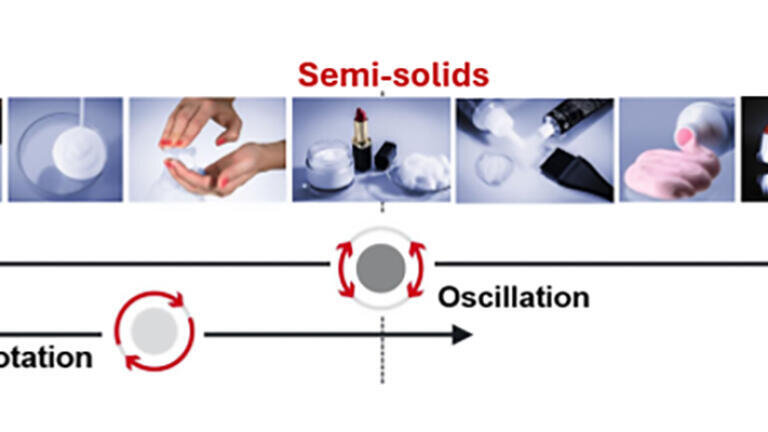
Rheology is the science of how materials deform and flow under applied forces. In the pharmaceutical field, rheological principles are essential for understanding and controlling materials that span a broad continuum of physical states, often described as the ‘rheology road’ (Figure 1). Along this conceptual path, systems range from low-viscosity liquids, through structured semi-solids such as gels, creams, and pastes, to highly elastic or rigid solid-like materials. Pharmaceutical products and intermediates occupy virtually every position along this road, and rheological methods are uniquely suited to characterise their flow, deformation, and viscoelastic response under relevant processing and use conditions. By quantifying parameters such as viscosity, yield stress, and the balance between elastic and viscous behaviour, rheology provides a unified framework for describing liquids, semi-solids, and solids within a single scientific discipline – making it inherently central to pharmaceutical science.
Figure 1: ‘The rheology road’.
Along the rheology road (Figure 1), the choice of rheological test depends on the material’s physical state. Rotational (steady-shear) tests are most useful for liquids and low-viscosity semi-solids, providing viscosity profiles, analysing shear-thinning behaviour and yield stress, and mimicking practical processes such as pumping or spreading. Oscillatory (dynamic) tests are preferred for structured semi-solids and solid-like gels, as they probe viscoelasticity, microstructural integrity, and the linear viscoelastic region without disrupting the internal network. For semi-solids, combining both methods offers complementary insights: Rotational tests define flow and processability, while oscillatory tests reveal structural strength and stability. By selecting the appropriate method along the rheology road, formulators can optimise both processing and end-use performance of pharmaceutical products.
Anton Paar’s new-generation MCR rheometers represent a significant advance in how rheology supports life-science research, development, and quality control (Figure 2). Designed to be the most precise, fastest, smartest, and most adaptable rheometers to date, they enable scientists to gain deeper insight into material behaviour, work more efficiently, and make decisions with greater confidence.
Because they combine these strengths in a single platform, the new MCR rheometers are ideally suited to the complex demands of life-science testing. They provide enhanced insight into structure and stability, allowing potential formulation risks and weaknesses to be identified at an early stage. At the same time, they support stronger control of manufacturing and quality by ensuring that materials behave consistently from laboratory development through to production.
A deeper understanding of flow, deformation, and storage behaviour helps reduce development risk, while faster and more efficient workflows enable laboratories to meet regulatory and documentation requirements without sacrificing productivity. The result is a high level of data integrity and confidence, which is essential for audits, regulatory submissions, and effective lifecycle management of life-science products.
Many pharmaceutical samples, such as low-viscosity protein solutions, present a specific analytical challenge: They are often highly valuable and available only in very limited quantities. From a rheological perspective, low-viscosity materials typically require larger measuring geometries to generate sufficient torque for accurate measurement, which in turn increases sample consumption. When only small volumes are available, this trade-off can limit the accessible shear rate range and reduce the quality of the data.
High rheometer precision is therefore essential when working with small sample volumes. Using small-diameter cone-plate geometries, precise torque resolution allows reliable measurements even at very low shear rates, despite the reduced sample size. This enables rheological characterisation over a broad shear rate range, which is critical for fully understanding the flow behaviour of pharmaceutical formulations.
This capability is particularly important for protein-based ophthalmic formulations. In eye drops, formulation scientists often aim for shear-thinning behaviour at high shear rates to facilitate easy administration, combined with yield stress behaviour at low shear rates to improve residence time and bioavailability on the eye surface. Capturing both regimes within a single measurement requires accurate data across several decades of shear rate, as illustrated in Figure 3.
Figure 3: Whether it is a precious low-viscosity protein or a single eye drop, just 70 µL is enough for complete characterisation. This means reduced sample volume without compromising measurement range, even at low viscosities.
Because such samples are often extremely valuable, the ability to recover them after testing is an additional advantage. For this purpose, dedicated lower plates with kidney-shaped collection grooves allow the sample to be efficiently retrieved after measurement (Figure 4).
This way, even very small volumes – in the order of a single eye drop – can be characterised comprehensively without compromising measurement range or data quality.
Figure 4: Lower measuring plate with a SmartGroove to collect valuable sample for reuse.
Rheology plays a key role in the formulation of life-science and pharmaceutical products, particularly semi-solid dosage forms such as creams, ointments, and lotions. These materials do not behave as simple liquids but exhibit a combination of viscous and elastic properties that change under stress, over time, and with temperature. Their performance, stability, and patient acceptability are closely linked to this complex flow behaviour. Rheological methods therefore provide essential insight into formulation structure and enable developers to design products that are stable during storage, robust during manufacturing, and easy to apply during use.
The importance of rheology for semi-solid pharmaceuticals is reflected in Chapter <1912> of the United States Pharmacopeia, which provides guidance on the rheological characterisation of these products [1]. USP <1912> emphasises that both viscous and elastic properties must be considered to properly assess product consistency, performance, and stability. One of the central parameters described is yield stress, defined as the stress at which a semi-solid begins to flow. Yield stress directly influences spreadability, texture, and resistance to phase separation, and is sensitive to formulation composition, temperature, and test conditions [2].
USP <1912> describes several approaches for determining yield stress, including oscillatory amplitude sweep measurements. In this method, an increasing shear strain or shear stress is applied at a constant frequency while monitoring the storage and loss moduli. Within the linear viscoelastic region, both moduli remain constant, indicating an intact internal structure. The end of this region, often referred to as the limiting stress, is commonly used as a measure of yield stress. At higher stresses, the crossover of the storage and loss moduli marks the transition from solid-like to liquid-like behavior and is defined as the flow point. Using a parallel-plate geometry, these characteristic values can be determined automatically with RheoCompass™ software in accordance with USP <1912>. With the new-generation MCR rheometers, the required measurement time for such amplitude sweeps can be reduced by about 50% compared to previous systems while delivering equivalent results, enabling faster and more efficient characterisation of semi-solid pharmaceutical formulations (Figure 5).
Rheology is playing an increasingly important role in the quality control of life-science products, where consistency, reliability, and efficiency are essential. In a QC environment, rheological measurements are often used to confirm batch-to-batch consistency, detect deviations early, and ensure that products meet predefined release specifications. High precision is critical, as even small changes in rheological parameters can indicate variations in raw materials, processing conditions, or product stability. Fast measurement routines support the high throughput required in QC laboratories, allowing large numbers of samples to be tested within tight timelines without compromising data quality.
At the same time, smart and adaptable rheometer platforms are key to successful routine QC operation. Intelligent software guidance, automated evaluation, and intuitive instrument handling help minimise operator-dependent variability and reduce the risk of errors, which is especially important in regulated environments. Adaptability ensures that a single rheometer can be used across multiple products, methods, and lifecycle stages, even as formulations or regulatory requirements evolve. Together, precision, speed, intelligence, and flexibility make rheology a robust and efficient QC tool that delivers reliable data, supports compliance, and strengthens confidence in product quality.
In parallel-plate rheological measurements, reliable stress transfer between the measuring system and the sample is essential for obtaining meaningful material properties. However, many pharmaceutical formulations, such as emulsions, suspensions, and structured fluids, are prone to wall slip [3]. In these cases, the sample does not deform uniformly in the bulk but instead moves relative to the measuring surfaces. This behavior can lead to significant measurement artifacts, including underestimated viscosity values and distorted flow or viscoelastic data.
To minimise wall-slip effects, parallel-plate geometries with roughened or textured surfaces are widely used (Figure 6). Surface roughness, such as sandblasted or perforated surfaces, enhances mechanical coupling between the sample and the measuring plates, ensuring that the applied deformation is transmitted into the bulk material. This approach is particularly important for complex pharmaceutical systems, where accurate determination of flow behaviour, yield stress, and viscoelastic properties is required. Appropriate selection of roughened measuring systems therefore plays a critical role in achieving reliable and reproducible rheological data.
Figure 6: To avoid wall slip, measuring systems with rough surfaces can be used: left: smooth; middle: sandblasted; right: perforated surfaces.
The diversity of modern pharmaceutical and life-science materials requires analytical instruments that can adapt to a wide range of applications, conditions, and regulatory demands. The new-generation MCR rheometers from Anton Paar are designed as highly flexible platforms, supported by the broadest accessory portfolio available for rotational and oscillatory rheology. This modular concept makes them ideally suited for both advanced research and sophisticated quality control, allowing a single instrument to address multiple dosage forms, formulations, and testing strategies throughout the product lifecycle.
Beyond classical rheological testing, the new-generation MCR rheometers allow rheology to be combined with optical methods to directly observe microstructural changes during deformation. This rheo-optical approach provides valuable insight into structural phenomena such as aggregation, phase separation, alignment, or network breakdown in complex formulations, helping scientists link flow behaviour to underlying structural mechanisms.
The adaptability of the MCR platform is further enhanced by the integration of additional experimental parameters such as humidity, UV light, pressure, or magnetic fields. This enables targeted studies of how environmental conditions influence rheological behaviour, which is particularly relevant for curing reactions, aging processes, and stimuli-responsive pharmaceutical or biomedical materials.
The new-generation rheometer extends analysis well beyond conventional rheological testing. When equipped with appropriate accessories, it can also function as a tribometer, a powder characterisation system, a dynamic mechanical analyser (DMA), and even a mechanical testing instrument. In this way, the MCR evolves into a comprehensive material characterisation platform, capable of addressing a wide range of analytical questions within a single, integrated system.
One illustrative application is the rheological investigation of UV-curing materials such as nail polishes, dental composites, or hydrogel-based artificial tissues. During the curing process, these systems undergo a pronounced transition from liquid-like to solid-like behaviour, accompanied by an increase in the viscoelastic moduli over several orders of magnitude. Capturing this rapid evolution requires rheometers with fast electronics and high temporal resolution, particularly for ultra-fast curing reactions (Figure 7).
Data integrity is a fundamental requirement for rheological measurements in pharmaceutical research, development, and quality-controlled environments. The RheoCompass software is designed to meet the highest level of regulatory expectations, providing full compliance with 21 CFR Part 11 for secure electronic records and signatures. In addition, it incorporates ALCOA++ principles, ensuring that data are attributable, legible, contemporaneous, original, accurate, complete, consistent, enduring, and available throughout the entire data lifecycle.
RheoCompass further aligns with GMP and cGMP requirements by supporting validated, standardised analytical workflows and controlled data management. Compliance-focused features such as user access control, audit trails, and tamper-evident data storage enable traceability and reproducibility of results. Together, these capabilities ensure reliable data handling, minimise compliance risks, and provide regulatory confidence for pharmaceutical rheological applications.
Rheology provides essential insight into the structure–function relationships that govern the performance, stability, and processability of pharmaceutical and life-science products. From early formulation studies along the rheology road to routine quality control and regulatory compliance, rheological methods enable informed decisions that reduce development risk, improve product consistency, and accelerate time-to-market. The new-generation MCR rheometers from Anton Paar combine high precision, fast measurement capability, intelligent workflows, and exceptional adaptability within a single platform, making them ideally suited to the evolving demands of modern life-science applications.
By integrating advanced rheological testing with robust data integrity and regulatory compliance, these systems support efficient product development, reliable quality control, and long-term confidence throughout the entire lifecycle of pharmaceutical products.
1. U.S. Pharmacopeia. USP <1912>. Measurement of yield stress of semi-solids, 2023.
2. Mezger, Thomas G. The Rheology Handbook: For users of rotational and oscillatory rheometers, 5th edition, Vincentz Network, Hamburg, 2022.
3. Mezger, Thomas G. Applied Rheology, 4th edition, Anton Paar GmbH, Graz, 2017.
PIN 27.2 Apr/May 2026


 Product directory











.jpg)
.jpg)