Analytical instrumentation
Published over 7 years ago. See the latest and most current information on Analytical instrumentation.
While fracking harbours a dirty reputation, new research from China suggests that using carbon dioxide instead of water could give the well stimulation technique an eco-friendly edge. The concept of using a greenhouse gas to minimise emissions seems counterintuitive, however according to researchers from the Chinese Academy of Sciences and China University of Petroleum, using CO2 to fracture rocks could simultaneously address the excessive amounts of water demanded by the fracking industry, as well as provide a solution to the issue of polluted water rising back to the surface.
The findings were published in the journal Joule and laud the technique as not only an effective way to extract oil from shale rock, but also a mechanism for storing captured atmospheric CO2 and reducing greenhouse gas emissions. In this sense, using carbon dioxide in fracking wells could also help combat climate change.
"Non-aqueous fracturing could be a potential solution to circumvent these issues," explains Nannan Sun, an in-house researcher at the Chinese Academy of Sciences. "We chose CO2 fracturing from a range of options because the process includes multiple benefits. However, we were still lacking a fundamental understanding of the technology, which is greatly important for its further development and deployment."
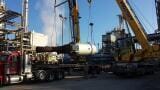
To test the potential of the greenhouse gas, the Chinese team used CO2 to frack five wells at the Jilin oil field. Not only did carbon dioxide work as an effective alternative to water but it also produced up to 20 times more oil than conventional H2O and chemical methods. For China, the breakthrough represents an exciting new opportunity to tap into shale gas resources and accelerate the country's fracking industry. It could also offer a clever solution to producers in arid, oil-rich regions like Texas, where water is often transported in via tanker trucks.
"These real-world results revealed that as compared to water fracturing, CO2 fracturing is an important and greener alternative," assert the researchers.
Of course, the technique isn't without complications. While most of the CO2 would be stored within the rocks, experts warn there is a possibility of leaks which would contribute to global warming.
From rising sea levels to shifting weather patterns, climate change is an issue with major consequences for the entire planet. Introducing new Nexis SCD-2030 technology, 'Analysis of Sulphur in Light Hydrocarbons According to ASTM D5623 Using Shimadzu's SCD-2030' spotlights the importance of linearity, repeatability and long-term stability during the testing phases.
PIN 27.4 Aug/Sept 2026


 Product directory


.jpg)









.jpg)




.jpg)