
Measurement and testing
In demanding industries such as petrochemicals, power generation, and hydraulics, managing particulate contamination has emerged as a key factor in safeguarding equipment, reducing emissions, and maintaining regulatory compliance. Whether present in lubricating oils, hydraulic fluids, or process exhausts, particles, even microscopic ones, pose persistent risks to operational integrity, environmental impact, and ultimately, the bottom line.
Historically, particulate measurement has often been limited to periodic sampling and lab analysis. While these methods provide useful snapshots, they leave critical gaps between measurements. Today’s demanding operational environments call for continuous, on-line monitoring solutions that deliver real-time data and enable swift corrective actions before problems escalate.
Particles suspended in hydraulic or lubricating fluids accelerate wear by acting as abrasives on sensitive components such as pumps, valves, and bearings. Over time, this wear reduces system reliability, increases downtime, and drives up maintenance costs. Additionally, particulate emissions into the atmosphere are increasingly regulated under tightening environmental legislation worldwide, forcing operators to maintain strict control over their emissions profiles.
Continuous particle monitoring not only supports regulatory compliance by providing consistent, documented cleanliness data but also forms an essential part of predictive maintenance strategies. Real-time insights allow maintenance teams to detect contamination trends early, adjust filtration or flushing processes, and optimise oil change intervals, which can significantly reduce operational costs.
Reliable particle measurement in industrial environments is no simple task. Fluids are often under high pressure, exposed to temperature fluctuations, and contain a complex mix of contaminants. Instruments must differentiate particles across a range of sizes—commonly between 4 and 21 micrometres—to accurately classify contamination according to international standards like ISO 4406.
Moreover, integrating these measurements into plant automation systems requires robust communication protocols that ensure noise-free, precise data transfer, even in electrically noisy industrial settings. These challenges have driven innovation in both sensor design and system connectivity.
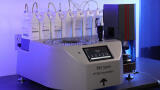
One example of this innovation is Bühler Technologies’ BPM-100 particle monitor, which uses the principle of light obscuration to detect particles suspended in fluid. Within the device’s measuring cell, a laser beam passes through the fluid, and particles are identified by the amount of light they block or scatter. This optical method provides a highly sensitive and accurate means of classifying particles by size and concentration.
The BPM-100 is built to withstand the demanding conditions found in hydraulic and lubrication systems, with a robust housing capable of handling pressures up to 420 bar dynamic and temperatures ranging from -20°C to +85°C. Its design allows installation directly into bypass lines via standard Minimess connectors, simplifying retrofits and new system integrations alike.
Beyond measurement accuracy, the BPM-100 offers multiple output options—including switching outputs, 4-20 mA analogue signals, CAN bus, and IO-Link digital communication—to seamlessly connect with modern automation systems. The incorporation of IO-Link, an IEC-standardised protocol, ensures reliable, noise-resistant data exchange, supporting Industry 4.0 initiatives and enabling predictive maintenance workflows.
In addition to particulate data, the BPM-100 can track secondary parameters such as fluid temperature, flow rate, and cumulative operating hours. These insights provide context to contamination trends and help maintenance planners correlate fluid condition with operational events.
Continuous particle monitoring delivers tangible benefits beyond compliance. By closely tracking contamination levels, operators can extend oil life and reduce filter replacements, lowering maintenance expenditures. Early detection of increased particle counts signals wear or contamination ingress, allowing timely interventions that prevent equipment damage and costly unplanned outages.
In environmental terms, better control over particulate emissions helps facilities meet increasingly strict air quality standards and reduces the risk of regulatory penalties. For industries under growing scrutiny, transparent, accurate emissions data is essential to maintain social licence to operate and demonstrate corporate responsibility.
The trend toward real-time, connected monitoring reflects a broader shift in industrial asset management—from reactive maintenance to condition-based, predictive strategies. Instruments like the BPM-100 empower operators with actionable data that drives smarter decision-making, optimises maintenance intervals, and supports operational excellence.
As global regulations tighten and public expectations for environmental stewardship rise, continuous particle monitoring is set to become an indispensable tool for industries reliant on clean, reliable fluid systems. Solutions that combine robust measurement technology with seamless integration into plant automation will enable operators to meet today’s challenges and future-proof their operations for tomorrow.
PIN 27.5 Oct/Nov 26



 Product directory


.jpg)






















.jpg)