Analytical instrumentation
Hydrogen is a versatile and clean fuel that can decarbonize industrial sectors such as oil refining, ammonia production, and steel manufacturing.
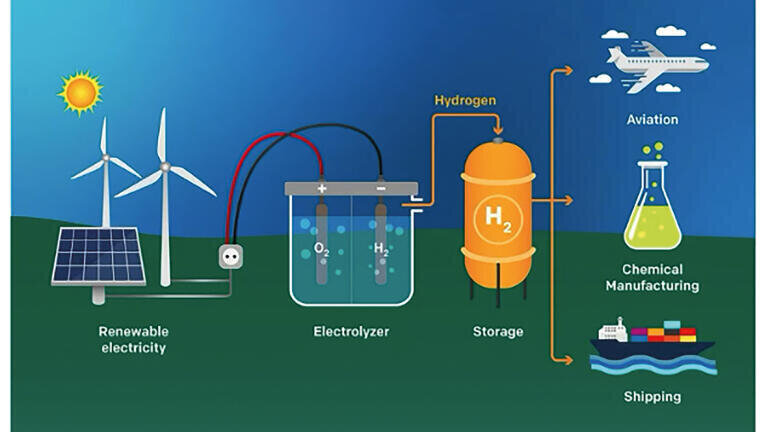
Green hydrogen, produced through water electrolysis using renewable electricity, presents an essential component in achieving 2050 zero carbon emission goal.
Different technologies, such as proton exchange membrane (PEM), anion exchange membrane (AEM), and solid oxide, are important in green hydrogen production.
Biomass is another renewable pathway for hydrogen production, categorized according to feedstock type.
First-generation biofuels is derived from edible feedstocks such as corn and seed oil; second-generation biofuels employ non-edible plant materials and thermochemical conversion methods such as gasification and pyrolysis; third-generation biofuels are produced from algae; and fourth-generation biofuels are produced from genetically modified microorganisms.
Another discovery for low-carbon pathways is integrated energy system models.
Reactor design affects hydrogen yield, with fixed bed and fluidized bed offering advantages based on scale and feedstock.
Overall, hydrogen produced from renewable sources and biomass present a solution for meeting global emissions target.
Increased research and development in technologies, catalytic processes, and integrated energy systems would allow for economic growth and decreased climate change.
Renewable sources are increasingly critical for economic growth and development, with the main focus targeted towards solar panels, wind, and hydropower [1].
Through industrial applications such as electricity from solar energy and biodiesel from biomass, renewable resources provide low-carbon solutions that will reduce fossil fuels and increase economic development.
Hydrogen is emerging as a critical energy carrier aligned with the global trend towards carbon emission reduction.
Hydrogen can be used in various applications such as oil refining, ammonia, and steel production [2].
Although hydrogen is a colorless gas, it can be categorized into various color codes to indicate the technology and production source [3].
There are around thirteen colors, with green being the primary one, and blue, grey, and white being more common than the other colors as seen in Figure 1 [4].
Through water electrolysis, green hydrogen is produced.
Green hydrogen has been emerging as an essential component for achieving the 2050 zero carbon emission goals.
In green hydrogen production, the core equipment is the electrolyzer with its principal production technologies: alkaline, proton exchange membrane (PEM), solid-oxide and anion exchange membrane (AEM).
At the center of the electrolyzer, there is a stack where water can be split into hydrogen and oxygen.
This consists of carefully layered and gas-tight gaskets/seals, bipolar plates, membrane and electrode assemblies that specify commercial know-how.
On an industrial scale, alkaline and PEM are commonly used due to their competitive cost and specs, with alkaline electrolyzer having a market share of 80%, lower CAPEX, and longer lifetime [4].
Alkaline electrolyzers can be used for up to 2100 kg/hr of hydrogen, requiring around 100 MW powder in production scale [4].
Hydrocarbon steam reforming followed by carbon capture, utilization, and storage (CCUS) produces blue hydrogen.
Using existing steam methane reforming (SMR), emissions can be reduced by 50-90% when compared to grey hydrogen [4].
Grey hydrogen is produced via SMR without CCUS, and although its production is low cost, it has high emissions.
Hydrogen serves as a clean energy source, with applications in power generation, heating, and industrial processes.
Hydrogen also has high energy density and strong functionality for renewable production, driving innovation and job creation in technical and constructional sectors.
Biomass can be generated from many sources, categorizing into first to fourth generation [4].
First generation biofuels are derived from edible feedstocks such as corn and seed oils.
Though this biomass source is abundant and has low cost, it also requires significant water resources and depends on fertilizers and pesticides.
Second generation biofuels are produced from non-edible plant materials like sawdust and lignocellulosic resources, which are abundant and do not compete with food production.
Switchgrass can be grown on arid land, enhancing space utilization, allowing for an increase in production.
Second generation biofuels use biochemical routes like cellulosic ethanol and thermochemical methods such as gasification, pyrolysis, and steam reformation to convert biomass into hydrogen.
Third generation biofuels are produced from algae and can be used with wastewater treatment.
Some benefits of third generation biofuels is that it will not compete with other industries for land and are not reliant on pesticides and fertilizers.
Despite these benefits, the production of biofuels from algae would be significantly more expensive due to complexities in cultivation and harvesting.
Algae also have a lower oil to dry mass ratio, making it less appealing for steam reforming [4].
Lastly, fourth generation biofuel sources incorporate the genetic modification of microalgae, attempting to overcome the limitations of the third generation.
There are many concerns regarding the ecological impact of releasing genetically modified organisms, such as disrupting natural ecosystems, altering habitats, and reducing biodiversity.
Processes using modified biomass, however, does not require high temperatures and pressure, reducing process costs and greenhouse gas emissions. A summary of the feedstocks by generation is listed in Figure 2 [4].
Biofuel hydrogen production methods are categorized into three groups: thermochemical, biological and electrochemical.
Thermochemical is considered the most technologically advanced method for bio-H2 production.
Thermochemical methods use heat to induce chemical reactions and closely relate to industrial practices when processing fossil fuels.
Biological methods use algae and bacteria to produce H2, and hold promise for waste utilization.
Electrochemical methods hope to improve the economic viability of water electrolysis through producing value-added products.
As mentioned previously, thermochemical methods use high temperatures to convert biomass and waste into hydrogen and fuels through decomposition and chemical transformation.
A key thermochemical conversion process is gasification, where biomass is converted into syngas (a mixture of H2, CO, CO2, and CH4).
Biomass source, gasification agent, reactor design, temperature and catalyst use are all factors that affect the composition of syngas.
H2 can be separated from syngas using cryogenic techniques and high-temperature proton conductors.
Focusing on production and the commercialization of syngas, biomass gasification occurs in four sequential steps: drying, pyrolysis, partial oxidation, and reduction.
Drying occurs at approximately 110°C, reducing the moisture content of the biomass [4].
Pyrolysis converts the biomass into gaseous phase, biochar, and tar through heating below 500°C and in an oxygen-free atmosphere [4].
The next step would be introducing a gasifying agent to facilitate the partial oxidation and reduction of the biochar, allowing for the production of syngas.
Biomass moisture contents of greater than 30 wt% make ignition of feedstock difficult and reduces the higher heating value of the syngas [4].
Higher density tar is more prone to blocking and damaging equipment.
Feedstock that is converted into syngas should be maximized and moisture content should be minimized, allowing for higher H2 yields and lower tar formation rates.
Tar, a complex mixture of organic molecules that block equipment, increase maintenance cost and reduce energy efficiencies, is difficult to reduce in biomass gasification.
Some adaptations have been proposed, such as alkaline earth metal catalysts, transition metal catalysts and natural mineral catalysts.
Alkaline Earth Metal Catalysts have been studied due to their ability to enhance the volatility of biomass and steam reforming reactions [4].
Compounds like KOH, NaOH, KHCO3 have shown to promote H2 production, biochar conversion, and tar gasification.
The methods used to introduce alkaline earth metals are impregnation of the biomass or as a sorbent/catalyst hybrid. These methods allow for the catalysts to partially vaporize.
The most widely studied transition metal catalysts are Ni-based catalysts [4].
This is due to their abundance, recyclability, and strong effectiveness in cleaving C-C, C-H, and O-H bonds.
The main disadvantage of Ni-based catalysts are being prone to deactivation via coking and sintering.
To combat this, alumina, zeolites, and CeO2 are proposed to enhance reaction rates, as well as using noble gases. Minerals such as dolomite and olivine offer cost-effective and abundant catalytic alternatives to metal catalysts.
Dolomite forms CaO and captures CO2 when oxidized at high temperatures. It also increases H2 selectivity while aiding in C-C and C-H bonds cleavage.
Steam methane reforming (SMR) is a commonly used production method, but for hydrogen to be a low-carbon energy carrier, the current generation methods needs to be integrated with CCS [3].
Integrated energy system models are often used to provide insights of low-carbon pathway scenarios and provide evidence of policy decisions.
Due to the vast quantity of hydrogen models, Hanley et al. only considered models and studies that have the entire energy system and its integration with the transport, thermal and electricity sectors.
Some studies that were examined were the global energy technology perspectives (ETP) model, the TIMES (The Integrated MARKAL-EFOM System) model, and the global energy assessment (GEA) model.
The ETP model, a technology-rich bottom-up model, uses both back casting and forecasting techniques.
MARKAL (Market Allocation) is a least-cost optimization model that models different global energy scenarios.
The GEA model forms energy pathways with different branching points that can be locked in for the future.
Most syngas is produced using an entrained flow reactor and coal as the carbon source [4].
Entrained flow reactors feed the gasifying agent and the fuel from the reactor.
Although entrained flow reactors are commonly used due to their high carbon conversion and their flexibility in fuels, they require small particle sizes (<1 mm) and high temperatures (1200-1600 ℃).
Biomass reactors can be categorized into fixed bed gasifiers and fluidized bed gasifiers.
Fixed bed gasifiers are more recommended for small scale production.
Figure [GT1.1]3 shows the optimal temperature ranges for resulting syngas and hydrogen production for various biomass feedstocks [4], as low temperatures reduce gasification rates but high temperatures can negatively impact hydrogen production.
The European Green Deal has a net-zero greenhouse gas emission target for 2050 [2].
Hydrogen and electricity can be used in the transport, commercial, and industrial sectors in a cost-effective manner, due to having significant decarbonization potential with produced with low or net-zero emissions.
To develop business cases for hydrogen and CCS value chains, financial and legal barriers need to be addressed.
Legal barriers for deploying hydrogen in Europe were looked at in the HyLaw project, and there were significant legislative barriers found that prevented the injection of hydrogen in the gas grid.
Matsuo et al. [5] developed an Optimal Power Generation Mix (OPGM) model which models the intermittency of renewable energy at a 10-minute resolution in Japan. In the study, the OPGM model was attempted to be improved through importing wind and solar PV power generation profile data.
The hydrogen gas turbine power generation was simulated and high efficiency fuel cells such as solid oxide fuel cells (SOFCs) and molten carbonate fuel cells (MCFCs) are used in distributed power systems.
In Figure 4, hydrogen can be generated by electrolysis of water using excess electricity by intermittent renewables or supplied as imported CO2-free hydrogen.
Hydrogen generated by electrolysis can be used in the power sector to fuel turbine generators.
The endogenous variables of the model included power generating, storing capacities, and hourly output. CO2-free hydrogen can be produced from renewable energy or fossil fuels, through steam reforming of fossil fuels and transportation by ship. The primary fossil fuel used is cheap lignite or natural gas that is produced in other countries, and the CO2 emitted by hydrogen is stored underground.
This method utilizes unevenly distributed CCS potentials, and transporting CO2-free hydrogen has the potential in reducing global CO2 emissions.
As climate change increases, the search for renewable sources increases.
Green hydrogen, produced through water electrolysis, has the potential in achieving decarbonization.
There are three main biofuel hydrogen production methods: thermochemical, biological, and electrochemical.
These methods allow for various pathways of utilizing waste and feedstocks, however, there are financial and legal barriers to overcome.
International models and targets show how hydrogen production was maintained with power generation and is cost-effective.
Catalysts have a large impact on mass production and can decrease costs and increase efficiency.
By advancing integrated energy models, hydrogen has a large potential in meeting global targets, reducing greenhouse gas emissions, and ultimately, supporting economic and environmental development.
Dr Raj Shah is a Director at Koehler Instrument Company in Holtsville, New York, where he has served for over three decades, contributing to the advancement of petroleum, fuels, lubricants, and analytical instrumentation technologies worldwide.
Over the course of his distinguished career in the energy and chemical engineering industries, he has become widely recognized for both his technical leadership and sustained service to global professional societies.
Dr. Shah is an elected Fellow by his peers at ASTM International, the Institute of Chemical Engineers (IChemE), the Chartered Management Institute (CMI), the Society of Tribologists and Lubrication Engineers (STLE), the American Institute of Chemists (AIC), the National Lubricating Grease Institute (NLGI), the Institute of Measurement and Control (InstMC), the American Oil Chemists’ Society (AOCS), the Institute of Physics (IOP),
The Energy Institute (EI), and The Royal Society of Chemistry (RSC).
These fellowships reflect his multidisciplinary impact across chemical engineering, tribology, measurement science, energy technology, and applied chemistry.
He is also the recipient of the prestigious ASTM Eagle Award and ASTM’s highest honor, the Award of Merit (Fellow), recognizing more than 30 years of leadership and contribution to Committee D02 on Petroleum Products, Liquid Fuels, and Lubricants.
He recently co-edited the bestseller, Fuels and Lubricants Handbook: Technology, Performance, Properties, and Testing, a major reference work for the industry.
Dr. Shah has now authored and co-authored over 750 technical publications, conference papers, and industry articles, and continues to be an active contributor to the scientific and engineering literature.
Further information regarding his work and recognitions can be found at https://shorturl.at/I7000.
Dr. Shah earned his doctorate in Chemical Engineering from The Pennsylvania State University and is a Fellow of The Chartered Management Institute, London.
He is a Chartered Scientist (CSci) with the Science Council, a Chartered Chemist (CChem) with the Royal Society of Chemistry, a Chartered Engineer (CEng) with the Engineering Council, UK, and a Chartered Petroleum Engineer (CPEng) with the Energy Institute.
He was recently granted the honorific distinction of “Eminent Engineer” by Tau Beta Pi, the oldest and largest engineering honor society in the United States, an honor reserved for engineers demonstrating exceptional professional achievement and character.
Actively engaged in academia and mentorship, Dr. Shah serves on the Advisory Boards of Farmingdale State College (Mechanical Technology and Engineering Management), Auburn University (Tribology and Lubrication Science), and the State University of New York at Stony Brook (Chemical Engineering and Materials Science & Engineering).
He is also an Adjunct Professor in the Department of Materials Science and Chemical Engineering at Stony Brook University.
Throughout his career, he has remained deeply committed to advancing engineering education, standards development, and technical excellence within the global energy community.
More information on Dr. Shah can be found at https://shorturl.at/yYl85.
Miss Sheena Chen is part of a thriving internship program at Koehler Instrument Company in Holtsville and is studying towards a degree in Chemical and Molecular Engineering at Stony Brook University, New York
Gavin Thomas is part of a thriving internship program at Koehler Instrument Company in Holtsville, NY and is a recent graduate of the Chemical and Molecular Engineering program at Stony Brook University.
He also works as a process engineer at Mill-Max in Oyster Bay, NY where he becomes hands-on with various production processes to ultimately improve safety, efficiency, and cost-effectiveness.
[1] Atia, Mohamed et al. (2025), “Green hydrogen production study in existing oil refinery with evaluating technical, economic, and environmental outcomes
[2] Reigstad, Gunhild A. et al. (2022), “Moving toward the low-carbon hydrogen economy
[3] Hanley, Emma S. et al. (2018), “The role of hydrogen in low carbon energy futures
[4] Openshaw, Dillon (2026), “Recent progress in bio-hydrogen production for sustainable energy and chemical production
[5] Matsu, Yuhji (2018), “A quantitative analysis of Japan’s optimal power generation mix in 2050 and the role of CO2- free hydrogen”
PIN 27.4 Aug/Sept 2026

 Product directory


.jpg)