-11518280.jpg)
Elemental analysis
Published over 3 years ago. See the latest and most current information on Elemental analysis.
From internal combustion engines in everyday vehicles to heavy-duty machinery in factories and manufacturing plants, lubricants have a critical role to play when it comes to mechanical health. They’re essential for any system that relies on moving metal parts. Key goals include reducing friction between surfaces, relieving mechanical stress and preventing issues like corrosion and oxidation. Lubricants are also used to suspend foreign particles and transport contaminants out of mechanical systems.
Analytical techniques help operators evaluate the performance of lubricants and assess the overall health of mechanical systems. How is it done? Below we take a closer look at some of the most useful techniques used for lubricant analysis.
Most labs rely on capillary tube viscometers to calculate the viscosity index of lubricants. This is an important parameter as viscosity determines how resistant a lubricant is to flow and shear. Good viscosity is especially important for lubricants used in mechanical systems that place high levels of strength and pressure on moving parts.
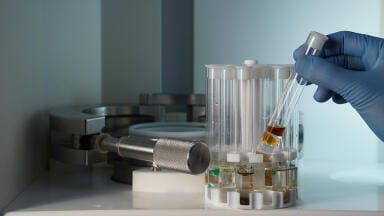
Parameters like viscosity are used to assess the performance and suitability of lubricants. In comparison, testing for wear metals and contaminants is a useful way to assess the overall health of the mechanical system. For example, high concentrations of metallic particles in lubricants can suggest serious wear on moving parts. Particles can be analysed to determine the source and schedule maintenance as soon as possible.
All lubricants degrade over time, which can have a negative impact on performance. Techniques like Infrared (IR) Spectroscopy are used to assess the breakdown of certain elements and determine when lubricants need to be flushed and replaced. Samples are analysed in the infrared spectrum, which reveals the unique properties of circulating lubricants.
Lubricant analysis is critical in the maritime sector where actively monitoring the condition of lubricants can help increase the lifespan of assets, reduce the risk of unplanned downtime and slash repair budgets. Solutions like the marine lubricant analysis program from Intertek step up to the challenge. The oil condition monitoring service sees samples analysed in state-of-the-art laboratories. Experienced data specialists then assess results to determine the health of maritime machinery.
Scientists rely on advanced elemental analysis techniques like X-Ray Fluorescence (XRF) to assess lubricants. Find out more about the latest turnkey solutions from American scientific instrument manufacturer Bruker AXS in ‘Elemental Analysis as easy as it can be – From Ultra-Low Sulphur to Catalyst Elements at Refineries, to Lubricants and Wear Metals in Engine Oils’.
PIN 27.4 Aug/Sept 2026

 Product directory


.jpg)