Flow level pressure
Published over 14 years ago. See the latest and most current information on Flow level pressure.
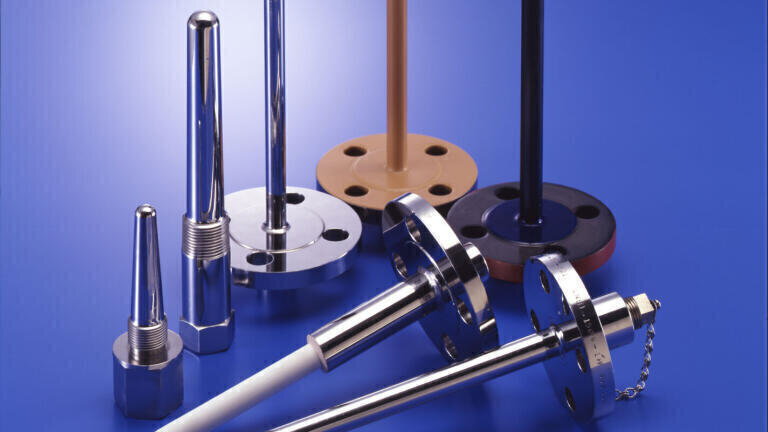
According to thermowell manufacturer Okazaki (Japan), the ASME PTC 19.3 (2010) revised standard for thermowells has many positives for end users. The standard now addresses in-line resonance, fatigue factors for oscillatory stress, effects of foundation compliance, sensor mass, stress intensification factors at the root of the thermowell, fluid mass and much more. This means the standard will enable a greater variety of thermowell geometries such as step wells and velocity collars, allowing designers to achieve faster response times in applications that call for a wake frequency calculation.
The maximum length of a thermowell for given service conditions is dependent upon both vibratory and steady state stress. The ASME PTC 19.3 calculations (2010) are used to determine if the selected well dimensions provide a well strong enough to withstand the stresses imposed by static pressure, steady state flow and vibration. The old PTC 19.3 standard was limiting in terms of what shapes could be used and provided no clear guidance on how to deal with problems such as shielding and in-line resonance.
PIN 27.4 Aug/Sept 2026



 Product directory


.jpg)